


First came the boom in exports of Brazilian raw materials to China. Then, greater competition from Chinese manufactured goods began to trouble Brazil. Now, for the first time, its trade surplus with China is becoming a deficit.
"China came to Brazil in 2001, 2002 looking for raw materials, and then it kept coming to explore the Brazilian market," explained Rodrigo Maciel, who leads the Brazil-China Chamber of Commerce.
While Brazilian exports quadrupled from 2001 to last year, to US$8.4 billion, imports of Chinese goods surged by six times to US$7.99 billion.
Since January, China even has edged out Argentina as Brazil's No.2 supplier of imported goods behind the US.
"This year we definitely are going to mark a trade deficit with China," Fernando Ribeiro, lead economist at the Foreign Trade Studies Center foundation, told reporters.
The trade balance for January and February was a US$390 million deficit for Brazil, a symptom of the new trade relationship: What was a US$2.4 billion trade surplus for Brazil back in 1983 by last year had shrunk to US$410.5 million.
According to the National Confederation of Industry, Chinese products are competing with 54 percent of Brazil's exports.
In Brazil, one out of four businesses is competing with imported Chinese merchandise. Some have stopped exporting or lost clients.
"There is a great deal of similarity between the goods the two countries export," Maciel said. "But China has created a much more competitive environment than Brazil looking at tax structure, infrastructure, capital costs or labor legislation."
China is well known for the low cost of its work force, but it also has one-upped Brazil on investment: its investment rate is double Brazil's, Ribeiro said.
China invests enormously in education, infrastructure and technology, noted Maciel, while "a lot of people have the mistaken impression China's competitiveness is a result of cheap labor and piracy."
Chinese competition is felt particularly in some sectors requiring a lot of manual labor such as footwear, textiles and small appliances.
In 2005 shoemakers in Brazil sold 23 million pairs fewer than the previous year and cut 15,000 jobs.
But in the next five years, the auto industry -- in which China has big ambitions -- is the looming new threat for the world's number nine car manufacturing country.
"Brazil likely will be one of the big losers because it sells a lot of inexpensive cars," Ribeiro said.
In the auto parts markets, Chinese competition already is making Brazilian manufacturers feel the pinch.
"It is just a taste of what we have ahead of us," Ribeiro sighed.
Brazilian exports led by raw materials continue to move at a reasonable rhythm, he added.
Rodrigo Maciel bemoans what he sees as a lack of initiative on Brazilian businesses' part.
While President Luiz Inacio Lula da Silva made the controversial decision of recognizing China as a market economy in 2004, Chinese investors have not stampeded into Brazil, often citing bureaucracy or Brazilian tax burdens.
"Brazil is lacking a long-term strategy vis-a-vis China," Maciel said.
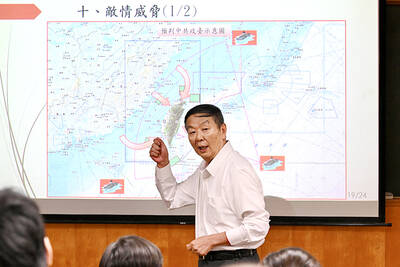
RETHINK? The defense ministry and Navy Command Headquarters could take over the indigenous submarine project and change its production timeline, a source said Admiral Huang Shu-kuang’s (黃曙光) resignation as head of the Indigenous Submarine Program and as a member of the National Security Council could affect the production of submarines, a source said yesterday. Huang in a statement last night said he had decided to resign due to national security concerns while expressing the hope that it would put a stop to political wrangling that only undermines the advancement of the nation’s defense capabilities. Taiwan People’s Party Legislator Vivian Huang (黃珊珊) yesterday said that the admiral, her older brother, felt it was time for him to step down and that he had completed what he
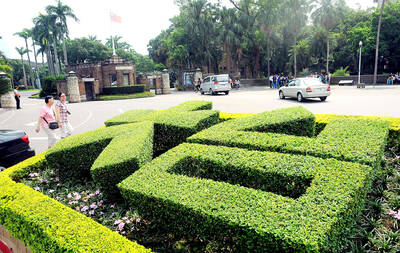
Taiwan has experienced its most significant improvement in the QS World University Rankings by Subject, data provided on Sunday by international higher education analyst Quacquarelli Symonds (QS) showed. Compared with last year’s edition of the rankings, which measure academic excellence and influence, Taiwanese universities made great improvements in the H Index metric, which evaluates research productivity and its impact, with a notable 30 percent increase overall, QS said. Taiwanese universities also made notable progress in the Citations per Paper metric, which measures the impact of research, achieving a 13 percent increase. Taiwanese universities gained 10 percent in Academic Reputation, but declined 18 percent
UNDER DISCUSSION: The combatant command would integrate fast attack boat and anti-ship missile groups to defend waters closest to the coastline, a source said The military could establish a new combatant command as early as 2026, which would be tasked with defending Taiwan’s territorial waters 24 nautical miles (44.4km) from the nation’s coastline, a source familiar with the matter said yesterday. The new command, which would fall under the Naval Command Headquarters, would be led by a vice admiral and integrate existing fast attack boat and anti-ship missile groups, along with the Naval Maritime Surveillance and Reconnaissance Command, said the source, who asked to remain anonymous. It could be launched by 2026, but details are being discussed and no final timetable has been announced, the source
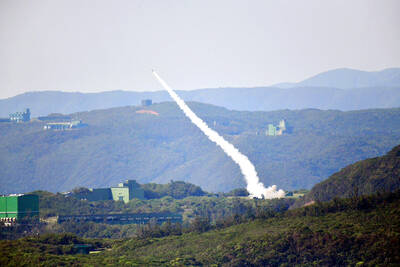
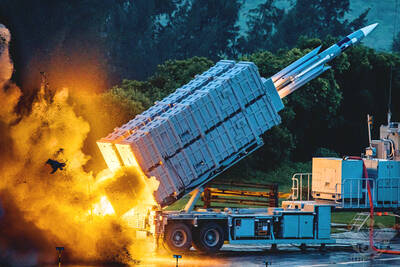
SHOT IN THE ARM: The new system can be integrated with Avenger and Stinger missiles to bolster regional air defense capabilities, a defense ministry report said Domestically developed Land Sword II (陸射劍二) missiles were successfully launched and hit target drones during a live-fire exercise at the Jiupeng Military Base in Pingtung County yesterday. The missiles, developed by the Chungshan Institute of Science and Technology (CSIST), were originally scheduled to launch on Tuesday last week, after the Tomb Sweeping Day holiday long weekend, but were postponed to yesterday due to weather conditions. Local residents and military enthusiasts gathered outside the base to watch the missile tests, with the first one launching at 9:10am. The Land Sword II system, which is derived from the Sky Sword II (天劍二) series, was turned


 RSS
RSS