


With the US real estate market slowing, fewer people are seeking loans. And with subprime lending standards tightening significantly, fewer people qualify for them.
The combination has resulted in less business for lenders and brokers, which in turn means that prospective borrowers should tread carefully.
People shopping for loans must always exercise vigilance against unscrupulous lenders. But analysts and industry executives say that in the midst of the current shakeout, borrowers should be especially cautious about loans.
Paul Miller, a mortgage industry analyst with Friedman, Billings & Ramsey, an investment firm in Arlington, Virginia, said that these days, some lenders or brokers cannot afford to be choosy. And that's where the problems can begin.
"All of a sudden, you might have only two people walking through the door, and only one of them looks like they'd be a good loan," Miller said.
But an unprincipled broker will decide that both loans are good, Miller said, because the broker needs the income.
In other words, to make a larger fee, the unscrupulous broker will qualify someone for a loan he or she really shouldn't get. Doing so is unethical at best and fraudulent at worst.
Michael Moskowitz, the president of Equity Now, a mortgage lender based in Manhattan, said that in harder times there is also more temptation to match borrowers with loans that might not be right for them, but which will carry higher profits for the company.
He said a former client in Connecticut had recently closed an US$880,000 refinance loan, although a second mortgage would have worked just as well. But that would have yielded the broker only US$4,000 in profit, compared with US$35,000 for the refinance.
Moskowitz said he urged the borrower, who had come to him for advice about another possible refinance loan, to complain to state regulators in Connecticut and New York, where the loan officer had his office, and to appeal to the investor who ultimately bought the loan.
"I believe he could present this as a predatory loan," Moskowitz said, but the borrower has been unwilling to do so.
Industry executives said borrowers should demand to see the final loan documents, known as the HUD-1 statement, 24 hours before the closing, to avoid any surprise costs or terms.
Moskowitz said borrowers should also ask the lender to connect them with three customers in similar situations.
"A reputable company will have no problems with that," he said.
Harry Dinham, the president of the National Association of Mortgage Brokers, said most brokers try to establish long-term relationships with their clients and seek to match them with the right loans. But he said borrowers should be vigilant.
But consumers can take some solace in that the downturn will weed some unscrupulous lenders from the mix, Dinham said.
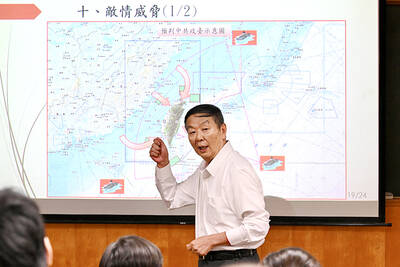
RETHINK? The defense ministry and Navy Command Headquarters could take over the indigenous submarine project and change its production timeline, a source said Admiral Huang Shu-kuang’s (黃曙光) resignation as head of the Indigenous Submarine Program and as a member of the National Security Council could affect the production of submarines, a source said yesterday. Huang in a statement last night said he had decided to resign due to national security concerns while expressing the hope that it would put a stop to political wrangling that only undermines the advancement of the nation’s defense capabilities. Taiwan People’s Party Legislator Vivian Huang (黃珊珊) yesterday said that the admiral, her older brother, felt it was time for him to step down and that he had completed what he

Taiwan has experienced its most significant improvement in the QS World University Rankings by Subject, data provided on Sunday by international higher education analyst Quacquarelli Symonds (QS) showed. Compared with last year’s edition of the rankings, which measure academic excellence and influence, Taiwanese universities made great improvements in the H Index metric, which evaluates research productivity and its impact, with a notable 30 percent increase overall, QS said. Taiwanese universities also made notable progress in the Citations per Paper metric, which measures the impact of research, achieving a 13 percent increase. Taiwanese universities gained 10 percent in Academic Reputation, but declined 18 percent
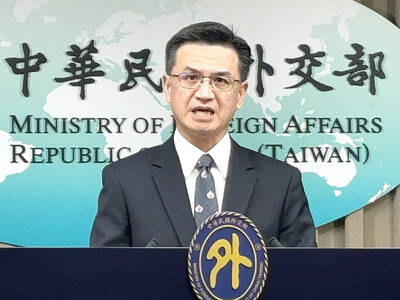
BULLY TACTICS: Beijing has continued its incursions into Taiwan’s airspace even as Xi Jinping talked about Taiwan being part of the Chinese family and nation China should stop its coercion of Taiwan and respect mainstream public opinion in Taiwan about sovereignty if its expression of goodwill is genuine, the Ministry of Foreign Affairs (MOFA) said yesterday. Ministry spokesman Jeff Liu (劉永健) made the comment in response to media queries about a meeting between former president Ma Ying-jeou (馬英九) and Chinese President Xi Jinping (習近平) the previous day. Ma voiced support for the so-called “1992 consensus,” while Xi said that although the two sides of the Taiwan Strait have “different systems,” this does not change the fact that they are “part of the same country,” and that “external

UNDER DISCUSSION: The combatant command would integrate fast attack boat and anti-ship missile groups to defend waters closest to the coastline, a source said The military could establish a new combatant command as early as 2026, which would be tasked with defending Taiwan’s territorial waters 24 nautical miles (44.4km) from the nation’s coastline, a source familiar with the matter said yesterday. The new command, which would fall under the Naval Command Headquarters, would be led by a vice admiral and integrate existing fast attack boat and anti-ship missile groups, along with the Naval Maritime Surveillance and Reconnaissance Command, said the source, who asked to remain anonymous. It could be launched by 2026, but details are being discussed and no final timetable has been announced, the source


 RSS
RSS