


The administration of US President President George W. Bush warned on Tuesday that a failure to strike a free-trade agreement with South Korea could damage US relations with East Asia.
The warning came as US lawmakers threatened to reject an agreement that does not include the opening up of South Korea's sensitive rice market and removal of non-tariff barriers to US motor vehicles.
The US and South Korea are racing ahead of a March 31 deadline to strike what could be the biggest free-trade agreement (FTA) since the 1993 North American Free Trade Agreement.
"Any let-up in focus that results in our inability to complete agreements with major emerging-market economies like South Korea could have unfortunate consequences," Deputy US Trade Representative Karan Bhatia told a congressional hearing on Tuesday on the free trade talks with South Korea.
"It would likely result in a shift of the region's attention from strengthening their relationships with the United States to doing deals with other major trading partners," he said.
Bush's powers to fast-track trade agreements expire in June, giving US negotiators up to March 31 to present a deal for a mandatory 90-day congressional review.
Bhatia said that a successful free trade pact with Seoul could provide an "important boost to US efforts to remain an active economic presence in a strategically vital" East Asia region.
The region, he said, accounted for more than 37 percent of total world GDP and 29 percent of US exports.
A South Korea-US FTA would establish a "model" that could be replicated with other Asian economies and help the US expand trade liberalization throughout the region, Bhatia said.
But US lawmakers criticized their negotiators on Tuesday for not doing enough to prise open the South Korean market, warning that they would not settle for any half-baked agreement.
The US is saddled with an US$11 billion deficit in automobile trade with South Korea.
Tami Overby, president of the American Chamber of Commerce in Seoul, said South Korea remained the "most closed" auto market and that past bilateral pacts failed to open it to international competition.
Republican Representative Wally Herger demanded that South Korea put rice on the negotiating table.
"This FTA must have comprehensive product coverage, including meaningful access for rice," he said.
Herger also urged US negotiators to reject any offer from South Korea to allow US beef access only in exchange for US abandonment of its rice demands.
Seoul has rejected US beef shipments after finding tiny bone fragments in them, saying it violated an agreement last year that lifted a three-year ban to keep out mad-cow disease.
Despite the differences, Bhatia said "there is strong commitment on both sides" to conclude a "high-quality, comprehensive, balanced and ultimately successful FTA."
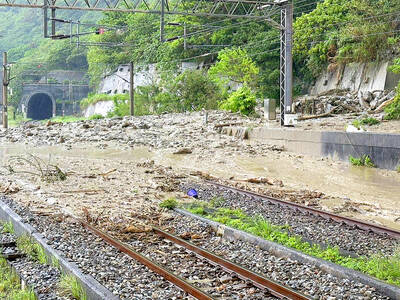
ROLLER-COASTER RIDE: More than five earthquakes ranging from magnitude 4.4 to 5.5 on the Richter scale shook eastern Taiwan in rapid succession yesterday afternoon Back-to-back weather fronts are forecast to hit Taiwan this week, resulting in rain across the nation in the coming days, the Central Weather Administration said yesterday, as it also warned residents in mountainous regions to be wary of landslides and rockfalls. As the first front approached, sporadic rainfall began in central and northern parts of Taiwan yesterday, the agency said, adding that rain is forecast to intensify in those regions today, while brief showers would also affect other parts of the nation. A second weather system is forecast to arrive on Thursday, bringing additional rain to the whole nation until Sunday, it
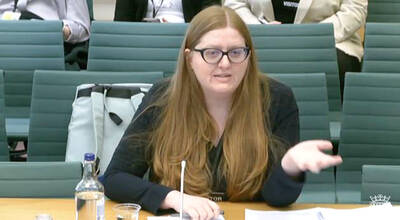
CONDITIONAL: The PRC imposes secret requirements that the funding it provides cannot be spent in states with diplomatic relations with Taiwan, Emma Reilly said China has been bribing UN officials to obtain “special benefits” and to block funding from countries that have diplomatic ties with Taiwan, a former UN employee told the British House of Commons on Tuesday. At a House of Commons Foreign Affairs Committee hearing into “international relations within the multilateral system,” former Office of the UN High Commissioner for Human Rights (OHCHR) employee Emma Reilly said in a written statement that “Beijing paid bribes to the two successive Presidents of the [UN] General Assembly” during the two-year negotiation of the Sustainable Development Goals. Another way China exercises influence within the UN Secretariat is
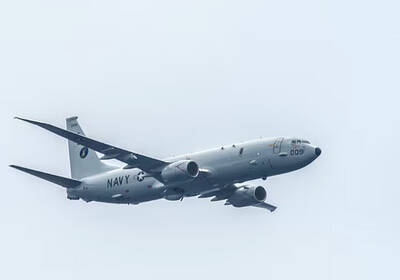
CHINA REACTS: The patrol and reconnaissance plane ‘transited the Taiwan Strait in international airspace,’ the 7th Fleet said, while Taipei said it saw nothing unusual The US 7th Fleet yesterday said that a US Navy P-8A Poseidon flew through the Taiwan Strait, a day after US and Chinese defense heads held their first talks since November 2022 in an effort to reduce regional tensions. The patrol and reconnaissance plane “transited the Taiwan Strait in international airspace,” the 7th Fleet said in a news release. “By operating within the Taiwan Strait in accordance with international law, the United States upholds the navigational rights and freedoms of all nations.” In a separate statement, the Ministry of National Defense said that it monitored nearby waters and airspace as the aircraft

Taiwan’s first drag queen to compete on the internationally acclaimed RuPaul’s Drag Race, Nymphia Wind (妮妃雅), was on Friday crowned the “Next Drag Superstar.” Dressed in a sparkling banana dress, Nymphia Wind swept onto the stage for the final, and stole the show. “Taiwan this is for you,” she said right after show host RuPaul announced her as the winner. “To those who feel like they don’t belong, just remember to live fearlessly and to live their truth,” she said on stage. One of the frontrunners for the past 15 episodes, the 28-year-old breezed through to the final after weeks of showcasing her unique


 RSS
RSS