


A newly released final report on the US' worst industrial accident since 1990 blames London-based BP for cost cutting that left its Texas City plant vulnerable to catastrophe, resulting in an explosion that killed 15 people and injured 170.
The US agency responsible for worker safety also failed to inspect plants with enough care and frequency to prevent an accident like the 2005 explosion, and does not have enough qualified inspectors for US oil and chemical facilities, the US government report and its lead investigator said on Tuesday.
US Chemical Safety and Hazard Investigation Board's (CSB) report said that although the Texas City plant had had several fatal accidents over the last 30 years, the federal Occupational Safety and Health Administration (OSHA) had done only one process safety management inspection at the refinery in 1998.
BP acquired the refinery when it merged with Amoco in 1998. Soon after, the report said, BP ordered a 25 percent, across-the-budget cut in fixed spending at its refineries. In a preliminary investigation of the accident released in October 2005, the CSB said the Texas City plant fostered a culture of bad management and failed to recognize and correct problems.
"The combination of cost-cutting, production pressures and failure to invest caused a progressive deterioration of safety at the refinery," CSB Chairwoman Carolyn Merritt said of the latest findings.
In a statement on Tuesday, BP said it has accepted responsibility for the accident, worked diligently to provide fair compensation to those injured and to families of those who died, and cooperated fully with the CSB.
In a brief statement released on Tuesday evening, Edwin Foulke, Assistant US Labor Secretary for OSHA, said the CSB report confirms OSHA's own investigative findings.
The CSB does not issue citations or fines but makes safety recommendations to plants, industry organizations and regulatory agencies such as OSHA and the US Environmental Protection Agency.
Democratic Representative John Dingell said his Energy and Commerce Committee plans hearings into BP's safety programs in light of the findings about the Texas City blast and the Prudhoe Bay oil spills last year.
Beginning in 2002, Merritt said, BP commissioned a series of audits and studies that revealed serious safety problems at the Texas City refinery, including a lack of preventative maintenance and training.
The reports were shared with BP executives in London and provided to at least one member of the executive board, she said.
"BP's response was too little and too late," Merritt said.
The Texas City explosion occurred when part of the plant's isomerization unit, which boosts the level of octane in gasoline, overfilled with highly flammable liquid hydrocarbons.
A geyser of flammable liquid and vapor ignited as the unit started up. Alarms and gauges that should have warned of the overfilling equipment failed to work.
At a public meeting on Tuesday, several citizens expressed cynicism in the petrochemical industry.
"It comes down to corporate greed," said Lee Medley of the Galveston County Central Labor Council. "BP just drew the short straw. This could have happened in any one of these refineries or chemical plants from Brownsville all the way to Pensacola, Florida. We've seen the same thing in every one you work at. It's short cuts, it's job consolidation."
The CSB report recommends, among other measures, that BP appoint a board member with expertise in process safety.
The report notes that proposed OSHA fines during the 20 years preceding the March 2005 explosion -- a period in which 10 people were killed at the refinery -- totaled US$270,255. But net fines collected after negotiations came to US$77,860. Six months after the blast, in September 2005, OSHA found BP committed more than 300 willful violations of its rules and fined it US$21.3 million.
At the time, BP chief executive John Browne defended the company's overall safety record but said its oversight of safety measures "wasn't excellent enough."
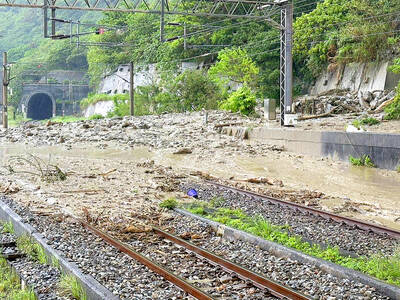
ROLLER-COASTER RIDE: More than five earthquakes ranging from magnitude 4.4 to 5.5 on the Richter scale shook eastern Taiwan in rapid succession yesterday afternoon Back-to-back weather fronts are forecast to hit Taiwan this week, resulting in rain across the nation in the coming days, the Central Weather Administration said yesterday, as it also warned residents in mountainous regions to be wary of landslides and rockfalls. As the first front approached, sporadic rainfall began in central and northern parts of Taiwan yesterday, the agency said, adding that rain is forecast to intensify in those regions today, while brief showers would also affect other parts of the nation. A second weather system is forecast to arrive on Thursday, bringing additional rain to the whole nation until Sunday, it
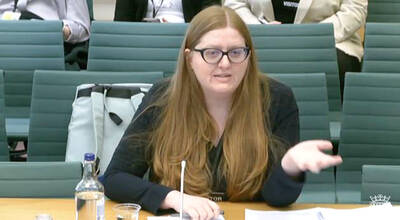
CONDITIONAL: The PRC imposes secret requirements that the funding it provides cannot be spent in states with diplomatic relations with Taiwan, Emma Reilly said China has been bribing UN officials to obtain “special benefits” and to block funding from countries that have diplomatic ties with Taiwan, a former UN employee told the British House of Commons on Tuesday. At a House of Commons Foreign Affairs Committee hearing into “international relations within the multilateral system,” former Office of the UN High Commissioner for Human Rights (OHCHR) employee Emma Reilly said in a written statement that “Beijing paid bribes to the two successive Presidents of the [UN] General Assembly” during the two-year negotiation of the Sustainable Development Goals. Another way China exercises influence within the UN Secretariat is
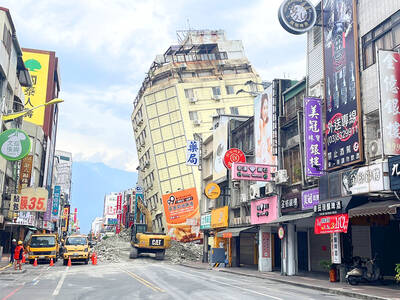
LANDSLIDES POSSIBLE: The agency advised the public to avoid visiting mountainous regions due to more expected aftershocks and rainfall from a series of weather fronts A series of earthquakes over the past few days were likely aftershocks of the April 3 earthquake in Hualien County, with further aftershocks to be expected for up to a year, the Central Weather Administration (CWA) said yesterday. Based on the nation’s experience after the quake on Sept. 21, 1999, more aftershocks are possible over the next six months to a year, the agency said. A total of 103 earthquakes of magnitude 4 on the local magnitude scale or higher hit Hualien County from 5:08pm on Monday to 10:27am yesterday, with 27 of them exceeding magnitude 5. They included two, of magnitude

Taiwan’s first drag queen to compete on the internationally acclaimed RuPaul’s Drag Race, Nymphia Wind (妮妃雅), was on Friday crowned the “Next Drag Superstar.” Dressed in a sparkling banana dress, Nymphia Wind swept onto the stage for the final, and stole the show. “Taiwan this is for you,” she said right after show host RuPaul announced her as the winner. “To those who feel like they don’t belong, just remember to live fearlessly and to live their truth,” she said on stage. One of the frontrunners for the past 15 episodes, the 28-year-old breezed through to the final after weeks of showcasing her unique


 RSS
RSS