


China's path to prosperity lies in opening up its financial sector, US Treasury Secretary Henry Paulson said yesterday in a speech urging the country's business leaders to embrace Wall Street-style capital markets.
"While China's people work every bit as hard -- if not harder -- than people in other economies, they are not yet as well off," Paulson said in a speech at the Shanghai Futures Exchange, where only a handful of commodities are traded by local brokers.
"People in many other parts of the world have more choices of where and how to save and routinely earn a much better return," Paulson said of the limited investment options open to Chinese citizens.
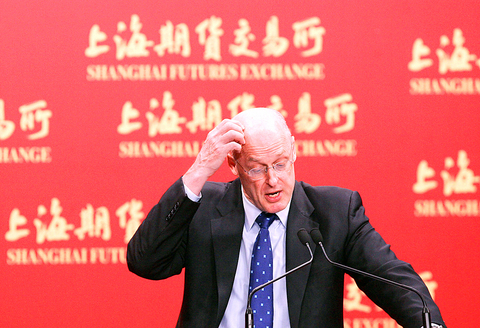
PHOTO: AP
The jolt to global financial markets last week triggered by a 9 percent drop in Shanghai shares reflects China's growing sway in international markets, as well as volatility in markets bloated by funds chasing too few investment opportunities.
Such volatility could be blunted by greater openness to international institutional investors and wider use of a variety of financial products including financial futures and corporate bonds, Paulson said.
"China's markets lack these important elements," he said.
"Without a meaningful institutional investor base, the market relies too much on retail investors. The result can be a more speculative environment and more volatile equity market," he said.
Paulson, a former head of investment powerhouse Goldman Sachs, chastised China for capping foreign investment in local banks, securities firms, insurers and other industries, saying its markets are in many ways are less open than those of other, smaller countries in Asia.
He also noted that the share trading quotas granted to foreign institutional investors account for less than 2 percent of China's total market capitalization.
"Nations that want robust, sustainable, harmonious growth do not impose caps," Paulson said.
"China is a large and powerful country, and you should not limit your own potential by restricting your access to world-class financial expertise that can enhance your capital markets," he said.
Paulson made little mention of China's currency controls, an issue that along with product piracy concerns has long dominated the US trade dialogue with Beijing. But he had been expected to raise the topic at a meeting on Wednesday in Beijing with Chinese Vice Premier Wu Yi (
China's leaders acknowledge the shortcomings of their developing financial markets. Just a week ago, Premier Wen Jiabao (
In his speech, Paulson urged China to move quicker on diversifying its economy and allowing more foreign competition in finance as well as other industries.
"I don't know of a single country in the world with a successful and sustainable well-balanced economy that doesn't have a strong capital market in place," he said.
"Rebalancing your economy and welcoming international competition in the financial services sector is a win-win proposition," he said.
"With an underdeveloped financial sector, investment in China doesn't reach its potential in generating returns, personal saving is not adequately rewarded, and risk is not appropriately priced, managed, and diversified," Paulson said.
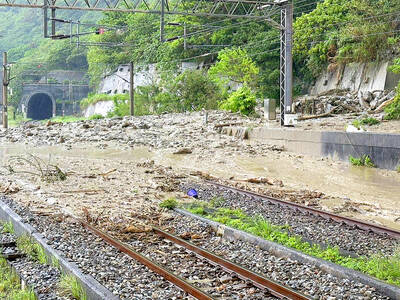
ROLLER-COASTER RIDE: More than five earthquakes ranging from magnitude 4.4 to 5.5 on the Richter scale shook eastern Taiwan in rapid succession yesterday afternoon Back-to-back weather fronts are forecast to hit Taiwan this week, resulting in rain across the nation in the coming days, the Central Weather Administration said yesterday, as it also warned residents in mountainous regions to be wary of landslides and rockfalls. As the first front approached, sporadic rainfall began in central and northern parts of Taiwan yesterday, the agency said, adding that rain is forecast to intensify in those regions today, while brief showers would also affect other parts of the nation. A second weather system is forecast to arrive on Thursday, bringing additional rain to the whole nation until Sunday, it
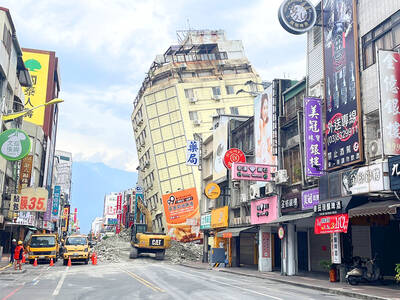
LANDSLIDES POSSIBLE: The agency advised the public to avoid visiting mountainous regions due to more expected aftershocks and rainfall from a series of weather fronts A series of earthquakes over the past few days were likely aftershocks of the April 3 earthquake in Hualien County, with further aftershocks to be expected for up to a year, the Central Weather Administration (CWA) said yesterday. Based on the nation’s experience after the quake on Sept. 21, 1999, more aftershocks are possible over the next six months to a year, the agency said. A total of 103 earthquakes of magnitude 4 on the local magnitude scale or higher hit Hualien County from 5:08pm on Monday to 10:27am yesterday, with 27 of them exceeding magnitude 5. They included two, of magnitude

CONDITIONAL: The PRC imposes secret requirements that the funding it provides cannot be spent in states with diplomatic relations with Taiwan, Emma Reilly said China has been bribing UN officials to obtain “special benefits” and to block funding from countries that have diplomatic ties with Taiwan, a former UN employee told the British House of Commons on Tuesday. At a House of Commons Foreign Affairs Committee hearing into “international relations within the multilateral system,” former Office of the UN High Commissioner for Human Rights (OHCHR) employee Emma Reilly said in a written statement that “Beijing paid bribes to the two successive Presidents of the [UN] General Assembly” during the two-year negotiation of the Sustainable Development Goals. Another way China exercises influence within the UN Secretariat is

Taiwan’s first drag queen to compete on the internationally acclaimed RuPaul’s Drag Race, Nymphia Wind (妮妃雅), was on Friday crowned the “Next Drag Superstar.” Dressed in a sparkling banana dress, Nymphia Wind swept onto the stage for the final, and stole the show. “Taiwan this is for you,” she said right after show host RuPaul announced her as the winner. “To those who feel like they don’t belong, just remember to live fearlessly and to live their truth,” she said on stage. One of the frontrunners for the past 15 episodes, the 28-year-old breezed through to the final after weeks of showcasing her unique


 RSS
RSS