


Wal-Mart's efforts to block the nation's largest sex discrimination lawsuit suffered a big setback on Tuesday when a federal appeals court in San Francisco ruled that the case should proceed as a class action.
In a 2-1 ruling, the 9th US Circuit Court of Appeals rejected Wal-Mart's argument that the lawsuit, which involves at least 1.5 million current and former women employees, was too unwieldy to handle in a single case.
Legal specialists said the ruling would increase pressure on Wal-Mart Stores to settle the case, in which the retailer is accused of discrimination in pay and promotions. Wal-Mart executives said they would appeal, voicing confidence that the decision would be overturned.
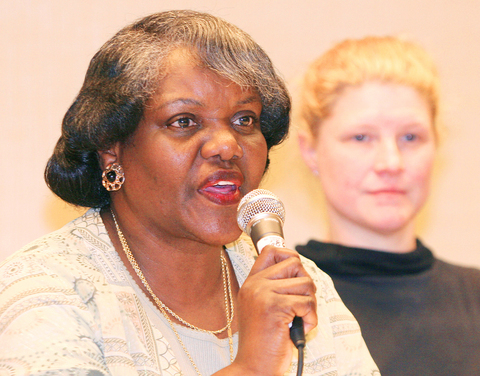
PHOTO: AP
The court ruled on Tuesday that the lawsuit should proceed as a class action -- the largest such civil rights case in history -- because it raised common questions of law and fact, because the six named plaintiffs were typical of the class and because there were so many women that it was impractical to handle the matter in individual cases.
The majority wrote, "Plaintiffs' expert opinions, factual evidence, statistical evidence, and anecdotal evidence present significant proof of a corporate policy of discrimination and support plaintiffs' contention that female employees nationwide were subject to a common pattern and practice of discrimination."
Wal-Mart's lead lawyer, Theodore Boutrous Jr, said that Tuesday's decision was not based on the merits of the case.
"Wal-Mart has a strong anti-discrimination policy," he said.
Arguing that the ruling contained factual and legal errors, Boutrous said Wal-Mart would ask the three-judge panel to reconsider the case and would also ask a full panel of 15 9th Circuit judges to consider it.
Boutrous asserted that Tuesday's decision conflicts with Supreme Court rulings and other Circuit Court rulings.
"We are optimistic about the chances of getting further review," Boutrous said. He asserted that the named plaintiffs were not typical of the class and that the case involved no common questions of law or fact.
He pointed to other appeals of court rulings that rejected class-action status involving thousands of plaintiffs, because such cases could prevent individual hearings to determine liability.
In the majority ruling, Judges Harry Pregerson and Michael Daly Hawkins wrote that due process does not require individualized hearings to determine damages.
A lawyer for the plaintiffs, Joseph Sellers, hailed Tuesday's decision. "This ruling confirms that no company, no matter how big, is exempt from the civil rights law, no matter what Wal-Mart claimed," he said.
Brad Seligman, the plaintiffs' lead lawyer, estimated that the class -- which includes all women who have worked at Wal-Mart at any time since Dec. 21, 1998 -- encompasses more than 2 million.
"Simple math, given the size of the class and the types of disparities we've shown, indicate that the losses to women are in the billions," Seligman said.
He said the ruling showed that "it is time for Wal-Mart to face the music."
But Wal-Mart's chief financial officer, Thomas Schoewe, said: "This decision will have no impact on our fiscal year 2007 financial performance. And does not require the company to take any action that will increase its cost of operations."
Peter Hillman, a partner at Chadbourne & Parke who represents management in employment law cases, said the ruling "obviously puts pressure -- incredible pressure -- on Wal-Mart to consider a settlement." He said the chances were slim that a higher court would agree to hear the case.

Taiwan has experienced its most significant improvement in the QS World University Rankings by Subject, data provided on Sunday by international higher education analyst Quacquarelli Symonds (QS) showed. Compared with last year’s edition of the rankings, which measure academic excellence and influence, Taiwanese universities made great improvements in the H Index metric, which evaluates research productivity and its impact, with a notable 30 percent increase overall, QS said. Taiwanese universities also made notable progress in the Citations per Paper metric, which measures the impact of research, achieving a 13 percent increase. Taiwanese universities gained 10 percent in Academic Reputation, but declined 18 percent

Chinese President Xi Jinping (習近平) yesterday met with former president Ma Ying-jeou (馬英九) at the Great Hall of the People in Beijing, with Xi’s opening statement once more emphasizing that people on both sides of the Taiwan Strait are Chinese and that foreign intervention cannot change their inevitable unification. Xi said that 5,000 years of history of zhonghua minzu (中華民族, ethnic Chinese group) have seen their ancestors move to Taiwan to establish new lives, while also documenting them fighting side-by-side against foreign forces and finally freeing Taiwan. “Both sides are Chinese,” and there are no issues that cannot be worked through, he

BULLY TACTICS: Beijing has continued its incursions into Taiwan’s airspace even as Xi Jinping talked about Taiwan being part of the Chinese family and nation China should stop its coercion of Taiwan and respect mainstream public opinion in Taiwan about sovereignty if its expression of goodwill is genuine, the Ministry of Foreign Affairs (MOFA) said yesterday. Ministry spokesman Jeff Liu (劉永健) made the comment in response to media queries about a meeting between former president Ma Ying-jeou (馬英九) and Chinese President Xi Jinping (習近平) the previous day. Ma voiced support for the so-called “1992 consensus,” while Xi said that although the two sides of the Taiwan Strait have “different systems,” this does not change the fact that they are “part of the same country,” and that “external

UNDER DISCUSSION: The combatant command would integrate fast attack boat and anti-ship missile groups to defend waters closest to the coastline, a source said The military could establish a new combatant command as early as 2026, which would be tasked with defending Taiwan’s territorial waters 24 nautical miles (44.4km) from the nation’s coastline, a source familiar with the matter said yesterday. The new command, which would fall under the Naval Command Headquarters, would be led by a vice admiral and integrate existing fast attack boat and anti-ship missile groups, along with the Naval Maritime Surveillance and Reconnaissance Command, said the source, who asked to remain anonymous. It could be launched by 2026, but details are being discussed and no final timetable has been announced, the source


 RSS
RSS