


The European Commission is due to launch plans for a "new generation" of free trade agreements on Wednesday by seeking mandates for talks with ASEAN, South Korea and India as well as Andean and Central American countries.
With the so-called Doha round of WTO negotiations stalled, the mandates highlight EU Trade Commissioner Peter Mandelson's new trade strategy, based on a "more rigorous" calculation of the possible economic gains from such deals.
EU foreign ministers are to pronounce on the package on Saturday, which would allow initial negotiations to get under way in the middle of next year if they give their approval.
The EU's executive arm hopes that by presenting its requests for mandates as a group it will be more difficult for member states to nit-pick over individual countries or regions, blocking the process.
The commission is eager to get to work on the accords because it estimates huge possible commercial gains that can be reaped by cutting trade barriers with the countries.
"Economic analysis we have done shows that there is an opportunity to increase our trade by 30 percent," said Simon Fraser, the head of Mandelson's office, in reference to the trade gains from a deal with South Korea.
Out in the cold
With Washington already in the midst of negotiations with Seoul, Brussels does not want to be left out in the cold.
The countries and regions targeted by the free trade agreements (FTAs), all developing or medium level income countries, are equally eager to forge such deals with the EU.
"India has been pushing very hard for such a deal," Fraser said.
Along with China, for which the EU has a separate trade strategy, ASEAN, India and South Korea make up the bulk of the emerging Asia region, where European trade interests are still weak.
With the 2001 launch of the current WTO free-trade talks in Doha, the EU chose to focus on a multilateral approach to trade at the expense of efforts to strike bilateral deals.
Bilateral talks underway at the time, such as with the Mercosur countries of South America and the Gulf states, later stalled in part because the focus shifted to the WTO negotiations.
However, since the WTO talks ground to a halt in July over EU and US intransigence on cutting agriculture subsidies, Brussels decided to give a new push to bilateral deals, a strategy already being pursued by the US and Japan.
Officially, concluding the Doha round remains the EU's main priority, but some of its main trade interests have been dropped from the negotiations, encouraging Brussels to seek other means to reach its ends.
"The Singapore issues are exactly the issues we want to tackle with India, ASEAN and South Korea," an EU official said in reference to WTO talks within the Doha round on investment, competition policy and public procurement, which were abandoned in 2003.
No easy task
Despite Brussels' eagerness to get a deal with ASEAN, the commission also recognizes that reaching an agreement with a grouping as diverse and relatively little integrated will not be easy.
"The one with [South] Korea is likely to be an easier one than ASEAN," the official said.
As in the case with India, South Korea does not have agriculture interests that will likely be a cause of concern for some of the EU's member states.
Meanwhile, the commission insists that it is not turning its back on poor African, Caribbean and Pacific countries that were the main beneficiaries of its "old generation" of free-trade agreements.
"We are negotiating six economic partnership agreements that are basically FTAs," Fraser said.
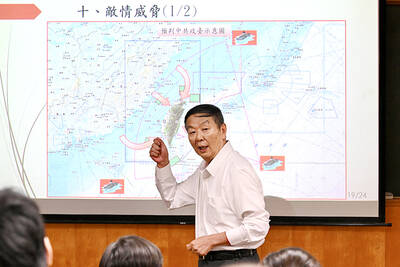
RETHINK? The defense ministry and Navy Command Headquarters could take over the indigenous submarine project and change its production timeline, a source said Admiral Huang Shu-kuang’s (黃曙光) resignation as head of the Indigenous Submarine Program and as a member of the National Security Council could affect the production of submarines, a source said yesterday. Huang in a statement last night said he had decided to resign due to national security concerns while expressing the hope that it would put a stop to political wrangling that only undermines the advancement of the nation’s defense capabilities. Taiwan People’s Party Legislator Vivian Huang (黃珊珊) yesterday said that the admiral, her older brother, felt it was time for him to step down and that he had completed what he
Taiwan has experienced its most significant improvement in the QS World University Rankings by Subject, data provided on Sunday by international higher education analyst Quacquarelli Symonds (QS) showed. Compared with last year’s edition of the rankings, which measure academic excellence and influence, Taiwanese universities made great improvements in the H Index metric, which evaluates research productivity and its impact, with a notable 30 percent increase overall, QS said. Taiwanese universities also made notable progress in the Citations per Paper metric, which measures the impact of research, achieving a 13 percent increase. Taiwanese universities gained 10 percent in Academic Reputation, but declined 18 percent
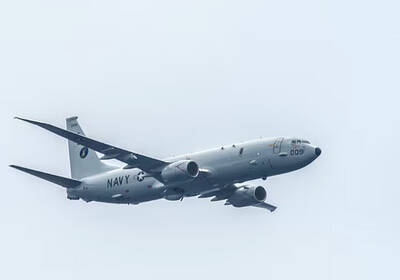
CHINA REACTS: The patrol and reconnaissance plane ‘transited the Taiwan Strait in international airspace,’ the 7th Fleet said, while Taipei said it saw nothing unusual The US 7th Fleet yesterday said that a US Navy P-8A Poseidon flew through the Taiwan Strait, a day after US and Chinese defense heads held their first talks since November 2022 in an effort to reduce regional tensions. The patrol and reconnaissance plane “transited the Taiwan Strait in international airspace,” the 7th Fleet said in a news release. “By operating within the Taiwan Strait in accordance with international law, the United States upholds the navigational rights and freedoms of all nations.” In a separate statement, the Ministry of National Defense said that it monitored nearby waters and airspace as the aircraft
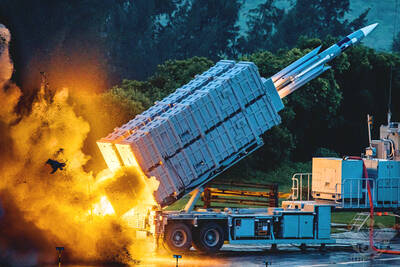
UNDER DISCUSSION: The combatant command would integrate fast attack boat and anti-ship missile groups to defend waters closest to the coastline, a source said The military could establish a new combatant command as early as 2026, which would be tasked with defending Taiwan’s territorial waters 24 nautical miles (44.4km) from the nation’s coastline, a source familiar with the matter said yesterday. The new command, which would fall under the Naval Command Headquarters, would be led by a vice admiral and integrate existing fast attack boat and anti-ship missile groups, along with the Naval Maritime Surveillance and Reconnaissance Command, said the source, who asked to remain anonymous. It could be launched by 2026, but details are being discussed and no final timetable has been announced, the source


 RSS
RSS