


The biggest companies in the global aerospace industry gathered yesterday for the start of China's only international air show, all vying for a slice of the booming Chinese aviation market.
The chiefs of civil and military aircraft manufacturers, parts suppliers and designers were among the thousands of delegates to the Sixth China International Aviation and Aerospace Exhibition in Zhuhai, Guangdong Province.
It is also being attended by 550 exhibitors from 33 countries and regions.
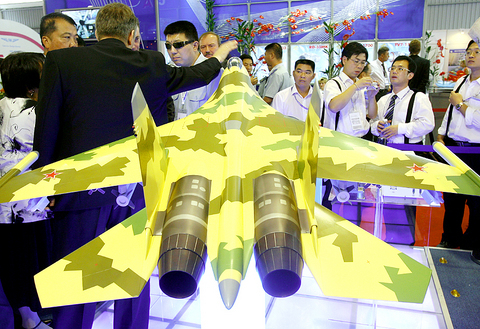
PHOTO: AP
Included in the list of exhibitors are US plane maker Boeing, its European rival Airbus Industries, French military giant Dassault Systemes and Russia's Tupolev.
Airbus China president Laurence Barron said the show offered key access to the Chinese market.
"China is a very important market for us; air traffic is doubling here every five years," Barron said. "It has already become a major market. We take China extremely seriously."
Government aviation procurement officials were also among the delegates.
"In the past, this exhibition has proved vital for us," said Awzy el Hafiz, the Egyptian government's representative at the show.
The air show will also feature demonstration flights of new aircraft from Tupolev and Cessna and a closing display by the Russian Air Force's Knights Aerobatic Team.
Notably, state-owned weapons manufacturer China Aerospace Science and Industry Corp (CASIC) will exhibit a record number of missiles and fighter jets.
The display will demonstrate "the advanced capability and level of Chinese missile weapon systems to safeguard its territorial air, sea and land," CASIC said in a statement.
One of the highlights of the show is expected to be China's most advanced fighter-pilot trainer -- the Shanying, or Mountain Eagle.
The two-seat, single-engine aircraft is capable of carrying 2,000kg weapon payloads such as short-range air-to-air missiles and rocket launchers and bombs. Daily demonstrations will be held at the show.
The much-anticipated FC-1 fighter aircraft, which China jointly developed with Pakistan, will not be on display, despite expectations.
China's rapid economic growth is fueling its fast-growing aviation market, which in turn is driving increased production of planes and engines.
Boeing Co has forecast a 7.3 percent annual growth rate in the Chinese commercial market, while Rolls Royce, the maker of airliner engines, believes it will need 2,600 new planes over the 20-year period.
Boeing has no plans to imitate rival Airbus Industrie by opening a Chinese factory, the president of Boeing China said yesterday, dismissing it as a symbolic step the US aircraft maker doesn't need to take to win orders.
"We have no plans to set up an assembly line at this time," David Wang said at the air show. "We do not believe symbolic investments lead to good business partnerships."
Boeing and Airbus are competing fiercely for market share in China. Chicago-based Boeing says it expects Chinese carriers to purchase 2,900 new planes worth US$280 billion over the next 20 years.
Airbus signed agreements last week to open a final assembly line in China, its first outside Europe, and China ordered 150 mid-size A320 aircraft to be produced there. The planes at the facility in Tianjin will be assembled from components manufactured in Europe.
Boeing is contributing to China's economy by working with Chinese parts suppliers, Wang said.
The company says it has bought Chinese-made components, including doors and wing parts, worth a total of US$730 million over the past two decades.
The company also has three Chinese joint ventures, one making advanced materials, another converting used 747 jumbo jets for use as cargo planes and the third to service aircraft.
"We have not demanded more orders" in exchange for those investments, Wang said. "But we think that because we work closely with the Chinese, we will get our fair share."|
Boeing accounts for about 60 percent of the approximately 900 aircraft in China's commercial fleets, while Airbus says its aircraft account for about 35 percent.
Chinese carriers have signed orders for 220 Boeing aircraft over the past two years, including a cargo version of its planned 777 long-range plane, due to start deliveries in 2008, Randy Baseler, Boeing's vice president for marketing, said.
Taiwan has experienced its most significant improvement in the QS World University Rankings by Subject, data provided on Sunday by international higher education analyst Quacquarelli Symonds (QS) showed. Compared with last year’s edition of the rankings, which measure academic excellence and influence, Taiwanese universities made great improvements in the H Index metric, which evaluates research productivity and its impact, with a notable 30 percent increase overall, QS said. Taiwanese universities also made notable progress in the Citations per Paper metric, which measures the impact of research, achieving a 13 percent increase. Taiwanese universities gained 10 percent in Academic Reputation, but declined 18 percent
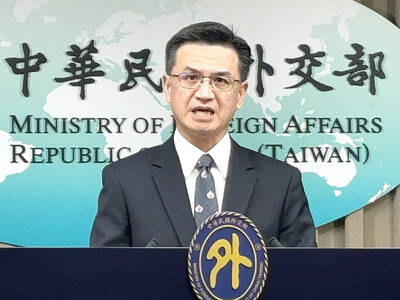
BULLY TACTICS: Beijing has continued its incursions into Taiwan’s airspace even as Xi Jinping talked about Taiwan being part of the Chinese family and nation China should stop its coercion of Taiwan and respect mainstream public opinion in Taiwan about sovereignty if its expression of goodwill is genuine, the Ministry of Foreign Affairs (MOFA) said yesterday. Ministry spokesman Jeff Liu (劉永健) made the comment in response to media queries about a meeting between former president Ma Ying-jeou (馬英九) and Chinese President Xi Jinping (習近平) the previous day. Ma voiced support for the so-called “1992 consensus,” while Xi said that although the two sides of the Taiwan Strait have “different systems,” this does not change the fact that they are “part of the same country,” and that “external
UNDER DISCUSSION: The combatant command would integrate fast attack boat and anti-ship missile groups to defend waters closest to the coastline, a source said The military could establish a new combatant command as early as 2026, which would be tasked with defending Taiwan’s territorial waters 24 nautical miles (44.4km) from the nation’s coastline, a source familiar with the matter said yesterday. The new command, which would fall under the Naval Command Headquarters, would be led by a vice admiral and integrate existing fast attack boat and anti-ship missile groups, along with the Naval Maritime Surveillance and Reconnaissance Command, said the source, who asked to remain anonymous. It could be launched by 2026, but details are being discussed and no final timetable has been announced, the source
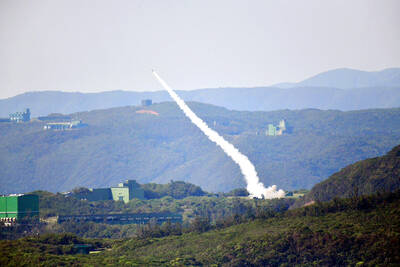
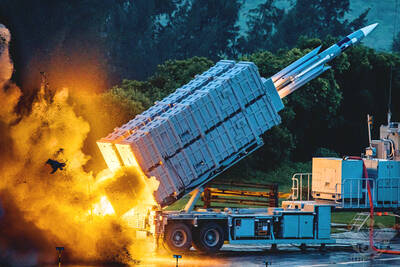
SHOT IN THE ARM: The new system can be integrated with Avenger and Stinger missiles to bolster regional air defense capabilities, a defense ministry report said Domestically developed Land Sword II (陸射劍二) missiles were successfully launched and hit target drones during a live-fire exercise at the Jiupeng Military Base in Pingtung County yesterday. The missiles, developed by the Chungshan Institute of Science and Technology (CSIST), were originally scheduled to launch on Tuesday last week, after the Tomb Sweeping Day holiday long weekend, but were postponed to yesterday due to weather conditions. Local residents and military enthusiasts gathered outside the base to watch the missile tests, with the first one launching at 9:10am. The Land Sword II system, which is derived from the Sky Sword II (天劍二) series, was turned


 RSS
RSS