


IMF policymakers yesterday backed the most sweeping overhaul of the institution for six decades to give fast-growing China, South Korea, Mexico and Turkey more influence.
The plan to overhaul the 61-year-old IMF, whose balance of power still largely reflects the economic landscape at the end of World War II, was given the green light by the IMF's International Monetary and Financial Committee.
"We welcome today agreement to a comprehensive reform package for quotas which, if moved forward, we want to be completed no later than the 2008 annual meetings," British Chancellor of the Exchequer Gordon Brown said.
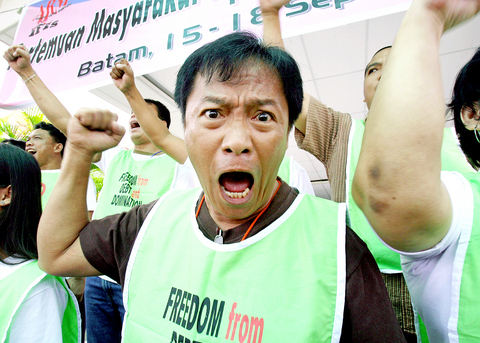
PHOTO: AFP
"These reforms we agreed should also enhance the participation and voice of low income countries in the International Monetary Fund," said Brown, chairman of the committee.
"This package when implemented will make significant progress in realigning quota shares with members' relative position in the world economy," said Brown, describing it as the biggest reform to the governance of the IMF for 60 years.
IMF Managing Director Rodrigo Rato, asked if China would be subject to greater pressure with an increase in its IMF voting rights, replied: "I don't think that the fact of having a larger role makes you subject to more pressure."
The plan now goes to the full 184-strong membership of the fund for final approval, with an announcement of the result of the vote expected by tomorrow.
During the 1990s the IMF was in the vanguard of efforts to resuscitate economies from Latin America to Asia, throwing out multibillion-dollar lifelines.
But recently it has had no major crisis to manage and with its lending on the decline the fund's own finances are running in the red.
Asian nations, backed by Japan, as well as developing countries have long been pushing for a greater say at the institution, which during its six-decade life so far has been dominated by the US, Europe and Japan.
The four countries to benefit from a boost in IMF voting stature are said by the fund to be the only members under-represented on all four of its criteria that determine a nation's voting rights.
Those criteria are the member's GDP, its openness to trade, the "variability" of its economy, in other words how volatile its growth is, and the amount of its reserves.
After the Singapore gathering, further discussions will seek agreement on a new formula to calculate the dollar quotas that each IMF member contributes to the fund and which determine its voting rights.
But within the membership there has been some disagreement on the reforms, with certain European and developing nations voicing dissatisfaction.
In addition four IMF members -- Argentina, Brazil, India and Egypt -- on Saturday expressed opposition to the overall reform drive and called for its suspension until "a simple and transparent formula" is worked out that is "truly reflective of the economic standing" of member countries.
Under the proposals here, China would see its share of total IMF voting rights raised to 3.65 percent from 2.94 percent now while South Korea's share would increase to 1.33 percent from 0.76.
Mexico would go to 1.43 percent from 1.20, with Turkey's participation climbing to 0.55 percent from 0.45.
The fund is also seeking to enhance its role in financial surveillance by shifting from a focus on individual countries to multilateral consultations, notably when the policies of one country "spill over" and affect the interests of others.
The proposal has been supported by the US, which would like to see more forceful IMF action on the Chinese exchange rate regime, which according to Washington gives Chinese goods an unfair advantage on export markets.
The committee in its statement "welcomed the multilateral consultation approach" and said progress toward drafting its "objectives, priorities and responsibilities" would be reviewed at a spring meeting in Washington.
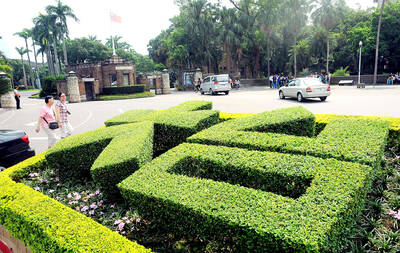
Taiwan has experienced its most significant improvement in the QS World University Rankings by Subject, data provided on Sunday by international higher education analyst Quacquarelli Symonds (QS) showed. Compared with last year’s edition of the rankings, which measure academic excellence and influence, Taiwanese universities made great improvements in the H Index metric, which evaluates research productivity and its impact, with a notable 30 percent increase overall, QS said. Taiwanese universities also made notable progress in the Citations per Paper metric, which measures the impact of research, achieving a 13 percent increase. Taiwanese universities gained 10 percent in Academic Reputation, but declined 18 percent

Chinese President Xi Jinping (習近平) yesterday met with former president Ma Ying-jeou (馬英九) at the Great Hall of the People in Beijing, with Xi’s opening statement once more emphasizing that people on both sides of the Taiwan Strait are Chinese and that foreign intervention cannot change their inevitable unification. Xi said that 5,000 years of history of zhonghua minzu (中華民族, ethnic Chinese group) have seen their ancestors move to Taiwan to establish new lives, while also documenting them fighting side-by-side against foreign forces and finally freeing Taiwan. “Both sides are Chinese,” and there are no issues that cannot be worked through, he
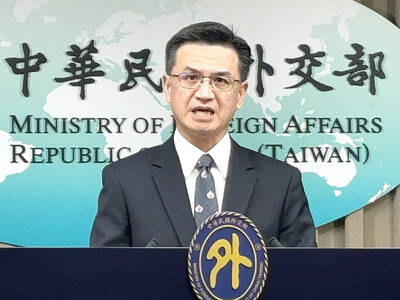
BULLY TACTICS: Beijing has continued its incursions into Taiwan’s airspace even as Xi Jinping talked about Taiwan being part of the Chinese family and nation China should stop its coercion of Taiwan and respect mainstream public opinion in Taiwan about sovereignty if its expression of goodwill is genuine, the Ministry of Foreign Affairs (MOFA) said yesterday. Ministry spokesman Jeff Liu (劉永健) made the comment in response to media queries about a meeting between former president Ma Ying-jeou (馬英九) and Chinese President Xi Jinping (習近平) the previous day. Ma voiced support for the so-called “1992 consensus,” while Xi said that although the two sides of the Taiwan Strait have “different systems,” this does not change the fact that they are “part of the same country,” and that “external
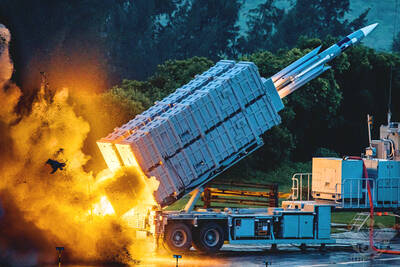
UNDER DISCUSSION: The combatant command would integrate fast attack boat and anti-ship missile groups to defend waters closest to the coastline, a source said The military could establish a new combatant command as early as 2026, which would be tasked with defending Taiwan’s territorial waters 24 nautical miles (44.4km) from the nation’s coastline, a source familiar with the matter said yesterday. The new command, which would fall under the Naval Command Headquarters, would be led by a vice admiral and integrate existing fast attack boat and anti-ship missile groups, along with the Naval Maritime Surveillance and Reconnaissance Command, said the source, who asked to remain anonymous. It could be launched by 2026, but details are being discussed and no final timetable has been announced, the source


 RSS
RSS