


High crude prices are not putting the brakes on global economic growth, and there is no reason for OPEC to change its production targets, key oil ministers said yesterday on the eve of a key meeting of the cartel.
United Arab Emirates' Energy Minister Mohamed Bin Dhaen al-Hamli the told the pan-Arab newspaper al-Hayat that the world economy was still growing briskly, "showing that the impact of oil prices is limited" despite concerns that stubbornly high prices could trigger a slowdown.
With prices hovering around US$67 a barrel and supplies outstripping demand, the 11-nation OPEC almost certainly will keep its current production quota steady when it meets today in Vienna, al-Hamli said.
"Inventories are comfortable, prices are coming down and nobody, I hope, is concerned about shortages of supply," said Saudi Arabian Oil Minister Ali Naimi. "We are very happy with the situation."
Although prices are more than US$10 a barrel off their July highs, economists concede that jittery market sentiment -- fueled by pipeline problems and political turmoil in the Middle East -- does not leave OPEC with much choice. Cutting output would drive prices even higher, and pumping more is not an option for most members already producing at maximum capacity.
"There's a lot of pressure there. I don't think we'll see any real change," said Jason Schenker, an economist with US-based Wachovia Corp.
OPEC's production target is now 28 million barrels a day, excluding Iraq, which is not part of the group's quota system. The cartel meets about 40 percent of the world's demand for crude.
Oil has been edging lower since light sweet crude hit a record US$78.40 a barrel on July 14, two days after fighting erupted in Lebanon.
It dipped below US$67 a barrel on Friday as traders focused on slackening demand and rising supplies.
Global production has taken a hit from BP's leak-prone Alaskan oil pipelines, outages in Iraq and Nigeria, Africa's biggest producer -- where militants have attacked oil infrastructure -- and concerns over Iran's escalating nuclear standoff with the UN Security Council.
OPEC president Edmund Daukoru, conceding the cartel has been "more or less on autopilot," said members would take a hard look at the latest trends.
"We're going to have to review the price fall and see if this signals a longer-term decline," said Daukoru, who doubles as Nigeria's oil minister.
"We have to assess whether the fall is in line with fundamentals or the fear factors, which appear to be more under control," Daukoru said.
But supplies remain ample. al-Hamli said OPEC maintains about 2 million barrels a day of spare capacity, and stocks are high elsewhere; the US Department of Energy said last week that inventories have hit their highest levels since 1998.
"Prices are going down, but this is a correction. What we are seeing is a fluctuation," Shukri Ghanem, the chairman of Libya's National Oil Corp, said yesterday. "We are working in a free market, and we expect prices to go up and down."
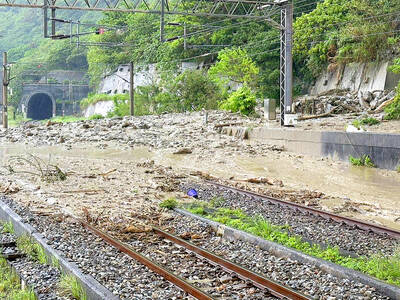
ROLLER-COASTER RIDE: More than five earthquakes ranging from magnitude 4.4 to 5.5 on the Richter scale shook eastern Taiwan in rapid succession yesterday afternoon Back-to-back weather fronts are forecast to hit Taiwan this week, resulting in rain across the nation in the coming days, the Central Weather Administration said yesterday, as it also warned residents in mountainous regions to be wary of landslides and rockfalls. As the first front approached, sporadic rainfall began in central and northern parts of Taiwan yesterday, the agency said, adding that rain is forecast to intensify in those regions today, while brief showers would also affect other parts of the nation. A second weather system is forecast to arrive on Thursday, bringing additional rain to the whole nation until Sunday, it

CONDITIONAL: The PRC imposes secret requirements that the funding it provides cannot be spent in states with diplomatic relations with Taiwan, Emma Reilly said China has been bribing UN officials to obtain “special benefits” and to block funding from countries that have diplomatic ties with Taiwan, a former UN employee told the British House of Commons on Tuesday. At a House of Commons Foreign Affairs Committee hearing into “international relations within the multilateral system,” former Office of the UN High Commissioner for Human Rights (OHCHR) employee Emma Reilly said in a written statement that “Beijing paid bribes to the two successive Presidents of the [UN] General Assembly” during the two-year negotiation of the Sustainable Development Goals. Another way China exercises influence within the UN Secretariat is

LANDSLIDES POSSIBLE: The agency advised the public to avoid visiting mountainous regions due to more expected aftershocks and rainfall from a series of weather fronts A series of earthquakes over the past few days were likely aftershocks of the April 3 earthquake in Hualien County, with further aftershocks to be expected for up to a year, the Central Weather Administration (CWA) said yesterday. Based on the nation’s experience after the quake on Sept. 21, 1999, more aftershocks are possible over the next six months to a year, the agency said. A total of 103 earthquakes of magnitude 4 on the local magnitude scale or higher hit Hualien County from 5:08pm on Monday to 10:27am yesterday, with 27 of them exceeding magnitude 5. They included two, of magnitude

Taiwan’s first drag queen to compete on the internationally acclaimed RuPaul’s Drag Race, Nymphia Wind (妮妃雅), was on Friday crowned the “Next Drag Superstar.” Dressed in a sparkling banana dress, Nymphia Wind swept onto the stage for the final, and stole the show. “Taiwan this is for you,” she said right after show host RuPaul announced her as the winner. “To those who feel like they don’t belong, just remember to live fearlessly and to live their truth,” she said on stage. One of the frontrunners for the past 15 episodes, the 28-year-old breezed through to the final after weeks of showcasing her unique


 RSS
RSS