


China has called on its 31 provinces to rein in their economies, state media said yesterday, in a sign the central government has yet to persuade local bureaucrats that red-hot growth is bad.
Vice Premier Zeng Peiyan (
"The central government has made explicit requirements on economic work in the second half," Zeng said during a recent trip to Yunnan Province.

PHOTO: AP
"Fixed-asset investment should be put under tight control and more efforts made to lower energy consumption and improve environmental protection," he said.
China's economy, the world's fourth largest, expanded 10.9 percent year-on-year in the first six months of the year, boosted by massive investment.
Significantly, Xinhua said 90 percent of all investment in the first half had been approved by governments at provincial level or below, reflecting different agendas in Bei-jing and elsewhere in the country.
Whereas the central government is concerned about macro-issues such as inflation and other symptoms of overheating, local governments prioritize growth because it means more jobs and less risk of social unrest.
Beijing may have awesome formal powers but its actual clout over decisions made hundreds of kilometers away is limited. In reality local officials are frequently calling the shots, according to observers.
"Local government dominance in China's economy appears the most important factor in China's macro-behavior," Andy Xie (謝國忠), a Hong Kong-based economist at Morgan Stanley, said in a recent research note.
In the complex game between Beijing and the provinces, the provincial players have important tactical advantages, Xie said.
"Local governments can create a fait accompli by starting numerous projects to deter macro-tightening by the central government, as cutting off liquidity would keep these projects unfinished," he said.
"Second, local government leaders often have a more senior rank than their regulators in the Communist Party hierarchy and, hence, have a major say in macro-policy," he said.
The economies in three-quarters of China's provinces expanded at 12 percent or more in the first six months, above the national figure of 10.9 percent, its key economic planner said in a report last week.
Moreover, local banks, often outside Beijing's direct supervision and control, have also continued lending to investment projects.
Commercial banks extended 2.34 trillion yuan (US$290 billion) in the first seven months of the year, according to statistics from the People's Bank of China.
This means the banks have used up 94 percent of the total loan quota of 2.5 trillion yuan they have been given for the whole year.
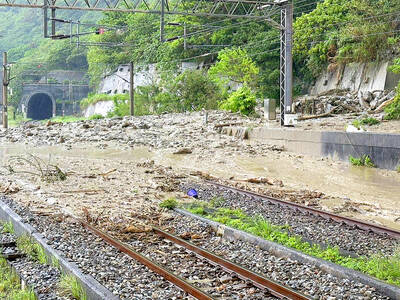
ROLLER-COASTER RIDE: More than five earthquakes ranging from magnitude 4.4 to 5.5 on the Richter scale shook eastern Taiwan in rapid succession yesterday afternoon Back-to-back weather fronts are forecast to hit Taiwan this week, resulting in rain across the nation in the coming days, the Central Weather Administration said yesterday, as it also warned residents in mountainous regions to be wary of landslides and rockfalls. As the first front approached, sporadic rainfall began in central and northern parts of Taiwan yesterday, the agency said, adding that rain is forecast to intensify in those regions today, while brief showers would also affect other parts of the nation. A second weather system is forecast to arrive on Thursday, bringing additional rain to the whole nation until Sunday, it

CONDITIONAL: The PRC imposes secret requirements that the funding it provides cannot be spent in states with diplomatic relations with Taiwan, Emma Reilly said China has been bribing UN officials to obtain “special benefits” and to block funding from countries that have diplomatic ties with Taiwan, a former UN employee told the British House of Commons on Tuesday. At a House of Commons Foreign Affairs Committee hearing into “international relations within the multilateral system,” former Office of the UN High Commissioner for Human Rights (OHCHR) employee Emma Reilly said in a written statement that “Beijing paid bribes to the two successive Presidents of the [UN] General Assembly” during the two-year negotiation of the Sustainable Development Goals. Another way China exercises influence within the UN Secretariat is
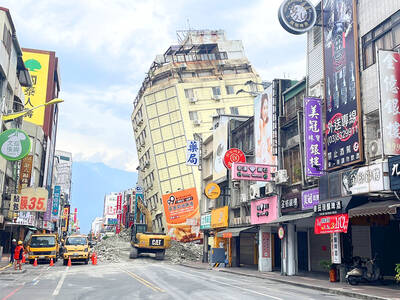
LANDSLIDES POSSIBLE: The agency advised the public to avoid visiting mountainous regions due to more expected aftershocks and rainfall from a series of weather fronts A series of earthquakes over the past few days were likely aftershocks of the April 3 earthquake in Hualien County, with further aftershocks to be expected for up to a year, the Central Weather Administration (CWA) said yesterday. Based on the nation’s experience after the quake on Sept. 21, 1999, more aftershocks are possible over the next six months to a year, the agency said. A total of 103 earthquakes of magnitude 4 on the local magnitude scale or higher hit Hualien County from 5:08pm on Monday to 10:27am yesterday, with 27 of them exceeding magnitude 5. They included two, of magnitude

Taiwan’s first drag queen to compete on the internationally acclaimed RuPaul’s Drag Race, Nymphia Wind (妮妃雅), was on Friday crowned the “Next Drag Superstar.” Dressed in a sparkling banana dress, Nymphia Wind swept onto the stage for the final, and stole the show. “Taiwan this is for you,” she said right after show host RuPaul announced her as the winner. “To those who feel like they don’t belong, just remember to live fearlessly and to live their truth,” she said on stage. One of the frontrunners for the past 15 episodes, the 28-year-old breezed through to the final after weeks of showcasing her unique


 RSS
RSS