


In the crowded hallways of Beijing's famous Silk Alley market, a vendor brazenly pulls out a folder displaying color photos of fake Louis Vuitton and Gucci bags for sale.
"Just like the real ones," the vendor promises as she points to bags that cost the equivalent of between US$75 and US$100, then offers lower quality versions for around US$20.
The potential sale took place last week, a day after Silk Alley and other major Beijing markets signed an agreement with big-name international brands including Louis Vuitton and Gucci not to sell fake versions of their products.
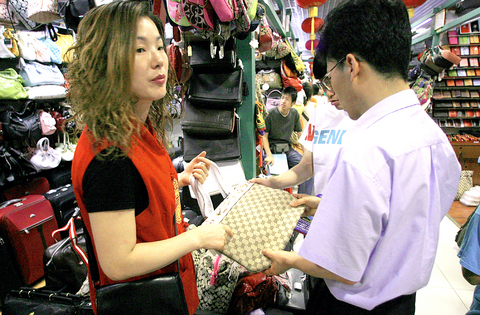
PHOTO: AFP
Under the agreement, the markets pledged to enforce a "two-strike" policy in which they would evict vendors who continued to sell those products after receiving one warning.
It was the latest in a seemingly endless stream of announcements by Chinese officials of crackdowns, laws and other actions to rein in the nation's counterfeit industry and mollify China's international trading partners.
The US has been a particularly sharp critic of China on piracy, charging Beijing is not doing enough to combat the problem that is costing US companies tens of billions of a year.
EU Trade Commissioner Peter Mandelson, who oversaw the signing of the markets agreement during his five-day visit to China, hailed it as a sign that progress was being made.
"This initiative is highly significant and should be an important step to maintain confidence in these markets. I hope we can build further on this foundation," Mandelson said.
Nevertheless, the sheer variety and accessibility of fake products at Silk Alley and other markets around Beijing raise questions about how willing and effective the government really is in regards to stemming piracy.
In Alien's Street, another famous market that is particularly popular with Russian customers, US$10 can buy a fake Gucci watch, a knock-off Vuitton handbag or even a copy of Van Gogh's famous painting Sunflowers.
A watch vendor said that most of the customers were foreigners, mainly Russians but also Malaysians, buying products in bulk to sell in their home countries.
"We deal in wholesale. It's the only way to make money. They are almost all repeat customers," she said.
At the Chaowai Men market next door, an enthusiastic store manager hawked fake wallets bearing imprints of popular, but not the biggest, brands.
When asked about "A" goods, the woman lifted a white curtain hanging on one wall to unveil a shelf lined with wallets carrying the logos of Burberry, Chanel, Gucci, and Louis Vuitton. The sales vendor eagerly explained that the simple, zippered wallets with the classic LV monogram logo, at a price of around US$7, were among her most popular items.
Products that were conspicuously absent in the markets were those related to the 2008 Beijing Olympics, of which the government receives a share of the sales revenues.
While Chinese authorities are seemingly incapable of stopping the flagrant sales of other fake products, they have warned that counterfeit Olympic products will not be tolerated and traders appear to be aware of the limits.
At Alien's Street, vendors shied away from inquiries about Olympics merchandise.
"Hardly anyone dares to sell [Olympics merchandise] without a license," said one man who was selling mobile phone ornaments.
Gao Shangtao, a Beijing-based Chinese lawyer specializing in commercial law, said China already had the laws to effectively fight counterfeiting, but enforcement was the main problem.
"The central government is very determined to strike against copyright violations. [But] on the local level, officials act on behalf of area economic interests and protect the copyright violators," Gao said.
Nevertheless, Gao said China was making some progress, citing the fact that there were an increasing number of intellectual property rights cases appearing in the courts.
There were also embryonic signs of vigilance against fake products at Silk Alley.
"There are regulations about which brands we cannot sell. All the big names, like LV or Prada, are not allowed," a 23-year-old sales attendant surnamed Wu said.
"Inspections are more frequent now. Once they find that you are selling, they confiscate the goods and then fine you," Wu said.
But when asked about the rows of fake Ralph Lauren Polo shirts on sale at her stall, Wu replied: "No one comes and checks these brands, so we still sell them."
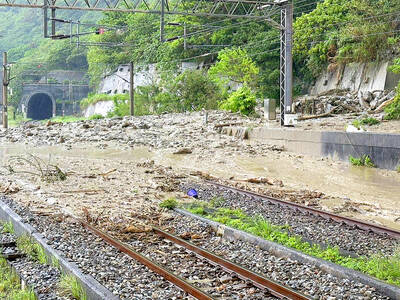
ROLLER-COASTER RIDE: More than five earthquakes ranging from magnitude 4.4 to 5.5 on the Richter scale shook eastern Taiwan in rapid succession yesterday afternoon Back-to-back weather fronts are forecast to hit Taiwan this week, resulting in rain across the nation in the coming days, the Central Weather Administration said yesterday, as it also warned residents in mountainous regions to be wary of landslides and rockfalls. As the first front approached, sporadic rainfall began in central and northern parts of Taiwan yesterday, the agency said, adding that rain is forecast to intensify in those regions today, while brief showers would also affect other parts of the nation. A second weather system is forecast to arrive on Thursday, bringing additional rain to the whole nation until Sunday, it

CONDITIONAL: The PRC imposes secret requirements that the funding it provides cannot be spent in states with diplomatic relations with Taiwan, Emma Reilly said China has been bribing UN officials to obtain “special benefits” and to block funding from countries that have diplomatic ties with Taiwan, a former UN employee told the British House of Commons on Tuesday. At a House of Commons Foreign Affairs Committee hearing into “international relations within the multilateral system,” former Office of the UN High Commissioner for Human Rights (OHCHR) employee Emma Reilly said in a written statement that “Beijing paid bribes to the two successive Presidents of the [UN] General Assembly” during the two-year negotiation of the Sustainable Development Goals. Another way China exercises influence within the UN Secretariat is
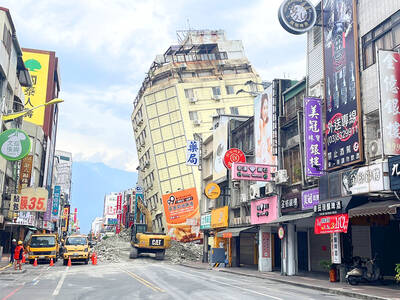
LANDSLIDES POSSIBLE: The agency advised the public to avoid visiting mountainous regions due to more expected aftershocks and rainfall from a series of weather fronts A series of earthquakes over the past few days were likely aftershocks of the April 3 earthquake in Hualien County, with further aftershocks to be expected for up to a year, the Central Weather Administration (CWA) said yesterday. Based on the nation’s experience after the quake on Sept. 21, 1999, more aftershocks are possible over the next six months to a year, the agency said. A total of 103 earthquakes of magnitude 4 on the local magnitude scale or higher hit Hualien County from 5:08pm on Monday to 10:27am yesterday, with 27 of them exceeding magnitude 5. They included two, of magnitude
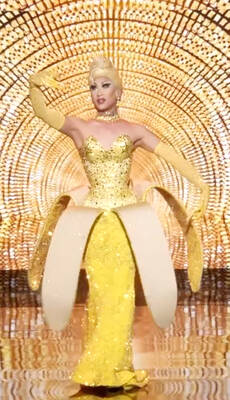
Taiwan’s first drag queen to compete on the internationally acclaimed RuPaul’s Drag Race, Nymphia Wind (妮妃雅), was on Friday crowned the “Next Drag Superstar.” Dressed in a sparkling banana dress, Nymphia Wind swept onto the stage for the final, and stole the show. “Taiwan this is for you,” she said right after show host RuPaul announced her as the winner. “To those who feel like they don’t belong, just remember to live fearlessly and to live their truth,” she said on stage. One of the frontrunners for the past 15 episodes, the 28-year-old breezed through to the final after weeks of showcasing her unique


 RSS
RSS