


The world's airlines' losses this year may reach US$3 billion, 36 percent more than forecast in March, as rising oil prices outstrip the benefits of economic growth and higher ticket prices, an industry group said.
The International Air Transport Association (IATA), whose 261 members represent 94 percent of scheduled air traffic, had forecast a loss of US$2.2 billion for the world's airlines.
"It's amazing that our forecast isn't worse than it is," Brian Pearce, chief economist of the Montreal-based group, said in an interview in Paris.
"It's because of the cost cuts, which have put the airlines in a really strong position, and also because we're in a really strong economic environment," he said.
The group's members as a whole haven't been profitable since 2000 when they earned US$3.7 billion. The carriers lost US$43.6 billion from 2001 through last year, IATA said, dragged down by the Sept. 11, 2001, terrorist attacks, SARS, excess capacity and rising oil prices.
IATA, whose annual meeting in Paris continues today, expects North American airlines to lose US$5.2 billion in this year. European airlines will probably earn US$1.3 billion, while Asian carriers are now expected to earn US$1.7 billion.
The more pessimistic forecast is based on Brent crude oil costing an average of US$66 a barrel compared with the US$57 a barrel on which the March projection was based. Crude oil for July delivery was at US$71.95 a barrel in London yesterday.
IATA in March forecast that airlines would post a profit of US$7.2 billion next year, based on average oil prices falling. The group today didn't make a specific projection for next year because of the uncertainty over whether the higher cost would lead to slower economic growth and a decline in demand, said IATA chief executive officer Giovanni Bisignani in an interview.
"We have to consider that traffic is booming, yields are high and load factors are at record levels," he said. "But if the fuel prices keep increasing, this rosy environment will finish quite quickly and so our optimism may also end."
Fuel costs for the world's airlines doubled from 2001 through this year to US$91 billion. IATA now expects the bill for carriers to total US$112 billion this year, with fuel rising to 26 percent of operating costs from 22 percent last year.
To combat the higher costs, airlines have used ticket surcharges, hedging, or financial contracts to lock in prices, cost cuts and use of newer, more fuel-efficient aircraft.
Bisignani says airlines until now have been able to recover about 40 percent of the higher fuel prices through hedging and another 20 percent through charges.
Air France KLM Group, Europe's largest carrier, has imposed surcharges five times in the last 18 months, with the long-haul charge now at 51 euros (US$66) a ticket. British Airways Plc last month raised the surcharge on long-haul flights by 17 percent to £35 (US$66), the seventh increase since May 2004.
Hedging has become less effective because as older financial contracts expire, new contracts are available only at higher target prices. Carriers having financial difficulties often don't hedge at all because they lack the cash or credit to buy the contracts.
AMR Corp's American Airlines chief executive Gerard Arpey said that was the case at his airline for some time.
"Regrettably, we moved away from our historic hedging program in mid-2003 because of our liquidity difficulties," Arpey said in an interview in Paris on Sunday.
"To hedge you need cash or a balance sheet," he said. "And in the dark days of 2003, we didn't have either one. Today we're in a stronger position and we're hedging again, but you can't turn the clock back, so you're now hedging in the US$60-dollar range."
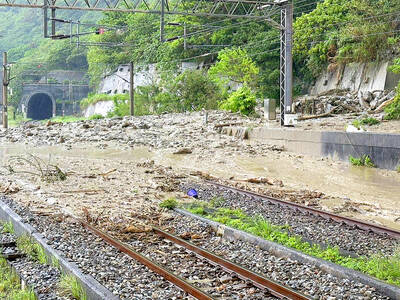
ROLLER-COASTER RIDE: More than five earthquakes ranging from magnitude 4.4 to 5.5 on the Richter scale shook eastern Taiwan in rapid succession yesterday afternoon Back-to-back weather fronts are forecast to hit Taiwan this week, resulting in rain across the nation in the coming days, the Central Weather Administration said yesterday, as it also warned residents in mountainous regions to be wary of landslides and rockfalls. As the first front approached, sporadic rainfall began in central and northern parts of Taiwan yesterday, the agency said, adding that rain is forecast to intensify in those regions today, while brief showers would also affect other parts of the nation. A second weather system is forecast to arrive on Thursday, bringing additional rain to the whole nation until Sunday, it

CONDITIONAL: The PRC imposes secret requirements that the funding it provides cannot be spent in states with diplomatic relations with Taiwan, Emma Reilly said China has been bribing UN officials to obtain “special benefits” and to block funding from countries that have diplomatic ties with Taiwan, a former UN employee told the British House of Commons on Tuesday. At a House of Commons Foreign Affairs Committee hearing into “international relations within the multilateral system,” former Office of the UN High Commissioner for Human Rights (OHCHR) employee Emma Reilly said in a written statement that “Beijing paid bribes to the two successive Presidents of the [UN] General Assembly” during the two-year negotiation of the Sustainable Development Goals. Another way China exercises influence within the UN Secretariat is
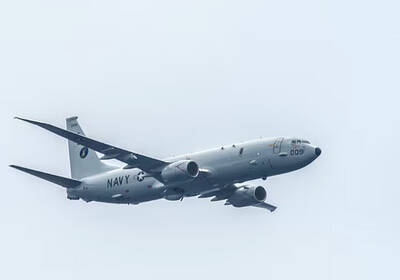
CHINA REACTS: The patrol and reconnaissance plane ‘transited the Taiwan Strait in international airspace,’ the 7th Fleet said, while Taipei said it saw nothing unusual The US 7th Fleet yesterday said that a US Navy P-8A Poseidon flew through the Taiwan Strait, a day after US and Chinese defense heads held their first talks since November 2022 in an effort to reduce regional tensions. The patrol and reconnaissance plane “transited the Taiwan Strait in international airspace,” the 7th Fleet said in a news release. “By operating within the Taiwan Strait in accordance with international law, the United States upholds the navigational rights and freedoms of all nations.” In a separate statement, the Ministry of National Defense said that it monitored nearby waters and airspace as the aircraft

Taiwan’s first drag queen to compete on the internationally acclaimed RuPaul’s Drag Race, Nymphia Wind (妮妃雅), was on Friday crowned the “Next Drag Superstar.” Dressed in a sparkling banana dress, Nymphia Wind swept onto the stage for the final, and stole the show. “Taiwan this is for you,” she said right after show host RuPaul announced her as the winner. “To those who feel like they don’t belong, just remember to live fearlessly and to live their truth,” she said on stage. One of the frontrunners for the past 15 episodes, the 28-year-old breezed through to the final after weeks of showcasing her unique


 RSS
RSS