


New US standards for diesel fuel that went into effect last Thursday are expected to open the door for auto manufacturers to introduce more diesel-powered cars to the US market, industry analysts say.
The new environmental rules require a 97 percent reduction in the sulfur content of highway diesel fuel, from its current level of 500 parts per million (ppm), to 15 ppm. Refiners were required to start producing this cleaner fuel as of Thursday, and it should be available nationwide by Oct. 15.
In addition to the obvious benefit of reducing emissions from the 13 million heavy trucks using diesel fuel, the new cleaner fuel could make it easier for automakers to introduce more passenger diesel cars that meet strict US emissions standards.
Only about 3.6 percent of new passenger vehicles registered in the US were powered by diesel, according to the Diesel Technology Forum, an industry group.
That is a sharp contrast to Europe, where about half the cars use diesel fuel.
But the US market is expected to rise, in part because of the better fuel economy from diesel.
The new cleaner diesel fuel "opens up the door of opportunity" to sell more diesel cars and light trucks in the US market, says Allen Schaeffer, executive director of the Diesel Technology Forum.
"Diesel has not had a great public image as a technology but that is changing. The new diesel engines have no visible exhaust, no smoke, the noise is equivalent to a gasoline model, and it offers 20 to 40 percent better fuel economy," he said.
Additionally, Schaeffer said, a diesel engine offers more "torque," or acceleration capability, compared with an equivalent gasoline engine.
But automakers still need to do more to tweak their diesel engines to meet US emissions standards. New diesel engines will use filters for particulates -- black soot particles -- but will need further reductions of nitrogen oxides.
David Cole, chairman of the Center for Automotive Research in Ann Arbor, Michigan, said greater use of diesel is possible but not guaranteed.
"A low-sulfur diesel is absolutely necessary if we are able to meet emissions standards," he said, but added that "nitrogen oxide standards are very difficult even with the cleaner fuel."
Cole said there is "a real horse race" among three different technologies in which automakers are trying to improve fuel efficiency: improvements to the traditional gasoline engine, the hybrid gasoline-electric powertrain and the diesel engine.
Each of these can offer some improvement, Cole said, but it remains unclear now which will end up being the most economical.
"Diesel is in the game and, I think we're going to see some interesting technology," he said. "Everyone is working on these technologies and they can't pick the winners."
Automakers have to determine how much additional costs will be borne by consumers for the cars in order to save on fuel. For example, diesel engines may add US$3,000 to the cost of a car and save 30 percent on fuel. Hybrids can cost US$4,000 to US$6,000 extra and save 30 percent or more, depending on driving habits.
"I don't see any problem with consumer acceptance, but the issue is really economics. Can they be competitive with existing technology with the cost penalty they have?" Cole said.
Currently, only a handful of diesel-powered passenger cars are sold in the US market by Volkswagen and DaimlerChrysler, along with several large pickup trucks from General Motors and Ford.
But on Thursday Chrysler Group said it will offer a diesel engine option for next year's Jeep Grand Cherokee, making it the first diesel-powered, full-size sport-utility vehicle to be offered in the US.
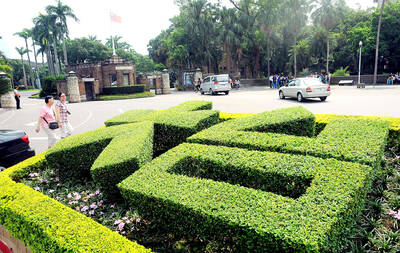
Taiwan has experienced its most significant improvement in the QS World University Rankings by Subject, data provided on Sunday by international higher education analyst Quacquarelli Symonds (QS) showed. Compared with last year’s edition of the rankings, which measure academic excellence and influence, Taiwanese universities made great improvements in the H Index metric, which evaluates research productivity and its impact, with a notable 30 percent increase overall, QS said. Taiwanese universities also made notable progress in the Citations per Paper metric, which measures the impact of research, achieving a 13 percent increase. Taiwanese universities gained 10 percent in Academic Reputation, but declined 18 percent
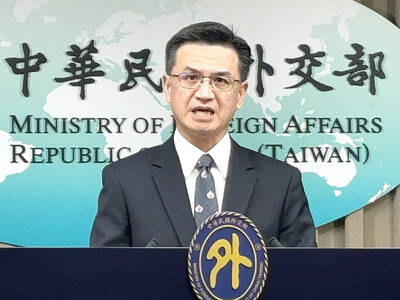
BULLY TACTICS: Beijing has continued its incursions into Taiwan’s airspace even as Xi Jinping talked about Taiwan being part of the Chinese family and nation China should stop its coercion of Taiwan and respect mainstream public opinion in Taiwan about sovereignty if its expression of goodwill is genuine, the Ministry of Foreign Affairs (MOFA) said yesterday. Ministry spokesman Jeff Liu (劉永健) made the comment in response to media queries about a meeting between former president Ma Ying-jeou (馬英九) and Chinese President Xi Jinping (習近平) the previous day. Ma voiced support for the so-called “1992 consensus,” while Xi said that although the two sides of the Taiwan Strait have “different systems,” this does not change the fact that they are “part of the same country,” and that “external
UNDER DISCUSSION: The combatant command would integrate fast attack boat and anti-ship missile groups to defend waters closest to the coastline, a source said The military could establish a new combatant command as early as 2026, which would be tasked with defending Taiwan’s territorial waters 24 nautical miles (44.4km) from the nation’s coastline, a source familiar with the matter said yesterday. The new command, which would fall under the Naval Command Headquarters, would be led by a vice admiral and integrate existing fast attack boat and anti-ship missile groups, along with the Naval Maritime Surveillance and Reconnaissance Command, said the source, who asked to remain anonymous. It could be launched by 2026, but details are being discussed and no final timetable has been announced, the source
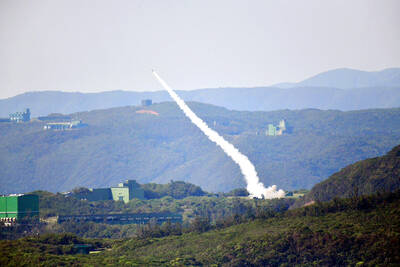
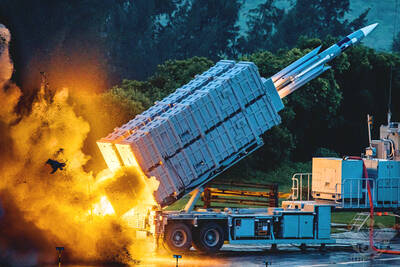
SHOT IN THE ARM: The new system can be integrated with Avenger and Stinger missiles to bolster regional air defense capabilities, a defense ministry report said Domestically developed Land Sword II (陸射劍二) missiles were successfully launched and hit target drones during a live-fire exercise at the Jiupeng Military Base in Pingtung County yesterday. The missiles, developed by the Chungshan Institute of Science and Technology (CSIST), were originally scheduled to launch on Tuesday last week, after the Tomb Sweeping Day holiday long weekend, but were postponed to yesterday due to weather conditions. Local residents and military enthusiasts gathered outside the base to watch the missile tests, with the first one launching at 9:10am. The Land Sword II system, which is derived from the Sky Sword II (天劍二) series, was turned


 RSS
RSS