


The yuan strengthened beyond eight to the US dollar for the first time in more than 12 years, prompting speculation that China's government is allowing faster gains to win US support for its currency policy.
Chinese Foreign Ministry Spokesman Liu Jianchao (
"The Treasury report was well received by China and the break of the `eight' level is probably a thank you for that," said Sean Callow, a currency strategist at Westpac Banking Corp in Singapore.
The currency closed at 7.9976 to the US dollar. It ended trading last week at 8.0062, from 8.0037 on the day the semi-annual Treasury review was released.
US lawmakers are pushing for faster yuan gains to narrow a trade deficit with China that reached US$201.6 billion last year.
They say China keeps the currency artificially weak to make more competitive exports that helped propel the pace of growth in the country to the fastest among the world's 20 largest economies.
The yuan hasn't risen more than 0.15 percent intraday since China scrapped a peg to the US dollar on July 21, in contrast with the maximum 0.3 percent the central bank said it would allow.
China's currency was last stronger than eight on Dec. 31, 1993, before the government devalued it against the US dollar. China also since then stopped using a specific currency for foreigners and international trade called Foreign Exchange Certificates.
The Treasury, in its twice-yearly review of world exchange rates, said China has made "far too little progress" in currency flexibility. Still, steps to loosen control over the yuan, and promises to do more, suggest the government isn't deliberately manipulating its currency, the review added.
"The US may be taking a soft approach on China, which is probably the right approach," said Jimmy Koh, head of Treasury research at United Overseas Bank in Singapore.
"It's provided a breathing space for China to respond. This is probably the start of more adjustment on the yuan," he said.
Such a strategy may draw fire from Senators Charles Schumer and Lindsey Graham, who propose a 27.5 percent tariff on imports from China should the yuan fail to rise faster. Schumer last Wednesday said he was "disappointed" with the Treasury decision.
The US will press China "every day" for more loosening, while opposing "protectionism," Treasury Undersecretary for International Affairs Tim Adams said in Washington the next day.
A customs bureau report last Friday showed China's trade surplus was larger than expected last month. The US$10.5 billion surplus compared with the US$7.2 billion median estimate of 21 economists in a Bloomberg survey, and the US$11.2 billion in March. China's economy grew 10.2 percent in the first quarter from a year ago.
China may offer further concessions on its exchange rate as payback for the US Treasury's stance, including widening the band in which the yuan trades, said Daiwa Institute of Research.
The government will pursue measures to make the yuan more responsive to market forces, Reuters reported, citing a draft of a joint statement by China and the EU.
The statement, which was dated Saturday and scheduled for release yesterday, follows a daylong meeting in Beijing between China's Finance Minister Jin Renqing (金人慶) and EU Internal Market and Services Commissioner Charlie McCreevy, Reuters reported.
"The US has given China some face by not labeling it a manipulator and China may give some back" by widening the band, Xiao Minjie (肖敏捷), a senior Daiwa economist, said a day after the US report.
"Widening the band could speed up yuan gains," he said.
Authorities may expand the band by the first anniversary of the end of the peg to the dollar, suggesting larger gains in the currency are achievable, Xiao said.
China has already taken steps to reduce the central bank's dominance over setting the exchange rate, including naming banks as market makers, who stand ready to buy and sell the yuan to companies and investors. It also started trade in forwards contracts and introduced currency swaps for hedging risk.
Taiwan has experienced its most significant improvement in the QS World University Rankings by Subject, data provided on Sunday by international higher education analyst Quacquarelli Symonds (QS) showed. Compared with last year’s edition of the rankings, which measure academic excellence and influence, Taiwanese universities made great improvements in the H Index metric, which evaluates research productivity and its impact, with a notable 30 percent increase overall, QS said. Taiwanese universities also made notable progress in the Citations per Paper metric, which measures the impact of research, achieving a 13 percent increase. Taiwanese universities gained 10 percent in Academic Reputation, but declined 18 percent
RETHINK? The defense ministry and Navy Command Headquarters could take over the indigenous submarine project and change its production timeline, a source said Admiral Huang Shu-kuang’s (黃曙光) resignation as head of the Indigenous Submarine Program and as a member of the National Security Council could affect the production of submarines, a source said yesterday. Huang in a statement last night said he had decided to resign due to national security concerns while expressing the hope that it would put a stop to political wrangling that only undermines the advancement of the nation’s defense capabilities. Taiwan People’s Party Legislator Vivian Huang (黃珊珊) yesterday said that the admiral, her older brother, felt it was time for him to step down and that he had completed what he
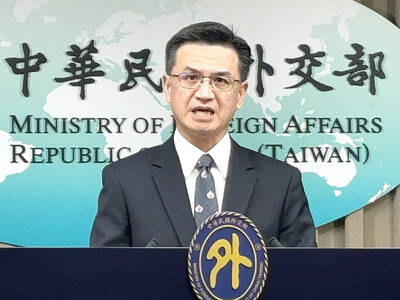
BULLY TACTICS: Beijing has continued its incursions into Taiwan’s airspace even as Xi Jinping talked about Taiwan being part of the Chinese family and nation China should stop its coercion of Taiwan and respect mainstream public opinion in Taiwan about sovereignty if its expression of goodwill is genuine, the Ministry of Foreign Affairs (MOFA) said yesterday. Ministry spokesman Jeff Liu (劉永健) made the comment in response to media queries about a meeting between former president Ma Ying-jeou (馬英九) and Chinese President Xi Jinping (習近平) the previous day. Ma voiced support for the so-called “1992 consensus,” while Xi said that although the two sides of the Taiwan Strait have “different systems,” this does not change the fact that they are “part of the same country,” and that “external

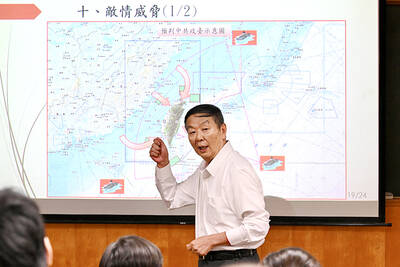
UNDER DISCUSSION: The combatant command would integrate fast attack boat and anti-ship missile groups to defend waters closest to the coastline, a source said The military could establish a new combatant command as early as 2026, which would be tasked with defending Taiwan’s territorial waters 24 nautical miles (44.4km) from the nation’s coastline, a source familiar with the matter said yesterday. The new command, which would fall under the Naval Command Headquarters, would be led by a vice admiral and integrate existing fast attack boat and anti-ship missile groups, along with the Naval Maritime Surveillance and Reconnaissance Command, said the source, who asked to remain anonymous. It could be launched by 2026, but details are being discussed and no final timetable has been announced, the source


 RSS
RSS