


Chinese President Hu Jintao (
Microsoft Corp believes that, after more than a decade of efforts, it is on the cusp of a breakthrough in China's vast potential market, where it has traditionally been hindered by widespread software piracy.
But even as Microsoft is winning Chinese government backing to crack down on piracy, the software maker and its competitors have come under fire for aiding government censorship efforts as they try to break into China's lucrative online market.
"Everybody sort of has this issue of, `How do you balance the sort of civil liberties aspect with the sort of real world that's the market out there,'" said analyst Charlie Di Bona with Bernstein & Co.
Meanwhile, Boeing Co has won pledges for big airplane orders that could help boost diplomacy efforts, although some say the company's potential there is limited by the strict regulation of Chinese airlines.
slow deregulation
"Everyone wants the market to deregulate, but it's happening slower than expected," said Richard Aboulafia, an analyst with the Teal Group.
The US' largest exporter also is seeing stiffer competition in China from rival Airbus SAS, raising concerns in part because so much business is at stake. Boeing believes China will require 2,600 new airplanes over the next 20 years.
"The Chinese market is probably going to be as strong as any single country in the world over the next 20 years ... so it's certainly one that Boeing wants to continue to be dominant in," said aviation analyst Paul Nisbet with JSA Research.
trade imbalance
Nisbet credits Boeing with astute sales and marketing efforts in China, but he said the company also is benefiting from both US and Chinese eagerness to address a growing trade imbalance.
The US has a US$202 billion trade deficit with China, and big purchases of Boeing airplanes help tip the scales back a bit.
At a meeting between US and Chinese officials last week, China pledged to complete a previous 150-plane commitment by buying 80 narrow-body 737-700 and 737-800 airplanes worth US$5.2 billion at list prices.
The order has yet to be final-ized, and airlines typically negotiate discounts.
Still, Aboulafia said he thinks the potential could be greater if there were looser restrictions, allowing more people to more easily start up airlines and buy planes.
"The fact that the Chinese government is placing these orders shows how close they are," said Aboulafia, who believes India is more promising in part because it's a more open market.
Robert Laird, vice president for China sales at Boeing, insists Chinese airlines, not the government, are making fleet purchasing decisions.
Redmond, Washington-based Microsoft has had a presence in China since 1992, but Tim Chen (
crackdown
The Chinese government has said it will crack down on illegitimate software use, and three major computer makers have said they would begin loading legitimate copies of Windows onto some of the computers sold there.
"China wants to be regarded as a mature player in the world stage, and to do so it has to respect intellectual property law," said Roger Kay with Endpoint Technologies Associates.
Such regulation is important to Microsoft because the market for Windows and other products is growing saturated in much of the developed world, leaving Microsoft hungry to boost sales in areas such as China and India.
But Di Bona said that, despite the high-profile promises, he thinks it will still be some time before Microsoft actually sees significant revenue from the pledged changes.
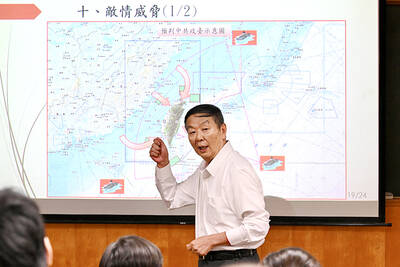
RETHINK? The defense ministry and Navy Command Headquarters could take over the indigenous submarine project and change its production timeline, a source said Admiral Huang Shu-kuang’s (黃曙光) resignation as head of the Indigenous Submarine Program and as a member of the National Security Council could affect the production of submarines, a source said yesterday. Huang in a statement last night said he had decided to resign due to national security concerns while expressing the hope that it would put a stop to political wrangling that only undermines the advancement of the nation’s defense capabilities. Taiwan People’s Party Legislator Vivian Huang (黃珊珊) yesterday said that the admiral, her older brother, felt it was time for him to step down and that he had completed what he

Taiwan has experienced its most significant improvement in the QS World University Rankings by Subject, data provided on Sunday by international higher education analyst Quacquarelli Symonds (QS) showed. Compared with last year’s edition of the rankings, which measure academic excellence and influence, Taiwanese universities made great improvements in the H Index metric, which evaluates research productivity and its impact, with a notable 30 percent increase overall, QS said. Taiwanese universities also made notable progress in the Citations per Paper metric, which measures the impact of research, achieving a 13 percent increase. Taiwanese universities gained 10 percent in Academic Reputation, but declined 18 percent
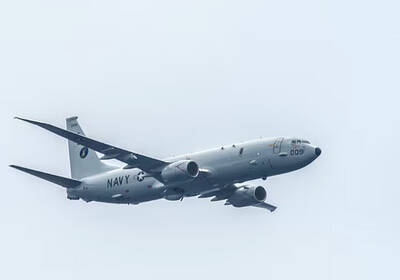
CHINA REACTS: The patrol and reconnaissance plane ‘transited the Taiwan Strait in international airspace,’ the 7th Fleet said, while Taipei said it saw nothing unusual The US 7th Fleet yesterday said that a US Navy P-8A Poseidon flew through the Taiwan Strait, a day after US and Chinese defense heads held their first talks since November 2022 in an effort to reduce regional tensions. The patrol and reconnaissance plane “transited the Taiwan Strait in international airspace,” the 7th Fleet said in a news release. “By operating within the Taiwan Strait in accordance with international law, the United States upholds the navigational rights and freedoms of all nations.” In a separate statement, the Ministry of National Defense said that it monitored nearby waters and airspace as the aircraft
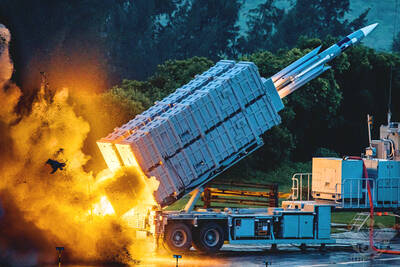
UNDER DISCUSSION: The combatant command would integrate fast attack boat and anti-ship missile groups to defend waters closest to the coastline, a source said The military could establish a new combatant command as early as 2026, which would be tasked with defending Taiwan’s territorial waters 24 nautical miles (44.4km) from the nation’s coastline, a source familiar with the matter said yesterday. The new command, which would fall under the Naval Command Headquarters, would be led by a vice admiral and integrate existing fast attack boat and anti-ship missile groups, along with the Naval Maritime Surveillance and Reconnaissance Command, said the source, who asked to remain anonymous. It could be launched by 2026, but details are being discussed and no final timetable has been announced, the source


 RSS
RSS