


China's government plans to let businesses and the public hold more foreign exchange, state media yesterday quoted a central bank official as saying, amid international pressure on Beijing to ease its strict currency controls.
The bank has submitted a proposal to shift the government's strategy on currency reserves to "foreign exchange held by the people," the official Xinhua news agency quoted Wu Xiaoling (吳曉靈), a deputy bank governor, as saying on Wednesday.
"The proposal means to relax the policies of foreign currency in order to boost the amount of foreign currency held by individuals," she was quoted as saying.
Her comments also were reported by the China Daily.
The reports didn't say when the change might take affect or give details of how it would affect businesses or individuals.
China requires its companies to sell to the government most of the foreign currency that they earn abroad, and travelers are allowed to take only a small amount of foreign exchange out of the country.
A state newspaper reported last month that China holds US$853.7 billion in foreign currency reserves -- the biggest in the world.
China is under pressure from the US and other trading partners to ease controls that they say keep the country's currency, the yuan, undervalued and give an unfair price advantage to Chinese exporters at the expense of foreign competitors.
On Wednesday, the US Secretary of the Treasury John Snow said the Bush administration will push China on trade issues from currency reform to copyright piracy during a US visit by China's president.
Snow told a House subcommittee that the administration believed its campaign of "quiet diplomacy" was working to get China to let its currency's value rise against the dollar. He predicted more change in this area in coming months.
"They need to do more," he said. "They are being too cautious."
He was questioned by lawmakers on the currency issue, which critics see as a main contributing factor to America's soaring trade deficit with China, an imbalance that hit an all-time high of US$202 billion last year.
Snow said the issue of currency valuations would be one of several economic topics President George W. Bush would raise with President Hu Jintao (
He also told lawmakers he believed the administration's efforts were beginning to show results.
"I think they are making some progress," Snow said. "I prefer ... quiet diplomacy to other things. I think it is going to produce better results."
US National Security Adviser Stephen Hadley said on Wednesday that Hu's visit "will reveal more about China's commitment to being a responsible stakeholder in the international system."
"China would do well to implement policies to correct its global trade imbalances, through expanding domestic demand, increasing market access for foreign goods and services, and adopting a flexible, market-based exchange rate for its currency," Hadley told the National Bureau of Asian Research.
Snow cited a recent Wall Street forecast that China's currency would rise in value by 12 percent to 14 percent by the end of this year against the dollar, far more than the small 3 percent appreciation in the yuan that has occurred since last July.
"Over the course of this year and next, I think we are going to see the currency move more and move in a direction that causes it to have higher valuation," he said.
But he said it was unlikely the Chinese would move "in one fell swoop" to a system in which the yuan's value is allowed to be set entirely by market forces.
Snow said the administration wants China to do more to crack down on the copyright piracy of US movies, music and computer programs. He said the administration also wants China to move faster to honor commitments to lower barriers to US exports, commitments China made when it joined the WTO in 2001.
Administration officials hope to use Hu's visit and a meeting next Tuesday in Washington of the US-China Joint Commission on Commerce and Trade, composed of top economic policymakers from both countries, to achieve trade concessions that will address the swelling trade gap.
"Our message to China is that we want to have economic engagement with you, but we want it to be mutually advantageous," Snow told lawmakers.
"It has got to be a two-way street and you have got to address these issues like the currency, like intellectual property rights and counterfeiting.... You have got to open up your markets," he said.
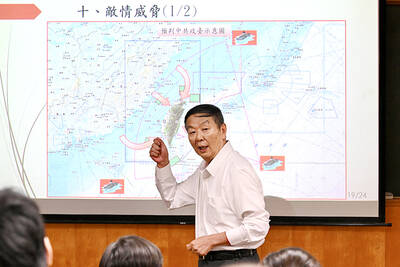
RETHINK? The defense ministry and Navy Command Headquarters could take over the indigenous submarine project and change its production timeline, a source said Admiral Huang Shu-kuang’s (黃曙光) resignation as head of the Indigenous Submarine Program and as a member of the National Security Council could affect the production of submarines, a source said yesterday. Huang in a statement last night said he had decided to resign due to national security concerns while expressing the hope that it would put a stop to political wrangling that only undermines the advancement of the nation’s defense capabilities. Taiwan People’s Party Legislator Vivian Huang (黃珊珊) yesterday said that the admiral, her older brother, felt it was time for him to step down and that he had completed what he
Taiwan has experienced its most significant improvement in the QS World University Rankings by Subject, data provided on Sunday by international higher education analyst Quacquarelli Symonds (QS) showed. Compared with last year’s edition of the rankings, which measure academic excellence and influence, Taiwanese universities made great improvements in the H Index metric, which evaluates research productivity and its impact, with a notable 30 percent increase overall, QS said. Taiwanese universities also made notable progress in the Citations per Paper metric, which measures the impact of research, achieving a 13 percent increase. Taiwanese universities gained 10 percent in Academic Reputation, but declined 18 percent
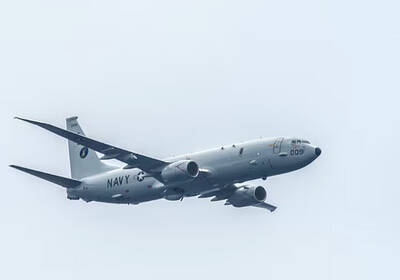
CHINA REACTS: The patrol and reconnaissance plane ‘transited the Taiwan Strait in international airspace,’ the 7th Fleet said, while Taipei said it saw nothing unusual The US 7th Fleet yesterday said that a US Navy P-8A Poseidon flew through the Taiwan Strait, a day after US and Chinese defense heads held their first talks since November 2022 in an effort to reduce regional tensions. The patrol and reconnaissance plane “transited the Taiwan Strait in international airspace,” the 7th Fleet said in a news release. “By operating within the Taiwan Strait in accordance with international law, the United States upholds the navigational rights and freedoms of all nations.” In a separate statement, the Ministry of National Defense said that it monitored nearby waters and airspace as the aircraft

UNDER DISCUSSION: The combatant command would integrate fast attack boat and anti-ship missile groups to defend waters closest to the coastline, a source said The military could establish a new combatant command as early as 2026, which would be tasked with defending Taiwan’s territorial waters 24 nautical miles (44.4km) from the nation’s coastline, a source familiar with the matter said yesterday. The new command, which would fall under the Naval Command Headquarters, would be led by a vice admiral and integrate existing fast attack boat and anti-ship missile groups, along with the Naval Maritime Surveillance and Reconnaissance Command, said the source, who asked to remain anonymous. It could be launched by 2026, but details are being discussed and no final timetable has been announced, the source


 RSS
RSS