


Prime Minister John Howard said yesterday that "very good progress" had been made in negotiations on opening Australia's vast uranium reserves up to China and a deal could be signed when Chinese Premier Wen Jiabao (溫家寶) visits next week.
In remarks that sent shares in Australian-listed uranium producers and explorers soaring, Howard said there had been progress in lengthy talks on Canberra's insistence that its uranium is not used in Chinese nuclear weapons.
"We have made very good progress," Howard said during a joint press conference in Canberra with visiting British Prime Minister Tony Blair.
"It's possible that the discussions could be satisfactorily concluded so that something could be said or signed when the Chinese premier visits Australia next week," he said.
Australia has some 40 percent of the world's known uranium reserves and has been keen to increase exports to fuel China's rapidly expanding nuclear power industry.
A senior Chinese official in Beijing said on Monday the two governments were poised to sign two deals, one on exports of Australian uranium to China and another on Chinese involvement in uranium exploration and mining in Australia.
Liu Jieyi (
Liu stressed the agreements would cover the "peaceful use of nuclear energy" and would be in line with safeguards laid down by the International Atomic Energy Agency.
During two days of meetings and speeches in Canberra, Blair and Howard have repeatedly stressed the strategic importance of helping the rapidly emerging economies of China and India achieve energy security.
Both Blair and Howard suggested nuclear power would offer the Asian giants a cleaner and more sustainable source of energy than the polluting coal and oil-fired stations on which they now rely.
Howard did not rule out lifting a ban on selling uranium to India due to New Delhi's refusal to sign the nuclear non-proliferation treaty, although he said the government was "not contemplating" a change in policy.
He said Australia will send a delegation to India and the US next month to examine details of a new nuclear agreement between the two countries.
Under the deal, India gains access to US nuclear technology in exchange for it separating its civil and military atomic programs and placing a majority of its reactors under international inspection.
Howard's comments about a possible deal with Beijing raised the prospect of cashed-up Chinese resources companies looking for joint ventures in Australia, sending shares in uranium companies skyrocketing.
Encounter Resources, a company holding exploration rights in parts of Western Australia, was up A$S0.40 or 85 percent at A$S0.88.
Toro Energy, which holds uranium exploration ground in South Australia, was up A$0.8 cents or 6.6 percent at AS1.40 dollars.
Deep Yellow, a Northern Territory explorer, was up A$0.05 or 44 percent at A$0.16.
BHP Billiton, which owns one of the world's largest uranium mines at Olympic Dam in South Australia state, rose A$0.07 or 26 percent to A$0.26 to a record closing high.
The country's other major uranium producer, Energy Resources Australia (ERA) rose A$0.45 or 3.5 percent to A$13.75.
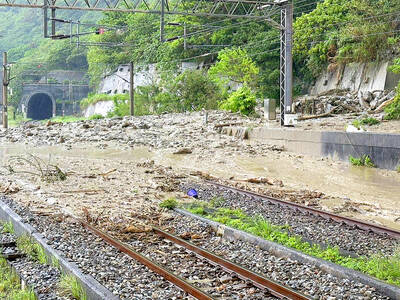
ROLLER-COASTER RIDE: More than five earthquakes ranging from magnitude 4.4 to 5.5 on the Richter scale shook eastern Taiwan in rapid succession yesterday afternoon Back-to-back weather fronts are forecast to hit Taiwan this week, resulting in rain across the nation in the coming days, the Central Weather Administration said yesterday, as it also warned residents in mountainous regions to be wary of landslides and rockfalls. As the first front approached, sporadic rainfall began in central and northern parts of Taiwan yesterday, the agency said, adding that rain is forecast to intensify in those regions today, while brief showers would also affect other parts of the nation. A second weather system is forecast to arrive on Thursday, bringing additional rain to the whole nation until Sunday, it

CONDITIONAL: The PRC imposes secret requirements that the funding it provides cannot be spent in states with diplomatic relations with Taiwan, Emma Reilly said China has been bribing UN officials to obtain “special benefits” and to block funding from countries that have diplomatic ties with Taiwan, a former UN employee told the British House of Commons on Tuesday. At a House of Commons Foreign Affairs Committee hearing into “international relations within the multilateral system,” former Office of the UN High Commissioner for Human Rights (OHCHR) employee Emma Reilly said in a written statement that “Beijing paid bribes to the two successive Presidents of the [UN] General Assembly” during the two-year negotiation of the Sustainable Development Goals. Another way China exercises influence within the UN Secretariat is

CHINA REACTS: The patrol and reconnaissance plane ‘transited the Taiwan Strait in international airspace,’ the 7th Fleet said, while Taipei said it saw nothing unusual The US 7th Fleet yesterday said that a US Navy P-8A Poseidon flew through the Taiwan Strait, a day after US and Chinese defense heads held their first talks since November 2022 in an effort to reduce regional tensions. The patrol and reconnaissance plane “transited the Taiwan Strait in international airspace,” the 7th Fleet said in a news release. “By operating within the Taiwan Strait in accordance with international law, the United States upholds the navigational rights and freedoms of all nations.” In a separate statement, the Ministry of National Defense said that it monitored nearby waters and airspace as the aircraft

Taiwan’s first drag queen to compete on the internationally acclaimed RuPaul’s Drag Race, Nymphia Wind (妮妃雅), was on Friday crowned the “Next Drag Superstar.” Dressed in a sparkling banana dress, Nymphia Wind swept onto the stage for the final, and stole the show. “Taiwan this is for you,” she said right after show host RuPaul announced her as the winner. “To those who feel like they don’t belong, just remember to live fearlessly and to live their truth,” she said on stage. One of the frontrunners for the past 15 episodes, the 28-year-old breezed through to the final after weeks of showcasing her unique


 RSS
RSS