


In the digital music market, France is singing a different tune.
A bill under debate in the French Parliament may require iPods to be able to play music purchased from competing Internet services, not just Apple Computer's own iTunes Music Store, forcing changes in the business model that gave rise to the revolution in legal digital music downloads.
The outcome of the debate, which began as an update to French copyright law, is far from clear. But taken to one logical conclusion, the legislation could lead Apple, the market leader, to leave the French music business, said Jonathan Arber, a research analyst in London at the technology consultancy Ovum.
"My gut feeling is that Apple will simply pull out of France if these amendments get through," Arber said. "Weighed against breaking their business model for all markets, it doesn't make sense for Apple to continue operating with the iPod and iTunes in France."
Debate lasted late into Thursday night; a vote in the National Assembly is set for next week. The bill, which also proposes to turn individual digital piracy into a violation no more serious than a parking ticket, would go next to the Senate, where it is unlikely to be altered significantly, political analysts say.
Some critics say the plan is technically unworkable, unfairly undermines Apple and opens the door to more piracy by crippling technology that protects copyrights. Supporters see France setting a long-overdue legal precedent that opens Apple's closed iPod-iTunes digital music system to competition.
Apple would not comment on the legislation. Led by chief executive Steve Jobs, Apple persuaded the world's major record labels in 2003 to sell songs over the Internet at US$0.99 each through the iTunes Music Store.
But the price of making it inexpensive, easy and attractive for consumers to buy online -- rather than sharing songs on the Internet without compensating record companies or musicians -- was the use of Apple's proprietary formats, making song buyers beholden to Apple and its players, which account for more than 70 percent of all devices sold.
The broad backing of Apple by music industry executives has turned into public and private griping over the company's control over the price of iTunes downloads and the domination of the highly profitable iPod, at what they see as the industry's expense.
The amendments proposed by the government, tacked onto what is being called the author's rights law, originate in part from a European view of the economy that makes it more acceptable there than in the US for governments to order competition in the marketplace for the benefit of consumers.
Renaud Donnedieu de Vabres, the minister of culture, told the Paris newspaper Liberation, "I want to give the Internet world and the cultural industries a secure legal structure to permit a real development -- or even explosion -- of online cultural offerings."
He added, "Everyone will be able to choose."
France is the third-largest digital music market in Europe, after the UK and Germany, according to GfK, a market research company based in Nuremberg, Germany. Downloads in France last year totaled 20 million songs worth US$23.3 million, while 4.7 million digital music players were sold, the company said.
As of Thursday, the copyright bill still had more than 400 amendments, many of them having to do with how devices interoperate. The most prominently affected device would be the iPod, but Sony's Walkman digital music players operate on a similar principle. In both cases, purchased online music can be transferred to the hardware only from a site owned by the same company -- the iTunes Music Store for iPods and Sony Connect for the Walkman. Sony declined to comment.
The development is especially rich in irony for Microsoft, a target of European antitrust action, which licenses its digital music format, called WMA, to any company willing to pay for it. Most non-Apple digital music players, like those produced by Samsung, Creative and Archos, allow WMA songs, while most online music merchants, like Rhapsody from RealNetworks, Music Now from America Online and Napster, sell songs in that format.

Taiwan has experienced its most significant improvement in the QS World University Rankings by Subject, data provided on Sunday by international higher education analyst Quacquarelli Symonds (QS) showed. Compared with last year’s edition of the rankings, which measure academic excellence and influence, Taiwanese universities made great improvements in the H Index metric, which evaluates research productivity and its impact, with a notable 30 percent increase overall, QS said. Taiwanese universities also made notable progress in the Citations per Paper metric, which measures the impact of research, achieving a 13 percent increase. Taiwanese universities gained 10 percent in Academic Reputation, but declined 18 percent

Chinese President Xi Jinping (習近平) yesterday met with former president Ma Ying-jeou (馬英九) at the Great Hall of the People in Beijing, with Xi’s opening statement once more emphasizing that people on both sides of the Taiwan Strait are Chinese and that foreign intervention cannot change their inevitable unification. Xi said that 5,000 years of history of zhonghua minzu (中華民族, ethnic Chinese group) have seen their ancestors move to Taiwan to establish new lives, while also documenting them fighting side-by-side against foreign forces and finally freeing Taiwan. “Both sides are Chinese,” and there are no issues that cannot be worked through, he
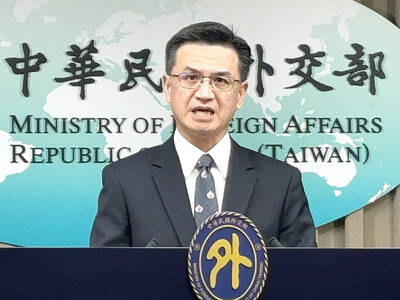
BULLY TACTICS: Beijing has continued its incursions into Taiwan’s airspace even as Xi Jinping talked about Taiwan being part of the Chinese family and nation China should stop its coercion of Taiwan and respect mainstream public opinion in Taiwan about sovereignty if its expression of goodwill is genuine, the Ministry of Foreign Affairs (MOFA) said yesterday. Ministry spokesman Jeff Liu (劉永健) made the comment in response to media queries about a meeting between former president Ma Ying-jeou (馬英九) and Chinese President Xi Jinping (習近平) the previous day. Ma voiced support for the so-called “1992 consensus,” while Xi said that although the two sides of the Taiwan Strait have “different systems,” this does not change the fact that they are “part of the same country,” and that “external

UNDER DISCUSSION: The combatant command would integrate fast attack boat and anti-ship missile groups to defend waters closest to the coastline, a source said The military could establish a new combatant command as early as 2026, which would be tasked with defending Taiwan’s territorial waters 24 nautical miles (44.4km) from the nation’s coastline, a source familiar with the matter said yesterday. The new command, which would fall under the Naval Command Headquarters, would be led by a vice admiral and integrate existing fast attack boat and anti-ship missile groups, along with the Naval Maritime Surveillance and Reconnaissance Command, said the source, who asked to remain anonymous. It could be launched by 2026, but details are being discussed and no final timetable has been announced, the source


 RSS
RSS