


South Korea's central bank signalled its faith in the country's economic revival yesterday by raising a key interest rate to stifle inflationary pressure produced by a long-awaited uptick in consumer spending.
The Bank of Korea jacked up the inter-bank overnight call-rate target for this month by 0.25 percentage points to 3.75 percent. The rate was held steady last month after a quarter-point rise in October.
The anti-inflation move came two days after the bank forecast the economy would grow five percent next year, up from this year's projected 3.9 percent, thanks to a recovery in consumer spending and brisk exports.
"There was some discussion on whether the call rate should be raised this month or next month but we have decided to do it this month in order to avoid adding uncertainty over this issue," the bank's governor, Park Seung, said.
"Presently, the rate is still lower than what is considered a neutral level but the gap has been narrowed much," he said in reference to an interest rate which would neither stoke nor curb an economic expansion.
Consumer confidence also improved last month for a third consecutive month, the National Statistical Office said yesterday.
Vice Finance Minister Bahk Byong-won said that the rate increase showed "confidence" about an economic turnaround.
"But private spending remains sluggish and weak investment sentiment also raises concerns over the slow pace of recovery," he told reporters.
Separately, Japan's central bank chief hit back yesterday at government pressure to keep flooding the financial system with cash, saying that the world's second-largest economy looked set to finally emerge from deflation next year.
"The possibility of departing from the present monetary policy framework is likely to increase over the course of fiscal 2006," Bank of Japan Governor Toshihiko Fukui said.
Prime Minister Junichiro Koizumi, in a rare warning to the autonomous central bank, has voiced caution about ending the stimulative monetary policy and warned Japan may not have whipped its decade-old scourge of deflation.
But the central bank has said it will keep its policy only until the consumer price index (CPI), an inflation gauge that excludes volatile food prices, shows a year-on-year change of zero or positive growth.
"The CPI figures for January through March 2006 are expected to show relatively clear positive year-on-year increases," Fukui told a lecture meeting in the central city of Nagoya, according to a central bank transcript.
Fukui -- who had met on Wednesday with Koizumi -- warned that the government should not think the central bank will bow to its pressure.
"Risks would emerge if we were at the government's beck and call, because [it could lead to] concerns of inflation," he said
He said the inflation index was likely to be in the clear as the effects were fading of lower electricity and telephone charges and rice prices.
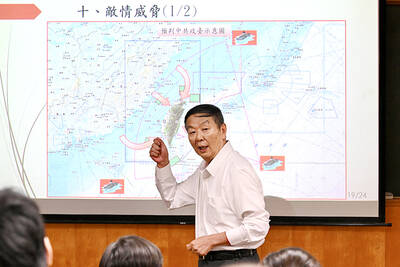
RETHINK? The defense ministry and Navy Command Headquarters could take over the indigenous submarine project and change its production timeline, a source said Admiral Huang Shu-kuang’s (黃曙光) resignation as head of the Indigenous Submarine Program and as a member of the National Security Council could affect the production of submarines, a source said yesterday. Huang in a statement last night said he had decided to resign due to national security concerns while expressing the hope that it would put a stop to political wrangling that only undermines the advancement of the nation’s defense capabilities. Taiwan People’s Party Legislator Vivian Huang (黃珊珊) yesterday said that the admiral, her older brother, felt it was time for him to step down and that he had completed what he
Taiwan has experienced its most significant improvement in the QS World University Rankings by Subject, data provided on Sunday by international higher education analyst Quacquarelli Symonds (QS) showed. Compared with last year’s edition of the rankings, which measure academic excellence and influence, Taiwanese universities made great improvements in the H Index metric, which evaluates research productivity and its impact, with a notable 30 percent increase overall, QS said. Taiwanese universities also made notable progress in the Citations per Paper metric, which measures the impact of research, achieving a 13 percent increase. Taiwanese universities gained 10 percent in Academic Reputation, but declined 18 percent
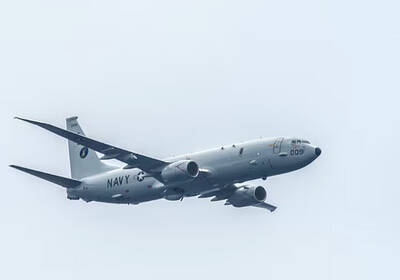
CHINA REACTS: The patrol and reconnaissance plane ‘transited the Taiwan Strait in international airspace,’ the 7th Fleet said, while Taipei said it saw nothing unusual The US 7th Fleet yesterday said that a US Navy P-8A Poseidon flew through the Taiwan Strait, a day after US and Chinese defense heads held their first talks since November 2022 in an effort to reduce regional tensions. The patrol and reconnaissance plane “transited the Taiwan Strait in international airspace,” the 7th Fleet said in a news release. “By operating within the Taiwan Strait in accordance with international law, the United States upholds the navigational rights and freedoms of all nations.” In a separate statement, the Ministry of National Defense said that it monitored nearby waters and airspace as the aircraft

UNDER DISCUSSION: The combatant command would integrate fast attack boat and anti-ship missile groups to defend waters closest to the coastline, a source said The military could establish a new combatant command as early as 2026, which would be tasked with defending Taiwan’s territorial waters 24 nautical miles (44.4km) from the nation’s coastline, a source familiar with the matter said yesterday. The new command, which would fall under the Naval Command Headquarters, would be led by a vice admiral and integrate existing fast attack boat and anti-ship missile groups, along with the Naval Maritime Surveillance and Reconnaissance Command, said the source, who asked to remain anonymous. It could be launched by 2026, but details are being discussed and no final timetable has been announced, the source


 RSS
RSS