


Deep in a vast hole in the earth, huge trucks crawl about like insects on a mission: This is Chuquicamata, the world's biggest open pit mine, an oddball tourist draw in Chile's desert and the origin of tonne after tonne of China-bound copper.
Every afternoon, a bus belonging to Codelco, the world's biggest copper concern, drops about 50 visitors off at a viewing area with an eye-popping panoramic view of the pit mine, in the middle of the Atacama desert, about 1,000km north of Santiago.
"We get about 35,000 visits every year" plus schoolchildren and technicians, spokesman Patricio Huerta says.
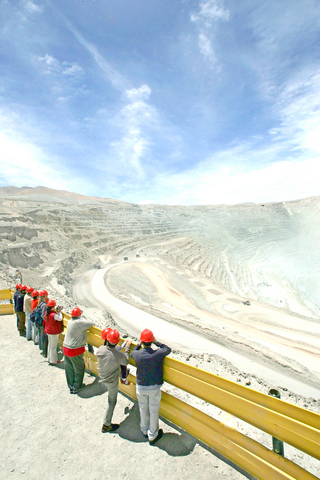
PHOTO: AFP
Many are backpacking young people, particularly Europeans, who follow the route of fabled Argentine-Cuban "guerrillero" Ernesto "Che" Guevara, who back in 1952 spent time at "Chuqui" learning about the grim conditions in which miners were living.
Like all of Chile's biggest mining operations, copper mining at that time was in the hands of US investors, namely the Guggenheim brothers.
In 1971, then-president Salvador Allende nationialized the mines and Codelco workers are widely considered to be blessed with good pay and working conditions.
Over the past 90 years as industrial development spiralled worldwide, Chuquicamata grew.
Additional mines nearby were opened such as Radomiro Tomic and Mina Sur.
But they pale in all comparisons to the impressive "Chuqui," which stretches 4.3km long, 3km wide and and plunges 825m down into the earth.
Copper prices' upward march on world markets, and soaring Chinese demand, are plain to see at Chuquicamata, where the business of bringing out the ore roars on 24 hours a day.
Jorge Tenorio, 56, watches with an expert's knowing stare as huge red plates of copper -- fresh out of the foundry-refinery -- are marked with "CCC" (Compaqma Codelco Chile) and loaded up before being sent to port at Antofagasta and Mejillones for export.
"It has been a year or two that shipments have been really strong to Asia -- to China and South Korea. It used to be mainly to the United States and Europe. Now, there are Chinese missions, Chinese who come to see `Chuqui,'" says Tenorio, who is in charge of the copper refinery's shipping unit. "They take a lot of pictures, ask questions, and see our products."
"There are Chinese engineers who come to check on our prod-ucts. They are really interested," Tenorio said. "They are demanding, but our product is top-notch."
Codelco has stepped up development of the north section of the mine, on which Codelco now relies heavily, to try to push annual output from the three Atacama desert mines from 900,000 tonnes -- 65 percent of Codelco's output -- to more than a million tonnes a year.
And plans are under way to take Chuqui wider and deeper. For now, the copper is not close to running out.
Experts estimate that in 90 years of operation, only about one third of the copper in the area has been mined.
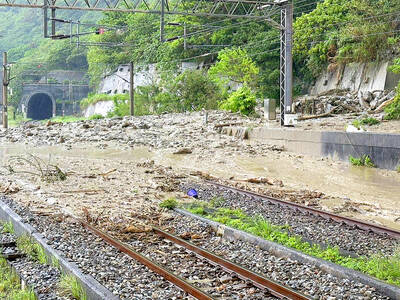
ROLLER-COASTER RIDE: More than five earthquakes ranging from magnitude 4.4 to 5.5 on the Richter scale shook eastern Taiwan in rapid succession yesterday afternoon Back-to-back weather fronts are forecast to hit Taiwan this week, resulting in rain across the nation in the coming days, the Central Weather Administration said yesterday, as it also warned residents in mountainous regions to be wary of landslides and rockfalls. As the first front approached, sporadic rainfall began in central and northern parts of Taiwan yesterday, the agency said, adding that rain is forecast to intensify in those regions today, while brief showers would also affect other parts of the nation. A second weather system is forecast to arrive on Thursday, bringing additional rain to the whole nation until Sunday, it
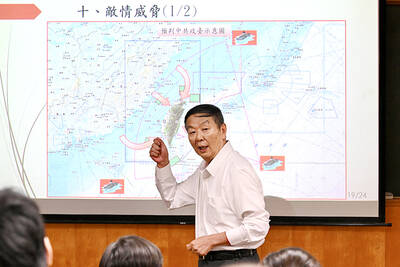
RETHINK? The defense ministry and Navy Command Headquarters could take over the indigenous submarine project and change its production timeline, a source said Admiral Huang Shu-kuang’s (黃曙光) resignation as head of the Indigenous Submarine Program and as a member of the National Security Council could affect the production of submarines, a source said yesterday. Huang in a statement last night said he had decided to resign due to national security concerns while expressing the hope that it would put a stop to political wrangling that only undermines the advancement of the nation’s defense capabilities. Taiwan People’s Party Legislator Vivian Huang (黃珊珊) yesterday said that the admiral, her older brother, felt it was time for him to step down and that he had completed what he

CONDITIONAL: The PRC imposes secret requirements that the funding it provides cannot be spent in states with diplomatic relations with Taiwan, Emma Reilly said China has been bribing UN officials to obtain “special benefits” and to block funding from countries that have diplomatic ties with Taiwan, a former UN employee told the British House of Commons on Tuesday. At a House of Commons Foreign Affairs Committee hearing into “international relations within the multilateral system,” former Office of the UN High Commissioner for Human Rights (OHCHR) employee Emma Reilly said in a written statement that “Beijing paid bribes to the two successive Presidents of the [UN] General Assembly” during the two-year negotiation of the Sustainable Development Goals. Another way China exercises influence within the UN Secretariat is
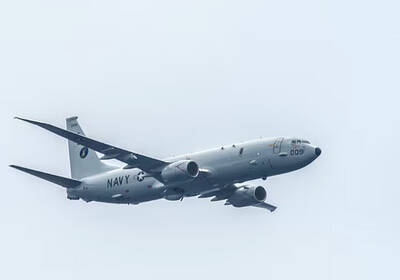
CHINA REACTS: The patrol and reconnaissance plane ‘transited the Taiwan Strait in international airspace,’ the 7th Fleet said, while Taipei said it saw nothing unusual The US 7th Fleet yesterday said that a US Navy P-8A Poseidon flew through the Taiwan Strait, a day after US and Chinese defense heads held their first talks since November 2022 in an effort to reduce regional tensions. The patrol and reconnaissance plane “transited the Taiwan Strait in international airspace,” the 7th Fleet said in a news release. “By operating within the Taiwan Strait in accordance with international law, the United States upholds the navigational rights and freedoms of all nations.” In a separate statement, the Ministry of National Defense said that it monitored nearby waters and airspace as the aircraft


 RSS
RSS