


Under a barrage of criticism that Wal-Mart Stores Inc is bad for the overall economy, the world's largest company is taking a public look at itself.
In an unusual move, Wal-Mart is sponsoring a gathering of noted economists who will debate the company's impact on the economy and individual communities. The session, to be held today in Washington, is Wal-Mart's latest step in a campaign to appear more open and repair its reputation among investors, politicians, employees and consumers.
Wal-Mart has built a US$285 billion machine on a low-cost model whose prices have given it a competitive edge over its rivals. Now, even as the discounter prepares for the holiday season with a public pledge to be even more aggressive on prices, it faces a dilemma on how to continue its momentum while also appeasing its critics. Negative publicity has already hurt its stock price and a tough economy has slowed its sales growth.
But holding an economic conference, to be attended by about 80 people from the press and academia, is a risky strategy. Some unflattering assessments of Wal-Mart are expected to be presented, according to papers obtained by journalists. Even some supporters who were presen-ting upbeat studies raised doubts about the retailer's business model.
"Wal-Mart has brought lower prices to people, but some of Wal-Mart's labor practices are questionable," said Jerry Hausman, economics professor at the Massachusetts Institute of Technology. His study found that Wal-Mart's entry into the food business has forced supermarkets to lower their prices by 5 percent more than they had planned, straining their profitability.
Wal-Mart's critics have argued that the retailer's low-cost model comes at the expense of the economy; its pay and benefits drive down those at other companies trying to compete. The retailer's low benefits have also forced employees to rely on Medicaid as a safety net, squeezing state coffers, they say. Opponents also believe that Wal-Mart destroys communities and creates retail sprawl.
The retailer has long argued that its low prices raise the standard of living for consumers, particularly low-income shoppers, and help control inflation.
"This is a first step in engaging in a dialogue that will be important to this company and to this country," said Nate Hurst, a Wal-Mart spokesman, though he ac-knowledged that holding the conference carries some risks because of the possibility of negative comments about the company.
The company hired Global Insight Inc, a forecasting company in Waltham, Massachusetts, to conduct a year-long economic analysis, giving economists unfettered access to internal wage and benefits data. All papers will be available for the public and posted on Global Insight's Web site today.
Wal-Mart's opponents believe the company's efforts are better spent elsewhere.
"We don't need additional studies to show us what we already know," said Chris Kofinis, a spokesman at the union-backed Wake Up Wal-Mart, one of the most vocal Wal-Mart critics. "Instead of supporting conferences, it should focus on its core problems and failures that it knows already exists."
Wal-Mart is growing more worried that the bad publicity is keeping some shoppers away from their stores, according to an internal memo made public by Wal-Mart Watch on Monday.
The August last year memo, drawn up by consulting firm McKinsey & Co, reported that 2 percent to 8 percent of 1,800 shoppers polled had stopped shopping at the retailer because of the negative press.
What could make things worse is Robert Greenwald's scathing documentary called Wal-Mart: The High Cost of Low Prices, which will have a limited theatrical release on Nov. 4 in New York and Los Angeles and then go to a week of screenings at 7,000 locations including churches, homes and libraries across the country organized by Wal-Mart critics.
Organizers hope to use the movie as a tool to accelerate the movement against Wal-Mart.
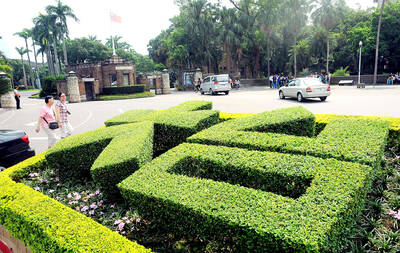
Taiwan has experienced its most significant improvement in the QS World University Rankings by Subject, data provided on Sunday by international higher education analyst Quacquarelli Symonds (QS) showed. Compared with last year’s edition of the rankings, which measure academic excellence and influence, Taiwanese universities made great improvements in the H Index metric, which evaluates research productivity and its impact, with a notable 30 percent increase overall, QS said. Taiwanese universities also made notable progress in the Citations per Paper metric, which measures the impact of research, achieving a 13 percent increase. Taiwanese universities gained 10 percent in Academic Reputation, but declined 18 percent
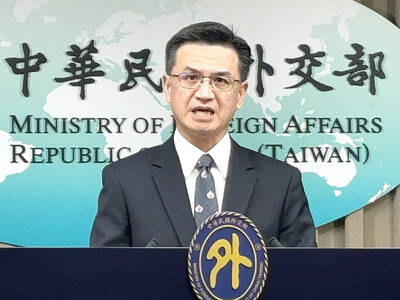
BULLY TACTICS: Beijing has continued its incursions into Taiwan’s airspace even as Xi Jinping talked about Taiwan being part of the Chinese family and nation China should stop its coercion of Taiwan and respect mainstream public opinion in Taiwan about sovereignty if its expression of goodwill is genuine, the Ministry of Foreign Affairs (MOFA) said yesterday. Ministry spokesman Jeff Liu (劉永健) made the comment in response to media queries about a meeting between former president Ma Ying-jeou (馬英九) and Chinese President Xi Jinping (習近平) the previous day. Ma voiced support for the so-called “1992 consensus,” while Xi said that although the two sides of the Taiwan Strait have “different systems,” this does not change the fact that they are “part of the same country,” and that “external
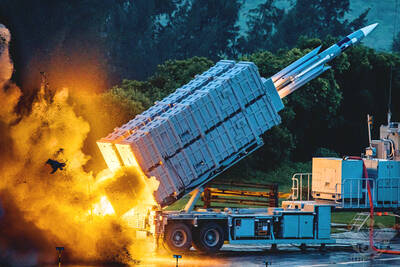
UNDER DISCUSSION: The combatant command would integrate fast attack boat and anti-ship missile groups to defend waters closest to the coastline, a source said The military could establish a new combatant command as early as 2026, which would be tasked with defending Taiwan’s territorial waters 24 nautical miles (44.4km) from the nation’s coastline, a source familiar with the matter said yesterday. The new command, which would fall under the Naval Command Headquarters, would be led by a vice admiral and integrate existing fast attack boat and anti-ship missile groups, along with the Naval Maritime Surveillance and Reconnaissance Command, said the source, who asked to remain anonymous. It could be launched by 2026, but details are being discussed and no final timetable has been announced, the source
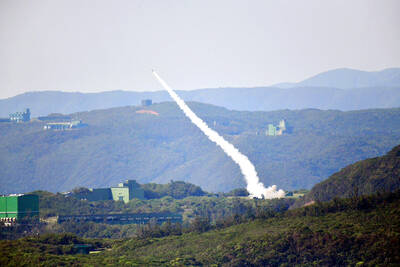
SHOT IN THE ARM: The new system can be integrated with Avenger and Stinger missiles to bolster regional air defense capabilities, a defense ministry report said Domestically developed Land Sword II (陸射劍二) missiles were successfully launched and hit target drones during a live-fire exercise at the Jiupeng Military Base in Pingtung County yesterday. The missiles, developed by the Chungshan Institute of Science and Technology (CSIST), were originally scheduled to launch on Tuesday last week, after the Tomb Sweeping Day holiday long weekend, but were postponed to yesterday due to weather conditions. Local residents and military enthusiasts gathered outside the base to watch the missile tests, with the first one launching at 9:10am. The Land Sword II system, which is derived from the Sky Sword II (天劍二) series, was turned


 RSS
RSS