


With the US economy showing resilience in the face of hurricanes and high energy costs, the Federal Reserve is expected to lift interest rates this week for the 12th time in as many meetings, analysts say.
The Federal Open Market Committee was expected to boost the federal funds rate by 25 basis points to 4.0 percent, sticking to Fed chairman Alan Greenspan's policy of gradual rate hikes.
Economists say Greenspan, who is stepping down in January after 18 years at the helm of the central bank, wants to ward off inflationary pressures and bring rates back to a "neutral" level after a long period of stimulation.
Richard Berner at Morgan Stanley said recent comments from Fed officials are meant to send a message that the central bank will not let inflation get out of control.
"A chorus of hawkish commentary from Fed officials has made it clear to market participants that a pause in the move to a `neutral' policy stance is unlikely," Berner said, adding that the Fed could go beyond "neutral" to a policy of "restraint" that attempts to cool off economic growth and inflation.
"With inflation expectations drifting higher, slack in the economy continuing to shrink and the chance that surging energy prices will filter into core rates of inflation, I think inflation risks are drifting higher. Thus, we think the Fed will move modestly to restraint, taking the federal funds rate to 5.0 percent over the course of 2006," he said.
Other analysts say the rate hike tomorrow is a certainty but that the future course for the Fed remains murky.
Avery Shenfeld at CIBC World Markets said the latest report showing a 3.8 percent growth pace in the third quarter despite Hurricane Katrina and record energy prices "has to be considered strong by all accounts," and added: "That will back the case for a rate hike next week and one to follow in December."
But he said there are signs of softening economic conditions, "most notably in the stretched conditions of household finances."
Many analysts say the slowdown in the economy will become evident in the fourth quarter, as debt-strapped consumers cope with high heating costs.
"If consumers start to slow down in the fourth quarter, that will be a key signal that Fed hikes [and high energy costs] are finally starting to bite," he said.
Steven Wieting at Citigroup agreed that consumers, who account for two-thirds of US economic activity, may start pulling back on spending soon.
"Energy costs took a bigger bite out of consumer incomes and will have even greater effect in the next few months, through several channels," Wieting said.
Some analysts argue that the Fed is dangerously close to pushing the economy into a downturn by lifting rates.
Josh Bivens of the Economic Policy Institute, a labor-oriented think tank, said the Fed faces the unusual situation of energy inflation while "core" prices, excluding food and energy, are stable -- rising at a 1.2 percent pace.
"Unfortunately, energy costs cannot be profitably addressed through Federal Reserve policy, and raising rates in response to them will only make the economic circumstances of American families even worse," he said.
But Brian Wesbury at Claymore Research said the economy is stronger than recent figures suggest, in part because the Fed has held rates low for too long.
"Despite widespread pessimism about hurricanes, energy prices, consumer debt, trade deficits and housing bubbles, the economy continues to grow at a remarkable pace," Wesbury said.
"This is because tax rates remain low, productivity continues to accelerate and Fed policy is still accommodative. However, overall inflation is on the rise," he said.
Deutsche Bank economists Peter Hooper and Joseph LaVorgna said they see the Fed continuing rate hikes under Ben Bernanke, who was nominated to replace Greenspan next year.
"This appointment will not significantly alter our expectations for monetary policy. We still see the Fed getting to 5.0 percent on the funds rate next year," they wrote.
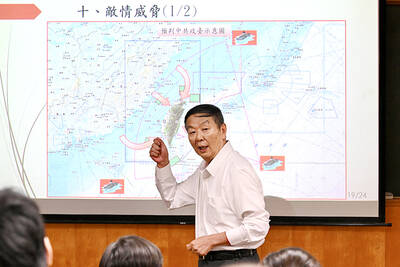
RETHINK? The defense ministry and Navy Command Headquarters could take over the indigenous submarine project and change its production timeline, a source said Admiral Huang Shu-kuang’s (黃曙光) resignation as head of the Indigenous Submarine Program and as a member of the National Security Council could affect the production of submarines, a source said yesterday. Huang in a statement last night said he had decided to resign due to national security concerns while expressing the hope that it would put a stop to political wrangling that only undermines the advancement of the nation’s defense capabilities. Taiwan People’s Party Legislator Vivian Huang (黃珊珊) yesterday said that the admiral, her older brother, felt it was time for him to step down and that he had completed what he

Taiwan has experienced its most significant improvement in the QS World University Rankings by Subject, data provided on Sunday by international higher education analyst Quacquarelli Symonds (QS) showed. Compared with last year’s edition of the rankings, which measure academic excellence and influence, Taiwanese universities made great improvements in the H Index metric, which evaluates research productivity and its impact, with a notable 30 percent increase overall, QS said. Taiwanese universities also made notable progress in the Citations per Paper metric, which measures the impact of research, achieving a 13 percent increase. Taiwanese universities gained 10 percent in Academic Reputation, but declined 18 percent
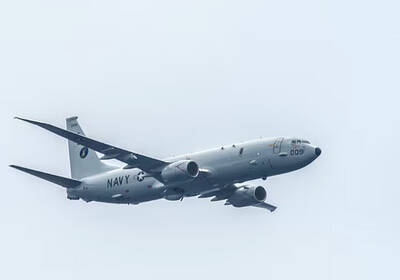
CHINA REACTS: The patrol and reconnaissance plane ‘transited the Taiwan Strait in international airspace,’ the 7th Fleet said, while Taipei said it saw nothing unusual The US 7th Fleet yesterday said that a US Navy P-8A Poseidon flew through the Taiwan Strait, a day after US and Chinese defense heads held their first talks since November 2022 in an effort to reduce regional tensions. The patrol and reconnaissance plane “transited the Taiwan Strait in international airspace,” the 7th Fleet said in a news release. “By operating within the Taiwan Strait in accordance with international law, the United States upholds the navigational rights and freedoms of all nations.” In a separate statement, the Ministry of National Defense said that it monitored nearby waters and airspace as the aircraft

UNDER DISCUSSION: The combatant command would integrate fast attack boat and anti-ship missile groups to defend waters closest to the coastline, a source said The military could establish a new combatant command as early as 2026, which would be tasked with defending Taiwan’s territorial waters 24 nautical miles (44.4km) from the nation’s coastline, a source familiar with the matter said yesterday. The new command, which would fall under the Naval Command Headquarters, would be led by a vice admiral and integrate existing fast attack boat and anti-ship missile groups, along with the Naval Maritime Surveillance and Reconnaissance Command, said the source, who asked to remain anonymous. It could be launched by 2026, but details are being discussed and no final timetable has been announced, the source


 RSS
RSS