


The intensifying battle between the two main technologies in the burgeoning flat-panel TV market -- and their main proponents -- is crystal clear at Japan's annual electronics show this week.
In one corner of the sprawling hall, Matsushita shows off its prototype 50-inch plasma display panel (PDP) that has the same brightness and clarity achieved so far only in larger models.
Sharp Corp, meanwhile, is pushing its upgraded liquid crystal display (LCD) televisions that it says aren't fuzzy when viewed from an angle -- a complaint in the past.
Like the competition between the next-generation DVD formats, HD DVD and Blu-ray Disc, also being highlighted at the CEATEC show in Chiba, just east of Tokyo, the competition between display technologies is heating up with the arrival of high-definition video and broadcast.
The switch
Industry experts say people are gradually expected to start switching from conventional cathode ray tube sets, which require far more space, to flat-panel TVs.
That could be the moneymaking opportunity that Japanese electronics makers have been yearning for after seeing their profits battered in recent years from plunging prices and fresh competition from cheaper Taiwanese and South Korean makers.
Matsushita Electric Industrial Co, maker of Panasonic products, has long been considered a leader in the TV industry, but Sharp is emerging as its main rival in the business -- not one-time leader Sony, which is undergoing a huge job-cut program to turn around its money-losing business.
"The focus of CEATEC is the flat television," Fumio Ohtsubo, a senior managing director who oversees Matsushita's TV business, said recently. "We're always watching to monitor Sharp's operations."
The annual show, called Combined Exhibition of Advanced Technologies, runs through tomorrow.
The two technologies -- LCD and PDP -- each have their strengths and weaknesses.
LCDs have been criticized as less accurate than PDPs in depicting fast-moving images like a soccer ball in flight.
With the latest upgrade, Sharp LCDs respond as quickly as four milliseconds, down from six milliseconds, said Sharp official Satoshi Fujioka, who was demonstrating that the LCD image of chestnuts didn't blur even when scrolled fast across the screen.
Sharp is also showing a new LCD that delivers excellent contrast even in dark places -- a feature that for now gives plasma-display panels a leg up over LCDs. Sharp plans to start offering the technology some time after April 1, targeting professional use in TV studios, where cathode ray tubes still dominate.
Its "megacontrast" technology offers contrast at 1 million to one -- meaning that the brightest spot on the screen is a million times brighter than the darkest spot, according to the Osaka-based manufacturer. LCDs more commonly offer contrast of up to about 1,500 to one, compared with 3,000 or 5,000 to one for plasma displays.
PDPs tend to use more electricity than LCDs, but Matsushita, also based in Osaka, with other companies backing PDP technology had a display at the show at the Makuhari Messe center, with research showing that power consumption has been cut by half for next-generation PDPs.
Time will Tell
John Yang, analyst at Standard & Poor's in Tokyo, believes it's too early to tell which companies will emerge the big winners in the display wars. So far, PDPs are likely to be more popular for larger screens and LCDs for smaller ones.
Due to their technology, LCDs are cheaper to per inch for smaller TVs -- say, smaller than 32 inches -- while PDPs are cheaper per inch for larger sets.
A 32-inch LCD typically sells for around ?200,000 (US$1,750), while a 42-inch PDP sells for around ?350,000 (US$3,100), although prices are affected by other factors such as features and when the product went on sale.
Key to winning would be cost cuts, and how companies can successfully "add value" to a product, be it wood paneling or tie-ups with content, to attract buyers who are willing to pay more, he said.
"With a supply glut next year, the market will weed out the weaker players," Yang said. "It's going to become more and more difficult to add value."
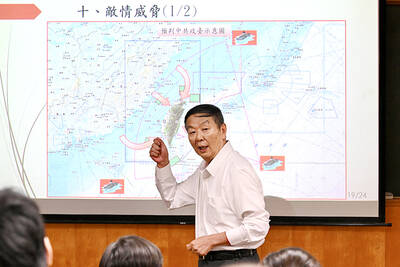
RETHINK? The defense ministry and Navy Command Headquarters could take over the indigenous submarine project and change its production timeline, a source said Admiral Huang Shu-kuang’s (黃曙光) resignation as head of the Indigenous Submarine Program and as a member of the National Security Council could affect the production of submarines, a source said yesterday. Huang in a statement last night said he had decided to resign due to national security concerns while expressing the hope that it would put a stop to political wrangling that only undermines the advancement of the nation’s defense capabilities. Taiwan People’s Party Legislator Vivian Huang (黃珊珊) yesterday said that the admiral, her older brother, felt it was time for him to step down and that he had completed what he
Taiwan has experienced its most significant improvement in the QS World University Rankings by Subject, data provided on Sunday by international higher education analyst Quacquarelli Symonds (QS) showed. Compared with last year’s edition of the rankings, which measure academic excellence and influence, Taiwanese universities made great improvements in the H Index metric, which evaluates research productivity and its impact, with a notable 30 percent increase overall, QS said. Taiwanese universities also made notable progress in the Citations per Paper metric, which measures the impact of research, achieving a 13 percent increase. Taiwanese universities gained 10 percent in Academic Reputation, but declined 18 percent

BULLY TACTICS: Beijing has continued its incursions into Taiwan’s airspace even as Xi Jinping talked about Taiwan being part of the Chinese family and nation China should stop its coercion of Taiwan and respect mainstream public opinion in Taiwan about sovereignty if its expression of goodwill is genuine, the Ministry of Foreign Affairs (MOFA) said yesterday. Ministry spokesman Jeff Liu (劉永健) made the comment in response to media queries about a meeting between former president Ma Ying-jeou (馬英九) and Chinese President Xi Jinping (習近平) the previous day. Ma voiced support for the so-called “1992 consensus,” while Xi said that although the two sides of the Taiwan Strait have “different systems,” this does not change the fact that they are “part of the same country,” and that “external

UNDER DISCUSSION: The combatant command would integrate fast attack boat and anti-ship missile groups to defend waters closest to the coastline, a source said The military could establish a new combatant command as early as 2026, which would be tasked with defending Taiwan’s territorial waters 24 nautical miles (44.4km) from the nation’s coastline, a source familiar with the matter said yesterday. The new command, which would fall under the Naval Command Headquarters, would be led by a vice admiral and integrate existing fast attack boat and anti-ship missile groups, along with the Naval Maritime Surveillance and Reconnaissance Command, said the source, who asked to remain anonymous. It could be launched by 2026, but details are being discussed and no final timetable has been announced, the source


 RSS
RSS