


Malicious hackers could take down cellular networks in large cities by inundating their popular text-messaging services with the equivalent of spam, said computer security researchers, who will announce the findings of their research yesterday.
Such an attack is possible, the researchers say, because cellphone companies provide the text message service to their networks in a way that could allow an attacker who jams the message system to disable the voice network as well.
And because the message services are accessible via the Internet, cellular networks are open to the "denial of service" attacks that occur regularly online, in which computers send so many messages or commands to a target that the rogue data blocks other machines from connecting.
By pushing 165 messages a second into the network, said Patrick McDaniel, a professor of computer science and engineering at Pennsylvania State University and the lead researcher on the paper, "you can congest all of Manhattan."
McDaniel and the other faculty author, Thomas La Porta, have extensive experience in computer security, including work in the telecommunications industry. The findings were to be released yesterday at Penn State, and as a formal research paper at a computer security conference next month.
Cellular companies acknowledge that such attacks are possible, but add that they have developed systems to prevent effective ones.
"If you're not prepared, that could happen," said Brian Scott, senior manager for wireless messaging operations for Sprint. "If you are prepared and you have means in place to identify, detect and mitigate that, it's not as much of a concern."
Other specialists said such systems would face many of the same obstacles as those that try to block denial of service attacks, one of the thorniest problems in countering hackers.
"The solutions don't tend to be very elegant" in the Internet world, said Gary McGraw, chief technical officer of Cigital, a security consultant to the computing and telecommunications industries.
"And I believe it will be the same thing on cellphones."
In their research, the authors concluded that all major cellular networks are vulnerable, and a single computer with a cable modem could do the job.
The researchers do not believe that anyone has disrupted cellphone networks in this way, though it appears to have occurred by accident in other nations.
McGraw, the chief technical officer of Cigital, said the goal of research like the Penn State paper was not to help hackers scale new heights, but to alert companies to problems before someone exploited them.
"It has to be done very responsibly and very carefully," he said. "You don't want people to panic, but you do want them to sit up take notice and do something about it."
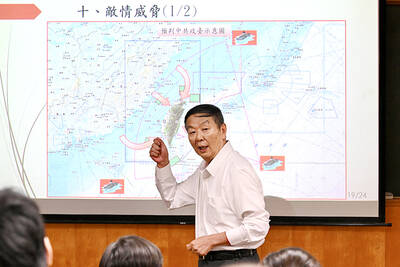
RETHINK? The defense ministry and Navy Command Headquarters could take over the indigenous submarine project and change its production timeline, a source said Admiral Huang Shu-kuang’s (黃曙光) resignation as head of the Indigenous Submarine Program and as a member of the National Security Council could affect the production of submarines, a source said yesterday. Huang in a statement last night said he had decided to resign due to national security concerns while expressing the hope that it would put a stop to political wrangling that only undermines the advancement of the nation’s defense capabilities. Taiwan People’s Party Legislator Vivian Huang (黃珊珊) yesterday said that the admiral, her older brother, felt it was time for him to step down and that he had completed what he
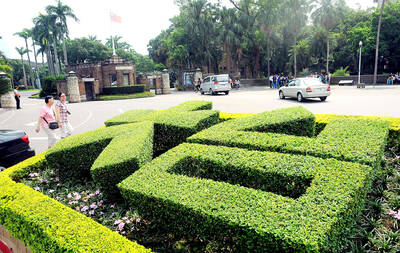
Taiwan has experienced its most significant improvement in the QS World University Rankings by Subject, data provided on Sunday by international higher education analyst Quacquarelli Symonds (QS) showed. Compared with last year’s edition of the rankings, which measure academic excellence and influence, Taiwanese universities made great improvements in the H Index metric, which evaluates research productivity and its impact, with a notable 30 percent increase overall, QS said. Taiwanese universities also made notable progress in the Citations per Paper metric, which measures the impact of research, achieving a 13 percent increase. Taiwanese universities gained 10 percent in Academic Reputation, but declined 18 percent

UNDER DISCUSSION: The combatant command would integrate fast attack boat and anti-ship missile groups to defend waters closest to the coastline, a source said The military could establish a new combatant command as early as 2026, which would be tasked with defending Taiwan’s territorial waters 24 nautical miles (44.4km) from the nation’s coastline, a source familiar with the matter said yesterday. The new command, which would fall under the Naval Command Headquarters, would be led by a vice admiral and integrate existing fast attack boat and anti-ship missile groups, along with the Naval Maritime Surveillance and Reconnaissance Command, said the source, who asked to remain anonymous. It could be launched by 2026, but details are being discussed and no final timetable has been announced, the source
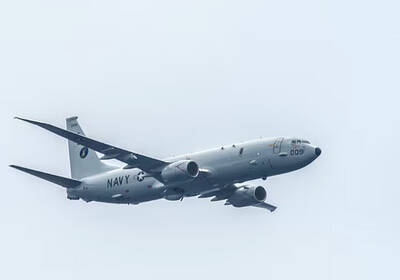
CHINA REACTS: The patrol and reconnaissance plane ‘transited the Taiwan Strait in international airspace,’ the 7th Fleet said, while Taipei said it saw nothing unusual The US 7th Fleet yesterday said that a US Navy P-8A Poseidon flew through the Taiwan Strait, a day after US and Chinese defense heads held their first talks since November 2022 in an effort to reduce regional tensions. The patrol and reconnaissance plane “transited the Taiwan Strait in international airspace,” the 7th Fleet said in a news release. “By operating within the Taiwan Strait in accordance with international law, the United States upholds the navigational rights and freedoms of all nations.” In a separate statement, the Ministry of National Defense said that it monitored nearby waters and airspace as the aircraft


 RSS
RSS