


From behind her big desk on the top floor of a sleek new office tower in Shanghai's Xintiandi district, Angelica Cheung, the guiding hand behind China's new edition of Vogue magazine, contemplated a very Chinese dilemma.
"Just a few years ago, China definitely wasn't ready and didn't have consumers at the level of Vogue," said Cheung, the magazine's editorial director, as smoothly spoken as she was elegant in a black-and-white pattern Max Mara blouse and skirt. "Two years from now, though, would have definitely been too late. That's the way China is, moving incredibly fast."
Fittingly for one of the world's premier fashion magazines, Cheung's offices are in a neighborhood whose name means "new heaven and earth," a roughly three-square-block area that contains some of Shanghai's most stylish real estate. By day or by night, Xintiandi is a stalking ground for young movers and shakers.
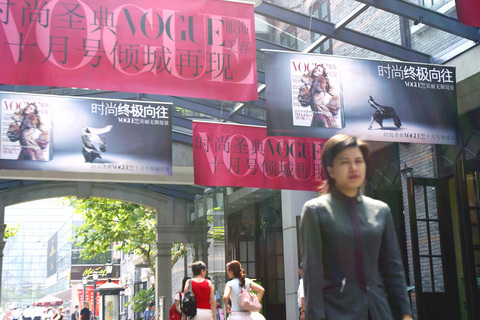
PHOTO: NY TIMES
All over the neighborhood, at bus stops and newsstands, huge reproductions of the magazine's second cover, featuring the leggy Brazilian model Giselle Bundchen wearing a fur-lined coat, beg for attention. The chances are good that the slick crowd here can relate to a Western model and the high-end fashions she is selling. But Vogue's US$8.6 million wager is by necessity about much more than winning over a postage-stamp-size portion of China, and it is not clear how many of the hundreds of millions of Chinese women are willing or able to join the Vogue bandwagon.
Vogue is not alone in its gamble, and in fact the race to create lucrative fashion and lifestyle magazine franchises based on successful Western publications has never been more crowded, with Elle, Cosmopolitan, Harper's Bazaar and Marie Claire already bulging from vendors' racks.
On the men's side of the newsstand, grinning models baring rippling midriffs peer out from the cover of the Chinese edition of Men's Health magazine, first published two years ago. Last May, the competition for the male fitness and lifestyle market was joined by FHM magazine, and there are persistent industry rumors here that two other foreign publications, Maxim and InStyle, will be introduced soon.
"How to pick the right tools and the right girls," was how the editors of FHM described their magazine, which puts scantily clad women on its covers and features purportedly candid talk about sex and relationships from single women.
"We court the metrosexual," Jun Jin, the editor, said. "That's our reader target, 22 to 45, with high education and high salary. They are crazy about new technology and they like dating pretty girls."
By reputation, China is all but closed to foreign news media. After years of involvement with the country, Rupert Murdoch said recently that his efforts to expand in China had "hit a brick wall," adding that Beijing was "quite paranoid about what gets through." In August, Beijing announced a tightening of controls on foreign media, saying this was necessary to "safeguard national culture."
But for now, it seems that Chinese authorities have decided that the fashion magazines, which promote whiter skin -- a popular theme -- Western styles and an obsession with brands, and the men's magazines -- which promote toned bodies and carry lifestyle and sex advice that would not be out of place on a newsstand in New York -- are safe.
Indeed, technically at least, Vogue's Chinese partner is the country's State Council, in whose name edicts like the one on foreign media are issued. All foreign publications in China are required to have a local partner, which must retain at least 51 percent ownership.

Chinese President Xi Jinping (習近平) yesterday met with former president Ma Ying-jeou (馬英九) at the Great Hall of the People in Beijing, with Xi’s opening statement once more emphasizing that people on both sides of the Taiwan Strait are Chinese and that foreign intervention cannot change their inevitable unification. Xi said that 5,000 years of history of zhonghua minzu (中華民族, ethnic Chinese group) have seen their ancestors move to Taiwan to establish new lives, while also documenting them fighting side-by-side against foreign forces and finally freeing Taiwan. “Both sides are Chinese,” and there are no issues that cannot be worked through, he
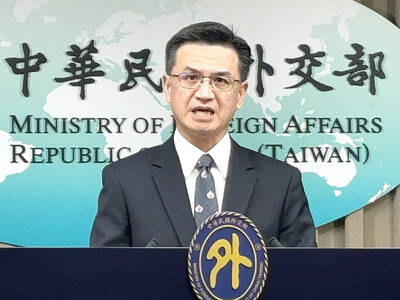
BULLY TACTICS: Beijing has continued its incursions into Taiwan’s airspace even as Xi Jinping talked about Taiwan being part of the Chinese family and nation China should stop its coercion of Taiwan and respect mainstream public opinion in Taiwan about sovereignty if its expression of goodwill is genuine, the Ministry of Foreign Affairs (MOFA) said yesterday. Ministry spokesman Jeff Liu (劉永健) made the comment in response to media queries about a meeting between former president Ma Ying-jeou (馬英九) and Chinese President Xi Jinping (習近平) the previous day. Ma voiced support for the so-called “1992 consensus,” while Xi said that although the two sides of the Taiwan Strait have “different systems,” this does not change the fact that they are “part of the same country,” and that “external

UNDER DISCUSSION: The combatant command would integrate fast attack boat and anti-ship missile groups to defend waters closest to the coastline, a source said The military could establish a new combatant command as early as 2026, which would be tasked with defending Taiwan’s territorial waters 24 nautical miles (44.4km) from the nation’s coastline, a source familiar with the matter said yesterday. The new command, which would fall under the Naval Command Headquarters, would be led by a vice admiral and integrate existing fast attack boat and anti-ship missile groups, along with the Naval Maritime Surveillance and Reconnaissance Command, said the source, who asked to remain anonymous. It could be launched by 2026, but details are being discussed and no final timetable has been announced, the source

CHANGING OF THE GUARD: Wellington Koo would likely take over as defense minister, while Joseph Wu would head the National Security Council, reports said President-elect William Lai (賴清德) yesterday tapped former Cabinet secretary-general Cho Jung-tai (卓榮泰) to be the next premier, to take office after the inauguration on May 20. Lai made the announcement at a news conference in Taipei, at which he unveiled the slogan “an active and innovative Cabinet,” or “AI” Cabinet. Cho, 65, served as the Cabinet secretary-general from September 2005 to January 2006 and again from September 2017 to December 2018, when Lai was premier under President Tsai Ing-wen (蔡英文). Lai stepped down from the post in late December 2018 to run for DPP chairman, a role left vacant following Tsai’s departure after


 RSS
RSS