


Sitting in his dingy office in downtown Moscow, Nikolai, a small-scale retailer, complains that he is struggling to make ends meet because of a relentless rise in corruption under President Vladimir Putin.
The businessman in his mid-30s, who operates five small stalls packed with cosmetics and leather goods, recently was forced to pay US$1,000 to tax police who were threatening to carry out continual checks on his bookkeeping.
Another time he had to buy expensive audio equipment for a police officer who detected minor violations of strict trading regulations.
"They make sure that you end up offering them something to get them off your backs," said the entrepreneur, who admitted to underpaying taxes and would not give his full name for fear of reprisal.
Corruption, a problem in Russia since czarist times, flourished during the chaos of the post-Soviet period under president Boris Yeltsin. Then, well-connected businessmen became billionaires virtually overnight by carving up the nation's resources in allegedly rigged privatizations for a fraction of their value.
Yeltsin's successor Putin, a stern-looking former colonel in the Soviet-era KGB, was elected five years ago promising to set Russia on the path to modernization and impose a "dictatorship of the law" to eliminate graft.
But a study published last month by the respected Indem Institute concluded that bribes paid by businesses to police, licensing bodies and state inspectors have soared nearly 10 times since 2001 to US$316 billion -- equivalent to more than double Russia's federal revenues.
The report found that the average bribe paid by companies had shot up from US$10,000 to US$136,000.
The survey of 1,000 businesses was met with disbelief in some quarters. But the global anti-corruption group Transparency International (TI) and Russia's business-funded National Anti-Corruption Committee estimate the level of graft has jumped as much as sevenfold since 2001.
"Corruption has become the main business in Russia and has taken over the entire system of government," said Kirill Kabanov, who has received death threats for his work as head of the anti-corruption committee.
Russia has risen on the TI scale of corruption, reaching No. 90 last year, along with such countries as Mozambique, Malawi. Three years ago, it had been rated 71. On that scale, the least corrupt is Finland, while Haiti and Bangladesh share the most corrupt spot.
A key turning-point was the politically charged campaign against Russia's erstwhile richest man, Mikhail Khodorkovsky, which the authorities launched in mid-2003, said Indem head Georgy Saratov. The second half of that year saw "headlong growth" in corruption, he said.
The billionaire tycoon was sentenced in May to nine years on fraud and tax evasion charges and his Yukos oil company was dismantled and largely renationalized to pay off multibillion-dollar tax demands.
Putin, who instituted a 13 percent flat income tax in a partly successful attempt to tackle chronic tax evasion, insisted that prosecutors went after Khodorkovsky and Yukos to make an example of a prominent tax cheat.
But Saratov noted the tycoon's public humbling -- which many believe was intended to neutralize a powerful political opponent and cement state control of oil -- has emboldened bureaucrats to declare open season on bribing businesses.
The head of the Russian branch of TI, Yelena Panfilova, believes the most dangerous legacy of the Khodorkovsky affair is that it accelerated a process that took away the last vestiges of the rule of law.
"There is no supremacy of the law. The belief that our courts are independent was always weak, but it has now disappeared completely," she said.
It isn't massive corporations like Yukos that have suffered most, but small and medium-sized enterprises that economists say could provide a durable engine of growth and help diversify Russia's oil-dependent economy.
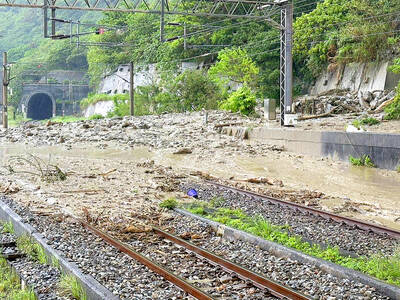
ROLLER-COASTER RIDE: More than five earthquakes ranging from magnitude 4.4 to 5.5 on the Richter scale shook eastern Taiwan in rapid succession yesterday afternoon Back-to-back weather fronts are forecast to hit Taiwan this week, resulting in rain across the nation in the coming days, the Central Weather Administration said yesterday, as it also warned residents in mountainous regions to be wary of landslides and rockfalls. As the first front approached, sporadic rainfall began in central and northern parts of Taiwan yesterday, the agency said, adding that rain is forecast to intensify in those regions today, while brief showers would also affect other parts of the nation. A second weather system is forecast to arrive on Thursday, bringing additional rain to the whole nation until Sunday, it

CONDITIONAL: The PRC imposes secret requirements that the funding it provides cannot be spent in states with diplomatic relations with Taiwan, Emma Reilly said China has been bribing UN officials to obtain “special benefits” and to block funding from countries that have diplomatic ties with Taiwan, a former UN employee told the British House of Commons on Tuesday. At a House of Commons Foreign Affairs Committee hearing into “international relations within the multilateral system,” former Office of the UN High Commissioner for Human Rights (OHCHR) employee Emma Reilly said in a written statement that “Beijing paid bribes to the two successive Presidents of the [UN] General Assembly” during the two-year negotiation of the Sustainable Development Goals. Another way China exercises influence within the UN Secretariat is
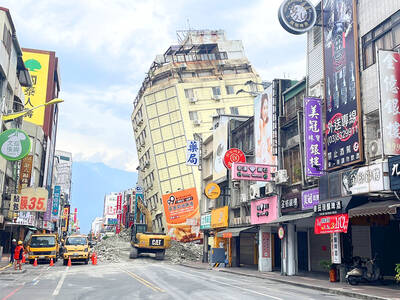
LANDSLIDES POSSIBLE: The agency advised the public to avoid visiting mountainous regions due to more expected aftershocks and rainfall from a series of weather fronts A series of earthquakes over the past few days were likely aftershocks of the April 3 earthquake in Hualien County, with further aftershocks to be expected for up to a year, the Central Weather Administration (CWA) said yesterday. Based on the nation’s experience after the quake on Sept. 21, 1999, more aftershocks are possible over the next six months to a year, the agency said. A total of 103 earthquakes of magnitude 4 on the local magnitude scale or higher hit Hualien County from 5:08pm on Monday to 10:27am yesterday, with 27 of them exceeding magnitude 5. They included two, of magnitude

Taiwan’s first drag queen to compete on the internationally acclaimed RuPaul’s Drag Race, Nymphia Wind (妮妃雅), was on Friday crowned the “Next Drag Superstar.” Dressed in a sparkling banana dress, Nymphia Wind swept onto the stage for the final, and stole the show. “Taiwan this is for you,” she said right after show host RuPaul announced her as the winner. “To those who feel like they don’t belong, just remember to live fearlessly and to live their truth,” she said on stage. One of the frontrunners for the past 15 episodes, the 28-year-old breezed through to the final after weeks of showcasing her unique


 RSS
RSS