


A new wave of bombings on Indonesia's Bail resort island will shake investor confidence at least temporarily, weakening the country's currency and stock market starting today, analysts said.
But the effect on other Asian markets was expected to be limited.
The blasts could hurt Indonesia's tourist industry -- an important foreign exchange source -- withdrawing a key prop for the currency.
Indonesia's investors were already on edge about possible public unrest due to the government's move on Saturday to more than double fuel prices.
"Markets are already nervous that the fuel price hike will trigger social unrest, and on top of that you have these bombs on Bali, which ... could create a lot of uncertainty," said Jakarta-based Standard Chartered economist Fauzi Ichsan.
Indonesia's economy is expected to grow at an average annual pace of 6.6 percent over the next five years, said Planning Minister Sri Mulyani Indrawati.
"We are still looking at average growth of 6.6 percent over the next five years, reaching 7.2 percent in 2009," Sri Mulyani said today at the World Islamic Economic Forum in Petaling Jaya, Malaysia.
Growth in Southeast Asia's largest economy slowed for the second straight quarter to 5.5 percent in the three months to June 30 as rising fuel prices and higher interest rates curbed consumer spending.
Saturday's bombing on the Indonesian resort island of Bali, which killed at least 25 people, and the growing threat of a bird flu epidemic may crimp growth further.
"In Bali, tourism is going to take another deep hit," said Bruce Gale, a political risk analyst at Hill & Associates Ltd. in Singapore. "The Indonesia economy will not be hit to the same extent as it was after the first Bali bombing. The first one was completely unexpected, and this one, although a bit of a surprise, was not totally unexpected."
Bali, a mountainous island east of Java known for its terraced rice paddies and temples, is one of the nation's biggest tourist attractions.
Standard and Poor's estimates that tourism accounts for about 5 percent of Indonesia's US$258 billion economy and employs 8 million people.
Indonesia's tourism industry was also hurt by Asia's 2003 outbreak of SARS and a recent bird outbreak of bird flu.
Still, analysts said the latest blasts' impact on tourism and markets could be temporary.
After the bombings three years ago, Indonesia's stock index fell about 20 percent in two weeks -- but regained its pre-bombing level within three months.
The US dollar jumped to 9,400 rupiah from about 9,000 after the 2002 attacks, but in three months it was lower than before the bombings.
However, the rupiah has only recently partly recovered from August, when soaring oil prices pushed the dollar to a more-than-four-year high of 11,800 rupiah.
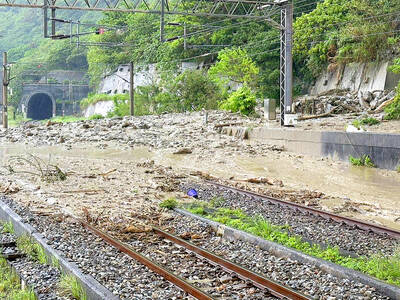
ROLLER-COASTER RIDE: More than five earthquakes ranging from magnitude 4.4 to 5.5 on the Richter scale shook eastern Taiwan in rapid succession yesterday afternoon Back-to-back weather fronts are forecast to hit Taiwan this week, resulting in rain across the nation in the coming days, the Central Weather Administration said yesterday, as it also warned residents in mountainous regions to be wary of landslides and rockfalls. As the first front approached, sporadic rainfall began in central and northern parts of Taiwan yesterday, the agency said, adding that rain is forecast to intensify in those regions today, while brief showers would also affect other parts of the nation. A second weather system is forecast to arrive on Thursday, bringing additional rain to the whole nation until Sunday, it

CONDITIONAL: The PRC imposes secret requirements that the funding it provides cannot be spent in states with diplomatic relations with Taiwan, Emma Reilly said China has been bribing UN officials to obtain “special benefits” and to block funding from countries that have diplomatic ties with Taiwan, a former UN employee told the British House of Commons on Tuesday. At a House of Commons Foreign Affairs Committee hearing into “international relations within the multilateral system,” former Office of the UN High Commissioner for Human Rights (OHCHR) employee Emma Reilly said in a written statement that “Beijing paid bribes to the two successive Presidents of the [UN] General Assembly” during the two-year negotiation of the Sustainable Development Goals. Another way China exercises influence within the UN Secretariat is
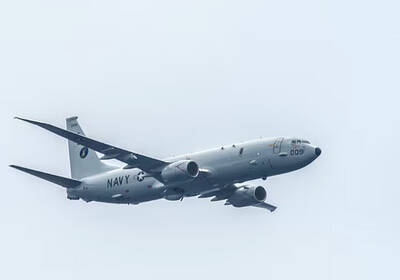
CHINA REACTS: The patrol and reconnaissance plane ‘transited the Taiwan Strait in international airspace,’ the 7th Fleet said, while Taipei said it saw nothing unusual The US 7th Fleet yesterday said that a US Navy P-8A Poseidon flew through the Taiwan Strait, a day after US and Chinese defense heads held their first talks since November 2022 in an effort to reduce regional tensions. The patrol and reconnaissance plane “transited the Taiwan Strait in international airspace,” the 7th Fleet said in a news release. “By operating within the Taiwan Strait in accordance with international law, the United States upholds the navigational rights and freedoms of all nations.” In a separate statement, the Ministry of National Defense said that it monitored nearby waters and airspace as the aircraft

Taiwan’s first drag queen to compete on the internationally acclaimed RuPaul’s Drag Race, Nymphia Wind (妮妃雅), was on Friday crowned the “Next Drag Superstar.” Dressed in a sparkling banana dress, Nymphia Wind swept onto the stage for the final, and stole the show. “Taiwan this is for you,” she said right after show host RuPaul announced her as the winner. “To those who feel like they don’t belong, just remember to live fearlessly and to live their truth,” she said on stage. One of the frontrunners for the past 15 episodes, the 28-year-old breezed through to the final after weeks of showcasing her unique


 RSS
RSS