


One of the Bank of Japan's policy board members said yesterday that the time for the central bank to change its super-stimulative monetary policy is nearing.
The comments by Miyako Suda, seen as one of the more hawkish policymakers, reinforce recent signals from Bank of Japan officials suggesting that a tightening of policy may come late this year or early next year.
The central bank has been pumping cash into the economy to keep interest rates close to zero in a bid to beat deflation and boost the economy. The Bank of Japan has vowed to continue with this policy until deflation gives way to mild inflation for a sustained period.
Economists believe that this condition may be met late this year or next year, but actual interest rate rises still seem some way off.
"I see [the question of] whether consumer price changes stay at or above zero as a key factor in deciding when to lift the policy and I see the timing for the lifting is nearing," Suda said in a prepared speech to business leaders in the western Japanese city of Kochi.
The remarks echoed comments from deputy governor Kazumasa Iwata two weeks ago when he said the Bank of Japan was "very close" to tightening policy.
Suda said although she expects the nationwide core consumer price index to show a year-on-year rise around the end of this year, the timing to end the so-called quantitative monetary easing should be taken "with plenty of leeway."
She was skeptical about the idea of raising interest rates or setting an inflation target at the time of exiting from the quantitative easing policy.
At its policy meeting this month, two of the nine Bank of Japan board members voted to lower the ?30 trillion to ?35 trillion (US$268 billion to US$313 billion) of funds made available by the Bank of Japan to commercial banks.
The IMF urged Japan's central bank to maintain its stimulative monetary policy in its twice-yearly World Economic Outlook report released last week.
"A premature end [to this policy] would endanger the progress that has been made in tackling deflation in recent years," the IMF said.
The nationwide core consumer price index fell 0.2 percent in July from a year earlier. The government will release the August data tomorrow.
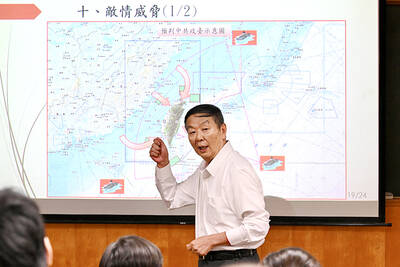
RETHINK? The defense ministry and Navy Command Headquarters could take over the indigenous submarine project and change its production timeline, a source said Admiral Huang Shu-kuang’s (黃曙光) resignation as head of the Indigenous Submarine Program and as a member of the National Security Council could affect the production of submarines, a source said yesterday. Huang in a statement last night said he had decided to resign due to national security concerns while expressing the hope that it would put a stop to political wrangling that only undermines the advancement of the nation’s defense capabilities. Taiwan People’s Party Legislator Vivian Huang (黃珊珊) yesterday said that the admiral, her older brother, felt it was time for him to step down and that he had completed what he
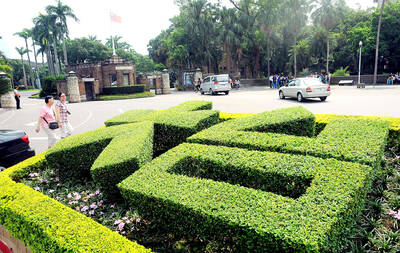
Taiwan has experienced its most significant improvement in the QS World University Rankings by Subject, data provided on Sunday by international higher education analyst Quacquarelli Symonds (QS) showed. Compared with last year’s edition of the rankings, which measure academic excellence and influence, Taiwanese universities made great improvements in the H Index metric, which evaluates research productivity and its impact, with a notable 30 percent increase overall, QS said. Taiwanese universities also made notable progress in the Citations per Paper metric, which measures the impact of research, achieving a 13 percent increase. Taiwanese universities gained 10 percent in Academic Reputation, but declined 18 percent
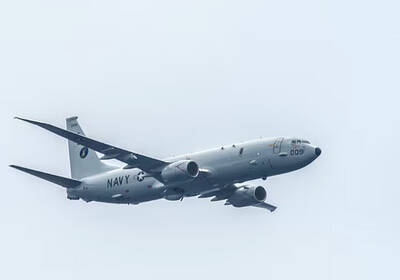
CHINA REACTS: The patrol and reconnaissance plane ‘transited the Taiwan Strait in international airspace,’ the 7th Fleet said, while Taipei said it saw nothing unusual The US 7th Fleet yesterday said that a US Navy P-8A Poseidon flew through the Taiwan Strait, a day after US and Chinese defense heads held their first talks since November 2022 in an effort to reduce regional tensions. The patrol and reconnaissance plane “transited the Taiwan Strait in international airspace,” the 7th Fleet said in a news release. “By operating within the Taiwan Strait in accordance with international law, the United States upholds the navigational rights and freedoms of all nations.” In a separate statement, the Ministry of National Defense said that it monitored nearby waters and airspace as the aircraft

UNDER DISCUSSION: The combatant command would integrate fast attack boat and anti-ship missile groups to defend waters closest to the coastline, a source said The military could establish a new combatant command as early as 2026, which would be tasked with defending Taiwan’s territorial waters 24 nautical miles (44.4km) from the nation’s coastline, a source familiar with the matter said yesterday. The new command, which would fall under the Naval Command Headquarters, would be led by a vice admiral and integrate existing fast attack boat and anti-ship missile groups, along with the Naval Maritime Surveillance and Reconnaissance Command, said the source, who asked to remain anonymous. It could be launched by 2026, but details are being discussed and no final timetable has been announced, the source


 RSS
RSS