


Indonesia must cut its expensive fuel subsidies and raise interest rates in the face of skyrocketing oil prices, which triggered a plunge in the rupiah and spooked investors over the past week, analysts said.
New York light sweet crude briefly hit an all-time high of US$68 a barrel on Thursday before retreating to US$66.13 the next day on the diminishing threat of Hurricane Katrina in the Gulf of Mexico.
But market observers believe the pullback is only temporary and that it is only a matter of time before prices gush past US$70 a barrel, after more than doubling since the end of 2003 when prices hovered near US$33.
Surging global oil prices have hammered Indonesia's rupiah as the government snaps up the greenback to pay for ever-pricier oil imports, swamping the market with rupiah.
The local currency closed Friday at 10,390 to 10,400 to the dollar after skirting 10,450 to 10,460, its weakest rate since January 2002. Aggressive intervention by the central Bank Indonesia earlier in the week failed to stop the currency plunging beyond the psychologically important 10,000 level.
Standard Chartered economist Fauzi Ichsan described the depreciation as "very serious," noting it took almost nine months for the rupiah to fall from 9,000 to 10,000 but only three days to drop further to 10,300.
"With such a plunge of the rupiah the issue has become one of confidence that the government and Bank Indonesia would not be able to control the rupiah and manage the fiscal situation," he said.
The government is further being squeezed as it forks out for spiralling fuel subsidies to consumers, with President Susilo Bambang Yudhoyono making the strongest indication yet last week that he may hike domestic fuel prices.
Despite being a member of the Organization of Petroleum Exporting Countries, Indonesia's underfunded and ageing energy sector is unable to supply fuel needed to meet domestic demand, meaning it has become a net importer.
The International Monetary Fund said last week Indonesia's economy was on a "strong footing" but that authorities had to slice fuel subsidies and address inflation.
Hiking fuel prices poses serious political risk in oil-producing countries with poverty-stricken populations where people see subsidized fuel as a right.
The last price rise in Indonesia in March sparked nationwide protests. These are likely to be repeated if the government raises prices, but analysts say a hike is crucial for the health of Southeast Asia's largest economy.
"This will create tension among the public and there will be demonstrations, strikes and so on, but we cannot avoid the increased price in the domestic market," said Didik Rachbini, an economist as the Institute for Development, Economy and Finance.
Jittery investors sold shares across all sectors in the past week, with the market closing Friday down 39.079 points or 3.6 percent at 1,048.874. The key index has shed about 12 percent of its value since Aug. 10.
Standard Chartered's Ichsan said that in the short term, the government needed to take four measures quickly, including the fuel price hike "to signal to the market that it is still committed to fiscal prudence."
As well, it needed to get its suspended privatization program back on track, raise short-term interest rates from 8.75 percent to more than 10 percent, and reverse a bank regulation introduced two months ago aiming to limit hot money which has discouraged too strongly short-term portfolio investment.
The central bank signalled on Thursday that it planned to raise rates next month but did not indicate by how much.
"These four measures have to be introduced as a package ... The government and Bank Indonesia have to show to the market, to the people, that they are in charge, that they know what they're doing," Ichsan said.
A longer term boost in capital inflows is meanwhile being hampered by legal uncertainty surrounding corruption, poor implementation of regional autonomy, labor rigidity and poor infrastructure, the economist warned.
Citigroup economist Anton Gunawan also said interest rates needed to be raised further. The central bank hiked the reference rate from 8.50 to 8.75 percent earlier this month, and last Wednesday raised a seven-day deposit rate.
"The key to this depreciation of the rupiah is that Bank Indonesia has been very late in responding to the increase in interest rates," he said, adding that the reference rate must be raised by at least 50 basis points more.
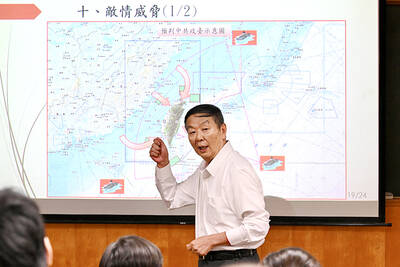
RETHINK? The defense ministry and Navy Command Headquarters could take over the indigenous submarine project and change its production timeline, a source said Admiral Huang Shu-kuang’s (黃曙光) resignation as head of the Indigenous Submarine Program and as a member of the National Security Council could affect the production of submarines, a source said yesterday. Huang in a statement last night said he had decided to resign due to national security concerns while expressing the hope that it would put a stop to political wrangling that only undermines the advancement of the nation’s defense capabilities. Taiwan People’s Party Legislator Vivian Huang (黃珊珊) yesterday said that the admiral, her older brother, felt it was time for him to step down and that he had completed what he

Taiwan has experienced its most significant improvement in the QS World University Rankings by Subject, data provided on Sunday by international higher education analyst Quacquarelli Symonds (QS) showed. Compared with last year’s edition of the rankings, which measure academic excellence and influence, Taiwanese universities made great improvements in the H Index metric, which evaluates research productivity and its impact, with a notable 30 percent increase overall, QS said. Taiwanese universities also made notable progress in the Citations per Paper metric, which measures the impact of research, achieving a 13 percent increase. Taiwanese universities gained 10 percent in Academic Reputation, but declined 18 percent
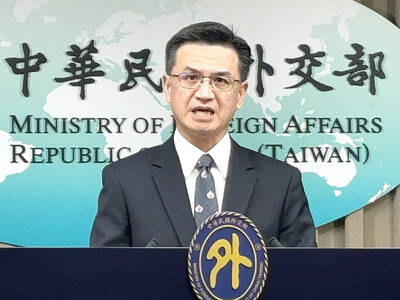
BULLY TACTICS: Beijing has continued its incursions into Taiwan’s airspace even as Xi Jinping talked about Taiwan being part of the Chinese family and nation China should stop its coercion of Taiwan and respect mainstream public opinion in Taiwan about sovereignty if its expression of goodwill is genuine, the Ministry of Foreign Affairs (MOFA) said yesterday. Ministry spokesman Jeff Liu (劉永健) made the comment in response to media queries about a meeting between former president Ma Ying-jeou (馬英九) and Chinese President Xi Jinping (習近平) the previous day. Ma voiced support for the so-called “1992 consensus,” while Xi said that although the two sides of the Taiwan Strait have “different systems,” this does not change the fact that they are “part of the same country,” and that “external

UNDER DISCUSSION: The combatant command would integrate fast attack boat and anti-ship missile groups to defend waters closest to the coastline, a source said The military could establish a new combatant command as early as 2026, which would be tasked with defending Taiwan’s territorial waters 24 nautical miles (44.4km) from the nation’s coastline, a source familiar with the matter said yesterday. The new command, which would fall under the Naval Command Headquarters, would be led by a vice admiral and integrate existing fast attack boat and anti-ship missile groups, along with the Naval Maritime Surveillance and Reconnaissance Command, said the source, who asked to remain anonymous. It could be launched by 2026, but details are being discussed and no final timetable has been announced, the source


 RSS
RSS