


Nokia Oyj and Motorola Inc, the world's two largest cellphone makers, both increased their share of the global market in the second quarter, widening their lead over competitors including Samsung Electronics Co and Siemens AG.
Nokia's global share rose to 31.9 percent in the second quarter from 30.4 percent in the previous three-month period and 29.6 percent a year earlier, Stamford, Connecticut-based researcher Gartner Inc said yesterday in an e-mailed statement.
Motorola's market share rose to 17.9 percent from 16.8 percent in the first quarter. Samsung's share slipped below 13 percent and Siemens' dropped below 5 percent.
"If you want to win market share, design your products well and have a good pricing," said George Wu (
The largest handset makers are gaining market share as Germany's Siemens exits the business and smaller rivals fail to keep pace with heightened competition. Nokia has cut prices on low-end phones and added higher-resolution cameras and new designs to maintain revenue growth and win market share.
Samsung `losing out'
"Nokia and Motorola are breaking away from everyone else," Carolina Milanesi, an analyst at Gartner's UK office, said in a telephone interview. "Samsung is losing out."
Global mobile-phone unit sales rose 5.5 percent in the second quarter from the previous three months, Gartner said. The researcher reiterated its estimate for global sales of 779 million units this year, compared with 674 million last year and 520 million in 2003.
Unit sales at Nokia rose 31 percent to 60.8 million in the quarter from 46.4 million a year earlier, Gartner said.
Motorola, the world's second-biggest handset maker, sold 34 million phones, up from 24.6 million a year earlier.
"Motorola had a really good quarter with continued success with its Razr phone, while Nokia had a better mid-tier proposition than last year," Milanesi said. "Nokia was leading in all regions except Japan and North America, where it is still struggling."
Nokia, which has a long-term target of a 40 percent market share, has reduced prices on some phones and plans to introduce 40 new models this year to recoup market share. Ten of the new phones will be so-called third-generation, or 3G, handsets, which allow users to hold video calls.
Samsung's market share fell to 12.8 percent from 13.3 percent in the previous quarter, further widening the gap with Motorola. Samsung's market share was up from 12.1 percent a year earlier.
Emerging markets
"At the moment Samsung is not playing in the low tier of the market," Milanesi said. "If it wants to continue to increase market share it will have to change strategy. Emerging markets will become more and more important."
LG Electronics Inc had a market share of 6.5 percent, up from 6.1 percent a year earlier and 6.2 percent in the first quarter.
Sony Ericsson Mobile Communications Ltd overtook Siemens for the first time in the second quarter, Milanesi said. Sony Ericsson had a 6.2 percent market share, compared with 5.5 percent in the previous quarter and 6.6 percent a year earlier.
Siemens' share fell to 4.7 percent, its lowest level since 1999, from 6.9 percent a year earlier and 5.5 percent in the first quarter, Gartner said.
After racking up more than 500 million euros (US$615 million) in losses from phones in the past year, Siemens decided in June to sell its mobile-phone business to Benq Corp (
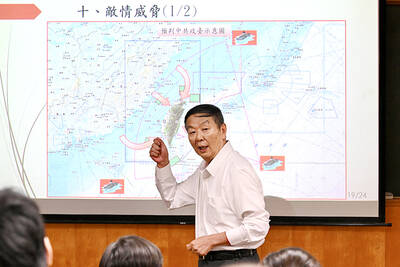
RETHINK? The defense ministry and Navy Command Headquarters could take over the indigenous submarine project and change its production timeline, a source said Admiral Huang Shu-kuang’s (黃曙光) resignation as head of the Indigenous Submarine Program and as a member of the National Security Council could affect the production of submarines, a source said yesterday. Huang in a statement last night said he had decided to resign due to national security concerns while expressing the hope that it would put a stop to political wrangling that only undermines the advancement of the nation’s defense capabilities. Taiwan People’s Party Legislator Vivian Huang (黃珊珊) yesterday said that the admiral, her older brother, felt it was time for him to step down and that he had completed what he
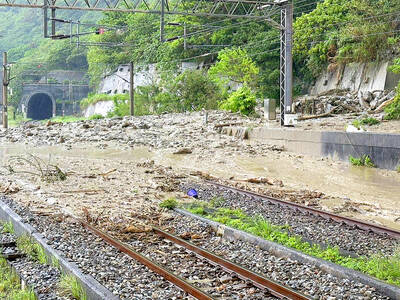
ROLLER-COASTER RIDE: More than five earthquakes ranging from magnitude 4.4 to 5.5 on the Richter scale shook eastern Taiwan in rapid succession yesterday afternoon Back-to-back weather fronts are forecast to hit Taiwan this week, resulting in rain across the nation in the coming days, the Central Weather Administration said yesterday, as it also warned residents in mountainous regions to be wary of landslides and rockfalls. As the first front approached, sporadic rainfall began in central and northern parts of Taiwan yesterday, the agency said, adding that rain is forecast to intensify in those regions today, while brief showers would also affect other parts of the nation. A second weather system is forecast to arrive on Thursday, bringing additional rain to the whole nation until Sunday, it
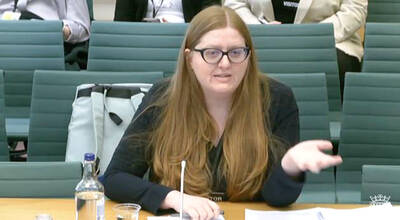
CONDITIONAL: The PRC imposes secret requirements that the funding it provides cannot be spent in states with diplomatic relations with Taiwan, Emma Reilly said China has been bribing UN officials to obtain “special benefits” and to block funding from countries that have diplomatic ties with Taiwan, a former UN employee told the British House of Commons on Tuesday. At a House of Commons Foreign Affairs Committee hearing into “international relations within the multilateral system,” former Office of the UN High Commissioner for Human Rights (OHCHR) employee Emma Reilly said in a written statement that “Beijing paid bribes to the two successive Presidents of the [UN] General Assembly” during the two-year negotiation of the Sustainable Development Goals. Another way China exercises influence within the UN Secretariat is
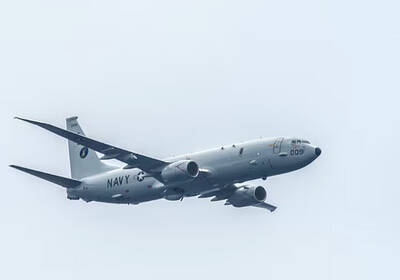
CHINA REACTS: The patrol and reconnaissance plane ‘transited the Taiwan Strait in international airspace,’ the 7th Fleet said, while Taipei said it saw nothing unusual The US 7th Fleet yesterday said that a US Navy P-8A Poseidon flew through the Taiwan Strait, a day after US and Chinese defense heads held their first talks since November 2022 in an effort to reduce regional tensions. The patrol and reconnaissance plane “transited the Taiwan Strait in international airspace,” the 7th Fleet said in a news release. “By operating within the Taiwan Strait in accordance with international law, the United States upholds the navigational rights and freedoms of all nations.” In a separate statement, the Ministry of National Defense said that it monitored nearby waters and airspace as the aircraft


 RSS
RSS