


Foreign investors are making headlines by pouring huge sums of money into China's largest banks, but it remains to be seen whether it will help improve corporate governance in the sector, analysts say.
"It really takes a long time to make fundamental change," said May Yan, vice president and senior analyst with ratings agency Moody's Investors.
"Whether the banks eventually will be on the right track and will improve and become commercially viable entities -- that is something that we need to wait and see about," she said.
Royal Bank of Scotland Group PLC announced last week it is leading a consortium that will spend ?1.7 billion (US$3 billion) to buy a 10 percent stake in Bank of China (
The deal is the third in as many months between foreign and major state-owned banks, following pledges by Bank of America and Singapore's Temasek to buy large stakes in China Construction Bank(中國建設銀行), the industry's No. 3.
The multi-billion-dollar acquisitions are set to continue, as Beijing pushes banks to secure foreign strategic investors ahead of planned listings in coming years.
But lingering over past and future deals are the problems -- the big state-run banks have long had with corporate governance -- and with senior executives running afoul of the law.
Only days before Royal Bank of Scotland unveiled its deal, the former chief executive of Bank of China's Hong Kong operation was handed a suspended death sentence for graft.
"Eventually they need to improve their profitability to be able to absorb any economic, macro changes and, fundamentally, they need to improve their corporate governance," Yan said.
"But if you're talking about a bank with 14,000 branches around the country, it's not easy to implement," she said.
Despite all the risks, no major player in the global banking business denies the need to have a significant presence in China.
"Probably the only place in the world with this kind of growth in the next 10 to 20 years is China," said John Wadle, UBS regional banking analyst.
He said partnerships allow offshore banks to build their existing businesses, including trade financing, but the real lure is the potential for massive expansion in the underdeveloped retail banking and capital markets.
But for the Chinese banks to become competitive with the global leaders, they need to kick some bad habits.
These including excessive dependence on the state, which, backed by 1.3 billion taxpayers, has a virtually unlimited ability to shore up the banks with more funds.
The government has already injected US$22.5 billion each in Bank of China and China Construction Bank and US$15 billion into Industrial and Commercial Bank of China (中國工商銀行).
The government hopes to clean up their balance sheets before the sector opens up fully to foreign competition at the end of next year.
In doing so, it has lightened their burden of non-performing loans, accrued through years of government-directed lending decisions and mismanagement.
The results have been positive, according to Benny Zhang, an analyst with Asian Banker Research: "Last year, China's banks did really well ... They had very high net profit."
But given the massive infusions of government money into the banks, the improvements in the industry are somewhat artificial, according to analysts.
And until the link between government and banking sector is severed, it is a case of buyer beware for foreign banks seeking Chinese partners, they said.
"In general, our view of the Chinese banking sector is their stand-alone financial performances are relatively weak," Yan said. "We're waiting to see some sustainable improvement on the banks' side -- not from external intervention -- before we move on their ratings."

Chinese President Xi Jinping (習近平) yesterday met with former president Ma Ying-jeou (馬英九) at the Great Hall of the People in Beijing, with Xi’s opening statement once more emphasizing that people on both sides of the Taiwan Strait are Chinese and that foreign intervention cannot change their inevitable unification. Xi said that 5,000 years of history of zhonghua minzu (中華民族, ethnic Chinese group) have seen their ancestors move to Taiwan to establish new lives, while also documenting them fighting side-by-side against foreign forces and finally freeing Taiwan. “Both sides are Chinese,” and there are no issues that cannot be worked through, he
Taiwan has experienced its most significant improvement in the QS World University Rankings by Subject, data provided on Sunday by international higher education analyst Quacquarelli Symonds (QS) showed. Compared with last year’s edition of the rankings, which measure academic excellence and influence, Taiwanese universities made great improvements in the H Index metric, which evaluates research productivity and its impact, with a notable 30 percent increase overall, QS said. Taiwanese universities also made notable progress in the Citations per Paper metric, which measures the impact of research, achieving a 13 percent increase. Taiwanese universities gained 10 percent in Academic Reputation, but declined 18 percent
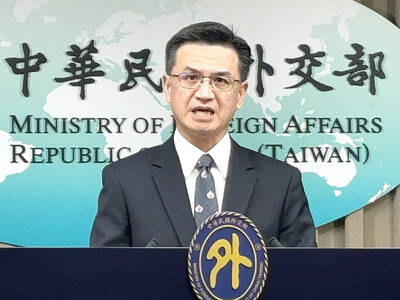
BULLY TACTICS: Beijing has continued its incursions into Taiwan’s airspace even as Xi Jinping talked about Taiwan being part of the Chinese family and nation China should stop its coercion of Taiwan and respect mainstream public opinion in Taiwan about sovereignty if its expression of goodwill is genuine, the Ministry of Foreign Affairs (MOFA) said yesterday. Ministry spokesman Jeff Liu (劉永健) made the comment in response to media queries about a meeting between former president Ma Ying-jeou (馬英九) and Chinese President Xi Jinping (習近平) the previous day. Ma voiced support for the so-called “1992 consensus,” while Xi said that although the two sides of the Taiwan Strait have “different systems,” this does not change the fact that they are “part of the same country,” and that “external

UNDER DISCUSSION: The combatant command would integrate fast attack boat and anti-ship missile groups to defend waters closest to the coastline, a source said The military could establish a new combatant command as early as 2026, which would be tasked with defending Taiwan’s territorial waters 24 nautical miles (44.4km) from the nation’s coastline, a source familiar with the matter said yesterday. The new command, which would fall under the Naval Command Headquarters, would be led by a vice admiral and integrate existing fast attack boat and anti-ship missile groups, along with the Naval Maritime Surveillance and Reconnaissance Command, said the source, who asked to remain anonymous. It could be launched by 2026, but details are being discussed and no final timetable has been announced, the source


 RSS
RSS