


The administration of US President George W. Bush believes it is close to an agreement with China to stem a flood of low-cost Chinese clothing imports that have been a boon to US consumers but have battered US manufacturers.
However, China's Commerce Ministry said yesterday that China and the US still have "substantial differences" in how to resolve disputes over Chinese textile exports.
The statement came after US and Chinese negotiators held a round of talks in San Francisco this week to discuss the Bush administration's safeguard measures that cap imports of shirts, pants and other clothing from China.

PHOTO: AFP
"Because the two sides still have substantial differences in some matters of principle, the two sides have agreed to continue discussions on this issue and jointly seek a way to resolve the issue," the ministry said in a statement.
US negotiators wrapped up two days of talks in San Francisco on Wednesday, saying agreement was within reach and could be accomplished with one more bargaining session.
The stakes for both countries are high. Americans could see their clothing bills rise by US$6 billion annually -- about US$20 for each US consumer -- if their access to cheap Chinese products is limited.
However, US textile and clothing manufacturers say they desperately need relief to stem a surge in Chinese imports that began on Jan. 1 after a three-decade system of global quotas expired. The US industry says 19 plants have been forced to close and 26,000 jobs lost this year alone.
For the Chinese, an agreement limiting textile and clothing imports would remove one item from a lengthy list of trade friction with the US, where lawmakers have grown increasingly unhappy with a trade deficit with China that hit an all-time high of US$162 billion last year and is running 32 percent above last year's pace, thanks to a 58 percent jump in clothing and textile imports.
David Spooner, the administration's chief textile negotiator, said the two days of talks at a hotel on Nob Hill had gone extremely well and that an agreement could be wrapped up with just one more round of discussions, expected to take place in China later this month.
"We hope we can resolve this in one more meeting, but we will take however long it takes," Spooner said in a telephone conference call.
However, industry representatives, who were briefed by US officials, sounded less optimistic, saying that both countries remained far apart in a number of areas.
The Bush administration has re-imposed quotas on various categories of clothing this year, but US manufacturers would prefer an agreement covering all areas of production that have been threatened by Chinese imports.
The US has the power to impose limits on Chinese textile shipments through 2008 under the terms by which China was admitted to the World Trade Organization.
These new quotas are known as "safeguards" and are designed to cover clothing and textile categories that are being disrupted by heavy Chinese imports. They cap annual growth in the categories covered to 7.5 percent.
US retailers, who have seen a variety of product lines from China cut off because the quotas for this year have already been reached, are lobbying the administration to allow greater growth in shipments each year than the safeguards provide.
Taiwan has experienced its most significant improvement in the QS World University Rankings by Subject, data provided on Sunday by international higher education analyst Quacquarelli Symonds (QS) showed. Compared with last year’s edition of the rankings, which measure academic excellence and influence, Taiwanese universities made great improvements in the H Index metric, which evaluates research productivity and its impact, with a notable 30 percent increase overall, QS said. Taiwanese universities also made notable progress in the Citations per Paper metric, which measures the impact of research, achieving a 13 percent increase. Taiwanese universities gained 10 percent in Academic Reputation, but declined 18 percent

Chinese President Xi Jinping (習近平) yesterday met with former president Ma Ying-jeou (馬英九) at the Great Hall of the People in Beijing, with Xi’s opening statement once more emphasizing that people on both sides of the Taiwan Strait are Chinese and that foreign intervention cannot change their inevitable unification. Xi said that 5,000 years of history of zhonghua minzu (中華民族, ethnic Chinese group) have seen their ancestors move to Taiwan to establish new lives, while also documenting them fighting side-by-side against foreign forces and finally freeing Taiwan. “Both sides are Chinese,” and there are no issues that cannot be worked through, he
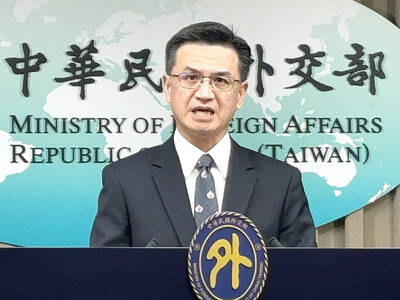
BULLY TACTICS: Beijing has continued its incursions into Taiwan’s airspace even as Xi Jinping talked about Taiwan being part of the Chinese family and nation China should stop its coercion of Taiwan and respect mainstream public opinion in Taiwan about sovereignty if its expression of goodwill is genuine, the Ministry of Foreign Affairs (MOFA) said yesterday. Ministry spokesman Jeff Liu (劉永健) made the comment in response to media queries about a meeting between former president Ma Ying-jeou (馬英九) and Chinese President Xi Jinping (習近平) the previous day. Ma voiced support for the so-called “1992 consensus,” while Xi said that although the two sides of the Taiwan Strait have “different systems,” this does not change the fact that they are “part of the same country,” and that “external

UNDER DISCUSSION: The combatant command would integrate fast attack boat and anti-ship missile groups to defend waters closest to the coastline, a source said The military could establish a new combatant command as early as 2026, which would be tasked with defending Taiwan’s territorial waters 24 nautical miles (44.4km) from the nation’s coastline, a source familiar with the matter said yesterday. The new command, which would fall under the Naval Command Headquarters, would be led by a vice admiral and integrate existing fast attack boat and anti-ship missile groups, along with the Naval Maritime Surveillance and Reconnaissance Command, said the source, who asked to remain anonymous. It could be launched by 2026, but details are being discussed and no final timetable has been announced, the source


 RSS
RSS