


Toyota Motor Corp, the world's second-biggest automaker and pioneer of environment-friendly cars, said yesterday it would start its first overseas production of hybrid vehicles this year in China.
Toyota will start building the Prius hybrid passenger vehicle by the end of this year at a plant run by Sichuan FAW Toyota Motor, a joint venture with China's FAW Group, in the northeast Chinese city of Changchun.
"Toyota regards China as one of its most important markets," Toyota executive vice-president Yoshimi Inaba said in a statement.
"I hope that this project can help contribute, if even in a small way, to the expansion of economic development in Changchun and its region and to the solution of environmental issues in China," he said.
China is the world's second biggest producer of greenhouse gases and is expected to surpass the US as the biggest within 10 years.
Toyota was the first automaker to introduce a hybrid vehicle powered by a combination of gasoline and electricity. It said on Wednesday it was working on 10 new hybrid vehicles after seeing its sales rocket among eco-conscious customers in the US.
Jim Press, president of Toyota Motor Sales USA, said the car maker aims by early in the next decade to sell a million hybrid vehicles a year globally.
Of that total, 600,000 would be sold in the US.
"To us, it's not a passing phase, but a vital technology for the 21st century," Press said at the annual Center for Automotive Research conference in Traverse City, Michigan.
Hybrid sales in the US are expected to surge to 1.2 million units by 2008, according to research by Oak Ridge Labs.
"People are buying hybrids for good reasons beyond fuel economy," Press said.
To meet its sales target, Toyota will have to add hybrid engines across its vehicle fleet, including trucks.
The automaker launched a luxury hybrid -- the Lexus RX 400h sports utility vehicle -- in April and began selling the Toyota Highlander Hybrid in June.
"Both offer the power of a V8 [engine], the mileage of an automatic Mini Cooper, and 80 percent less smog-forming emissions than conventional SUVs," Press said.
Next year, Toyota plans to introduce two more hybrids -- the Lexus GS hybrid sedan and a Camry hybrid built in the automaker's Kentucky plant.
Japanese rival Honda Motor Co currently has three hybrid vehicles while Ford Motor Co has two hybrids in the market and three more in development.
General Motors Corp, Chrysler and Nissan Motor Co also have hybrids in development.
Toyota is also working on clean diesel, natural gas and fuel-cell vehicles.
Fuel cells offer the best long-term solution for reducing pollution, Press said.
A number of automakers have developed prototypes but they have not yet found a way to produce them at commercially viable prices, while the infrastructure needed to deliver hydrogen to drivers is lacking.
Japan's top-selling newspaper, the Yomiuri Shimbun, said yesterday that Honda Motor, General Motors and BMW had agreed to a tie-up to develop hydrogen fuel-cell vehicles, billed as the next generation of eco-friendly cars.
General Motors and Toyota were planning shortly to launch a fuel-cell joint venture. But the two firms are to scrap the venture over a disagreement on how much technology to share with each other, according to a report in Japan's Asahi Shimbun newspaper last week.

Chinese President Xi Jinping (習近平) yesterday met with former president Ma Ying-jeou (馬英九) at the Great Hall of the People in Beijing, with Xi’s opening statement once more emphasizing that people on both sides of the Taiwan Strait are Chinese and that foreign intervention cannot change their inevitable unification. Xi said that 5,000 years of history of zhonghua minzu (中華民族, ethnic Chinese group) have seen their ancestors move to Taiwan to establish new lives, while also documenting them fighting side-by-side against foreign forces and finally freeing Taiwan. “Both sides are Chinese,” and there are no issues that cannot be worked through, he
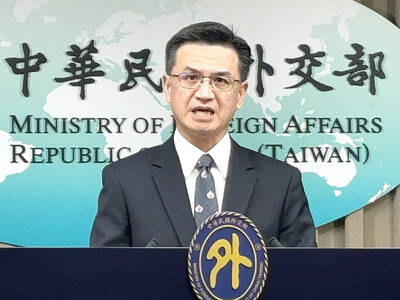
BULLY TACTICS: Beijing has continued its incursions into Taiwan’s airspace even as Xi Jinping talked about Taiwan being part of the Chinese family and nation China should stop its coercion of Taiwan and respect mainstream public opinion in Taiwan about sovereignty if its expression of goodwill is genuine, the Ministry of Foreign Affairs (MOFA) said yesterday. Ministry spokesman Jeff Liu (劉永健) made the comment in response to media queries about a meeting between former president Ma Ying-jeou (馬英九) and Chinese President Xi Jinping (習近平) the previous day. Ma voiced support for the so-called “1992 consensus,” while Xi said that although the two sides of the Taiwan Strait have “different systems,” this does not change the fact that they are “part of the same country,” and that “external
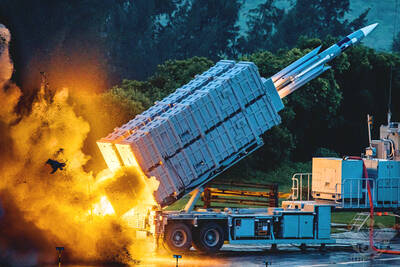
UNDER DISCUSSION: The combatant command would integrate fast attack boat and anti-ship missile groups to defend waters closest to the coastline, a source said The military could establish a new combatant command as early as 2026, which would be tasked with defending Taiwan’s territorial waters 24 nautical miles (44.4km) from the nation’s coastline, a source familiar with the matter said yesterday. The new command, which would fall under the Naval Command Headquarters, would be led by a vice admiral and integrate existing fast attack boat and anti-ship missile groups, along with the Naval Maritime Surveillance and Reconnaissance Command, said the source, who asked to remain anonymous. It could be launched by 2026, but details are being discussed and no final timetable has been announced, the source

CHANGING OF THE GUARD: Wellington Koo would likely take over as defense minister, while Joseph Wu would head the National Security Council, reports said President-elect William Lai (賴清德) yesterday tapped former Cabinet secretary-general Cho Jung-tai (卓榮泰) to be the next premier, to take office after the inauguration on May 20. Lai made the announcement at a news conference in Taipei, at which he unveiled the slogan “an active and innovative Cabinet,” or “AI” Cabinet. Cho, 65, served as the Cabinet secretary-general from September 2005 to January 2006 and again from September 2017 to December 2018, when Lai was premier under President Tsai Ing-wen (蔡英文). Lai stepped down from the post in late December 2018 to run for DPP chairman, a role left vacant following Tsai’s departure after


 RSS
RSS