


The EU signed contracts with a group of Chinese companies to develop a range of commercial applications for Europe's planned Galileo satellite navigation system.
The announcement made on Thursday is likely to ruffle feathers at the US Defense Department, which controls the rival Global Positioning System, a system it is racing to upgrade. Like the EU's discussions on lifting the Chinese arms embargo -- a move vehemently opposed by Washington -- the decision to give China a prominent role in the Galileo satellite program highlights divergent approaches to dealing with China's military ambitions between the US and the EU.
Currently China's involvement in Galileo is limited to civilian satellite technology, but analysts believe in the future Beijing may be able to use it for military purposes.
In the latest development, the Galileo Joint Undertaking, which brings together representatives from the European Commission and the European Space Agency, signed three contracts with China Galileo Industries Ltd on behalf of the EU at a ceremony in Beijing.
China Galileo Industries is a state-owned company consisting of China Aerospace Science and Industry Corporation, China Electronics Technology Group Corporation, China Satcom Guomai Communication and the Chinese Academy of Space Technology.
Under the agreement signed by the National Remote Sensing Center of China and China's Ministry of Science, the four domestic companies will work with the EU on commercializing Galileo's civilian applications, according to the Joint Undertaking.
The Chinese companies, for example, will develop a land transport system based on accurate navigation information provided by Galileo, which the EU hopes will lead to a worldwide standard. Another contract focuses on upgrading communication and navigation for China's fishing vessels.
"Today we have entered a new phase ... Chinese entities are now actively working in the development of the Galileo System. These three contracts are just the first; we intend to sign others in the near future," Rainer Grohe, executive director of the Galileo Joint Undertaking, was quoted by Dow Jones Newswires as saying.
China in September 2003 agreed to invest 200 million euros (now US$242 million) in Galileo, of which a total of 70 million euros has been earmarked for the development of tailor-made applications. Galileo, a 30-satellite system, is due to go into service in 2008.
The planned satellite network is designed to end Europe's reliance on GPS because the military-run system gives no guarantee to maintain an uninterrupted service. Galileo will be able to detect the exact positioning of users to within about 1m.
The US is upgrading GPS with a stronger military-only signal that will be less vulnerable to enemy interference than the weaker civilian signal currently in use. But the upgrade will be completed in the next decade, after Galileo has come into operation.
Since the beginning, Galileo has put the spotlight on Europe's relations with the outside world. Initially, the US was concerned Galileo might interfere with the military applications of its GPS, which is used by its troops and NATO. A technical fix was eventually found. However, Washington remains uneasy about China's participation in the development of Galileo, fearing it could help Beijing close the technology gap with the US on missile guidance.
Galileo will have both civil and defense capabilities.
EU Foreign Policy Chief Javier Solana earlier this week said that both the EU and China were "continuing" to work toward a possible agreement to lift the arms embargo. The ban was imposed after the Chinese military crushed student protests in Tiananmen Square in 1989.
EU governments have agreed to cover as much as one-third of the 3.2 billion-euro Galileo project. The system will be run by a consortium of European companies.
The EU last month accepted a merged offer bringing together two multinational groups, comprising Franco-German concern European Aeronautic Defence & Space Co, British satellite-communications provider Inmarsat Ventures Ltd and French defense company Thales SA with a second group, comprised of Italian defense company Finmeccanica SpA, French telecommunications concern Alcatel SA, Spain's state-run airport authority Aena and Spanish satellite group Hispasat.
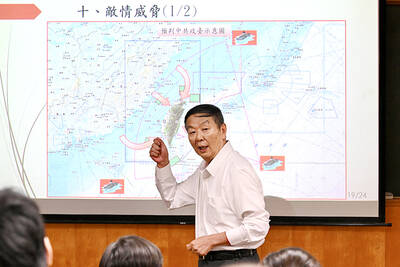
RETHINK? The defense ministry and Navy Command Headquarters could take over the indigenous submarine project and change its production timeline, a source said Admiral Huang Shu-kuang’s (黃曙光) resignation as head of the Indigenous Submarine Program and as a member of the National Security Council could affect the production of submarines, a source said yesterday. Huang in a statement last night said he had decided to resign due to national security concerns while expressing the hope that it would put a stop to political wrangling that only undermines the advancement of the nation’s defense capabilities. Taiwan People’s Party Legislator Vivian Huang (黃珊珊) yesterday said that the admiral, her older brother, felt it was time for him to step down and that he had completed what he
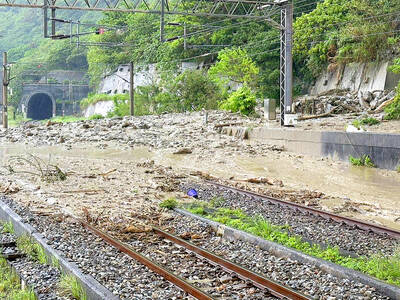
ROLLER-COASTER RIDE: More than five earthquakes ranging from magnitude 4.4 to 5.5 on the Richter scale shook eastern Taiwan in rapid succession yesterday afternoon Back-to-back weather fronts are forecast to hit Taiwan this week, resulting in rain across the nation in the coming days, the Central Weather Administration said yesterday, as it also warned residents in mountainous regions to be wary of landslides and rockfalls. As the first front approached, sporadic rainfall began in central and northern parts of Taiwan yesterday, the agency said, adding that rain is forecast to intensify in those regions today, while brief showers would also affect other parts of the nation. A second weather system is forecast to arrive on Thursday, bringing additional rain to the whole nation until Sunday, it

CONDITIONAL: The PRC imposes secret requirements that the funding it provides cannot be spent in states with diplomatic relations with Taiwan, Emma Reilly said China has been bribing UN officials to obtain “special benefits” and to block funding from countries that have diplomatic ties with Taiwan, a former UN employee told the British House of Commons on Tuesday. At a House of Commons Foreign Affairs Committee hearing into “international relations within the multilateral system,” former Office of the UN High Commissioner for Human Rights (OHCHR) employee Emma Reilly said in a written statement that “Beijing paid bribes to the two successive Presidents of the [UN] General Assembly” during the two-year negotiation of the Sustainable Development Goals. Another way China exercises influence within the UN Secretariat is
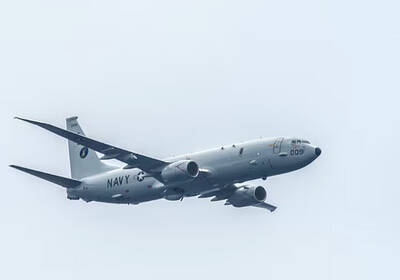
CHINA REACTS: The patrol and reconnaissance plane ‘transited the Taiwan Strait in international airspace,’ the 7th Fleet said, while Taipei said it saw nothing unusual The US 7th Fleet yesterday said that a US Navy P-8A Poseidon flew through the Taiwan Strait, a day after US and Chinese defense heads held their first talks since November 2022 in an effort to reduce regional tensions. The patrol and reconnaissance plane “transited the Taiwan Strait in international airspace,” the 7th Fleet said in a news release. “By operating within the Taiwan Strait in accordance with international law, the United States upholds the navigational rights and freedoms of all nations.” In a separate statement, the Ministry of National Defense said that it monitored nearby waters and airspace as the aircraft


 RSS
RSS