


Faced with a dizzying rise in Chinese textile imports since quotas were lifted in January, Canadian unions are pressing the government to introduce protectionist measures similar to trade barriers in Europe and the US.
There has been a "106 percent increase in Chinese imports of men's clothes since the beginning of the year, 282 percent more jackets, 415 percent more bras, 629 percent more coats ... these are staggering numbers," said to Lina Aristeo, the local director of Unite Here, a North American association created last year and representing 490,000 members.
Chinese textile imports in Canada are up 40 percent in total since quotas were abolished, Aristeo said, prompting fear of massive job losses among the 144,000 Canadian clothing industry workers, more than half of them in the French-speaking province of Quebec.
Once the jewel of the Canadian textile industry, but now on its last legs, Montreal had long benefitted from the low Canadian dollar and low salaries to sell clothes to its southern neighbor, but neither factor will save it now as Mexican and Chinese goods flood the US market.
Between December and June, factory closures or shift cuts have forced 1,200 people in the sector out of work in Quebec, including 800 in Huntington, devastating the small town of 2,600 people south of Montreal.
Faced with this situation, Unite Here and the Federation des travailleurs du Quebec, the largest trade union in the province, complained to the Canadian International Trade Tribunal on Friday to compel the Canadian government to act.
"We're asking the government to put safeguards in place to limit the increase of Chinese imports to 7.5 percent," Aristeo told reporters.
Such protections were already negotiated as part of the agreement to allow China to join the World Trade Organization, but Canadian Prime Minister Paul Martin's minority government has balked at the idea.
The decision not to follow the lead of the US or EU was applauded by the Economic Institute of Montreal, a think tank that decries the use of protectionist measures to counter the flight of companies abroad.
In May, the US imposed quotas in seven categories limiting increases of Chinese imports to seven percent until 2008, in accordance with the agreement allowing China into the WTO.
The EU has also signed an agreement with Beijing to limit imports of a dozen Chinese textile products by eight to 12.5 percent until the end of 2007.
In Canada, the separatist Bloc Quebecois tried in vain to push the government to act.
"If the industry makes a request ... we'll look at it objectively," said Andrew Hannan, a spokesperson for Canada's department of international trade, noting no such request had been made.
In fact, only a handful of small and medium-sized businesses have complained to the unions.
"The representatives of the Canadian and Quebec clothing industry are no longer the true representatives of the industry. In most cases, they're the ones importing textiles," Aristeo said.
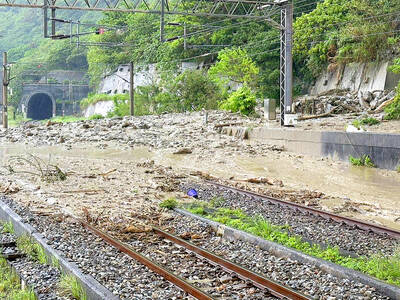
ROLLER-COASTER RIDE: More than five earthquakes ranging from magnitude 4.4 to 5.5 on the Richter scale shook eastern Taiwan in rapid succession yesterday afternoon Back-to-back weather fronts are forecast to hit Taiwan this week, resulting in rain across the nation in the coming days, the Central Weather Administration said yesterday, as it also warned residents in mountainous regions to be wary of landslides and rockfalls. As the first front approached, sporadic rainfall began in central and northern parts of Taiwan yesterday, the agency said, adding that rain is forecast to intensify in those regions today, while brief showers would also affect other parts of the nation. A second weather system is forecast to arrive on Thursday, bringing additional rain to the whole nation until Sunday, it

CONDITIONAL: The PRC imposes secret requirements that the funding it provides cannot be spent in states with diplomatic relations with Taiwan, Emma Reilly said China has been bribing UN officials to obtain “special benefits” and to block funding from countries that have diplomatic ties with Taiwan, a former UN employee told the British House of Commons on Tuesday. At a House of Commons Foreign Affairs Committee hearing into “international relations within the multilateral system,” former Office of the UN High Commissioner for Human Rights (OHCHR) employee Emma Reilly said in a written statement that “Beijing paid bribes to the two successive Presidents of the [UN] General Assembly” during the two-year negotiation of the Sustainable Development Goals. Another way China exercises influence within the UN Secretariat is
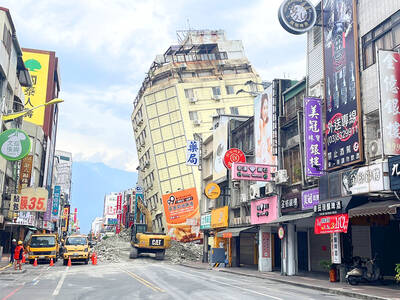
LANDSLIDES POSSIBLE: The agency advised the public to avoid visiting mountainous regions due to more expected aftershocks and rainfall from a series of weather fronts A series of earthquakes over the past few days were likely aftershocks of the April 3 earthquake in Hualien County, with further aftershocks to be expected for up to a year, the Central Weather Administration (CWA) said yesterday. Based on the nation’s experience after the quake on Sept. 21, 1999, more aftershocks are possible over the next six months to a year, the agency said. A total of 103 earthquakes of magnitude 4 on the local magnitude scale or higher hit Hualien County from 5:08pm on Monday to 10:27am yesterday, with 27 of them exceeding magnitude 5. They included two, of magnitude
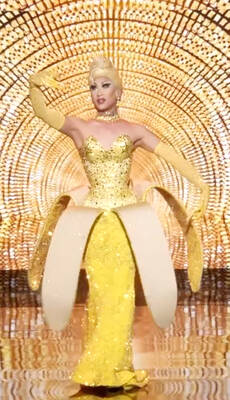
Taiwan’s first drag queen to compete on the internationally acclaimed RuPaul’s Drag Race, Nymphia Wind (妮妃雅), was on Friday crowned the “Next Drag Superstar.” Dressed in a sparkling banana dress, Nymphia Wind swept onto the stage for the final, and stole the show. “Taiwan this is for you,” she said right after show host RuPaul announced her as the winner. “To those who feel like they don’t belong, just remember to live fearlessly and to live their truth,” she said on stage. One of the frontrunners for the past 15 episodes, the 28-year-old breezed through to the final after weeks of showcasing her unique


 RSS
RSS