


Chinese Prime Minister Wen Jiabao (
Wen told a gathering of Asian and European finance ministers a "basically" stable yuan exchange rate was in the interests of both China and other nations.
"Keeping the yuan exchange rate basically stable at a reasonable and balanced level is in the interest of economic development not only in China but also in neighboring countries and in the region as a whole and contributes to world financial stability and expansion of trade," Wen said.
He was speaking at the annual Asia-Europe Meeting (ASEM) of finance ministers in the northern Chinese city of Tianjin.
The yuan has been pegged around 8.28 to the US dollar for a decade, giving rise to growing chorus of complaints from countries believing the Chinese currency is now too cheap and gives the nation's exporters an unfair advantage.
Fending off pressure, the Chinese premier said every country was entitled to choose an exchange rate mechanism suitable for its own conditions.
He said China's exchange rate reform would have to take place based on an "independent initiative" from Beijing, in a controlled manner and as a result of a "gradual process," warning against "undue haste."
"By `independent initiative,' we mean to independently determine the modality, content and timing of the reform in accordance with China's needs for reform and development," Wen said.
"We must take into consideration both the present needs and the future development and guard against undue haste."
Wen acknowledged China needed to develop a more market-oriented and flexible exchange rate system, but cautioned that since any reform will have far-reaching impact, "it still requires a great deal of preparation."
China must first take into account the possible impact on the country's macro-economic stability, economic growth and job market, as well as the state of its financial system, he said.
Other factors include the level of financial regulations, resilience of the enterprises and effect on foreign trade as well as the economic and financial performance of other countries, he said.
"We must push forward the reform but always stay on top of the challenges, so as to prevent fluctuations in the financial market and economic instability," Wen said.
He said China's attitude was "responsible" and will be beneficial to China's and the global economies.
China has been under heavy pressure from the US and sometime Europe to ease the peg.
Washington has blamed the yuan's peg on its ballooning trade deficit with China. Two US senators are sponsoring a bill that would slap a 27.5 percent tariff on Chinese imports if Beijing does not take meaningful steps to revalue the yuan.
Japan's finance minister Sadakazu Tanigaki urged China to adopt yuan flexibility "sooner rather than later" during a meeting with his Chinese counterpart on the sidelines of ASEM Saturday.
European finance policy makers, however, indicated yesterday they were beginning to support China's view.
"I think it's up to the Chinese authorities to decide at what base and when they will adopt decisions in that direction," said Joaquin Almunia, European Commissioner responsible for economic and financial affairs.
"I think they are perfectly cognizant of what are the demands of the other main economies of the world, what are the needs of other economies, but they are in charge of the Chinese economy and they know perfectly well what to do and when to do it."
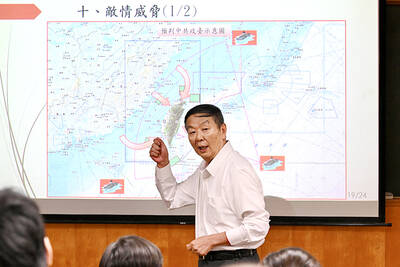
RETHINK? The defense ministry and Navy Command Headquarters could take over the indigenous submarine project and change its production timeline, a source said Admiral Huang Shu-kuang’s (黃曙光) resignation as head of the Indigenous Submarine Program and as a member of the National Security Council could affect the production of submarines, a source said yesterday. Huang in a statement last night said he had decided to resign due to national security concerns while expressing the hope that it would put a stop to political wrangling that only undermines the advancement of the nation’s defense capabilities. Taiwan People’s Party Legislator Vivian Huang (黃珊珊) yesterday said that the admiral, her older brother, felt it was time for him to step down and that he had completed what he

Taiwan has experienced its most significant improvement in the QS World University Rankings by Subject, data provided on Sunday by international higher education analyst Quacquarelli Symonds (QS) showed. Compared with last year’s edition of the rankings, which measure academic excellence and influence, Taiwanese universities made great improvements in the H Index metric, which evaluates research productivity and its impact, with a notable 30 percent increase overall, QS said. Taiwanese universities also made notable progress in the Citations per Paper metric, which measures the impact of research, achieving a 13 percent increase. Taiwanese universities gained 10 percent in Academic Reputation, but declined 18 percent
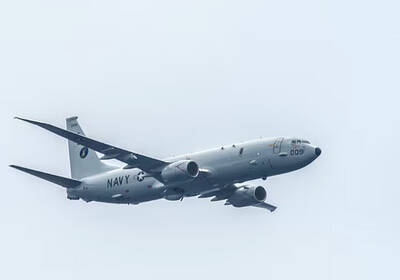
CHINA REACTS: The patrol and reconnaissance plane ‘transited the Taiwan Strait in international airspace,’ the 7th Fleet said, while Taipei said it saw nothing unusual The US 7th Fleet yesterday said that a US Navy P-8A Poseidon flew through the Taiwan Strait, a day after US and Chinese defense heads held their first talks since November 2022 in an effort to reduce regional tensions. The patrol and reconnaissance plane “transited the Taiwan Strait in international airspace,” the 7th Fleet said in a news release. “By operating within the Taiwan Strait in accordance with international law, the United States upholds the navigational rights and freedoms of all nations.” In a separate statement, the Ministry of National Defense said that it monitored nearby waters and airspace as the aircraft
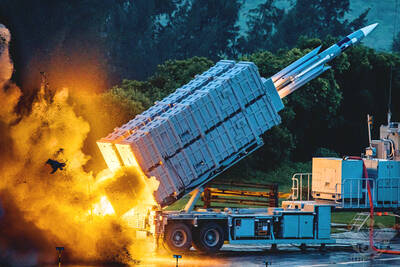
UNDER DISCUSSION: The combatant command would integrate fast attack boat and anti-ship missile groups to defend waters closest to the coastline, a source said The military could establish a new combatant command as early as 2026, which would be tasked with defending Taiwan’s territorial waters 24 nautical miles (44.4km) from the nation’s coastline, a source familiar with the matter said yesterday. The new command, which would fall under the Naval Command Headquarters, would be led by a vice admiral and integrate existing fast attack boat and anti-ship missile groups, along with the Naval Maritime Surveillance and Reconnaissance Command, said the source, who asked to remain anonymous. It could be launched by 2026, but details are being discussed and no final timetable has been announced, the source


 RSS
RSS