


China's stock market has bounced back smartly from eight-year lows but analysts said they still see a fall of up to 40 percent before the main index finds longer-term stability.
In a rollercoaster week, the benchmark Shanghai composite index touched an eight-year closing low on June 3 before staging the biggest one-day rally in three years on Wednesday. From here on, though, it could all be downhill.
"I could easily see the market falling another 20, 30, 40 percent," market watcher Fraser Howie said, author of Privatizing China, a study of China's stock markets.
"The rally [Wednesday] only got us back to where we were three weeks ago ... Even if it goes up another 10 to 20 percent, that only gets us back to where we were at the beginning of the year," he said.
After the main index closed at 1,013.64 a week ago, the government flagged its concern about the state of the market through state media reports that it would bailout to debt-saddled brokerages.
It also said it would allow companies to buy back tradable shares to boost their stock prices and suspended its review of applications for new listings.
The China Securities Regulatory Commission also granted approval for fund management firms to invest their own capital in securities funds, according to a Shanghai Securities report.
"They're at their wits' end over the market in general -- they're getting desperate," said Howie.
"They're already throwing new incentives into the pot to try to boost the market without seeing the results of their most important reforms."
Peter So, head of China equities research at Macquarie Securities, also attributed the stock price rises in part to rumors that the government would inject new funds into the market.
But "it's just general market speculation, there's no new news there," he said.
Howie said he was not encouraged by the upturn in the market on Wednesday, which saw the Shanghai Composite Index rise 8.21 percent to 1,115.58, its largest single day gain since June 2002.
The Shanghai Composite Index recorded far higher levels at the turn of the decade, closing at a peak of 2,242.42 on June 13, 2001.
Since then, it has lost about half of its value despite robust growth in the economy as a whole.
Last year, the Shanghai and Shenzhen exchanges were Asia's worst performing markets, prompting government pledges of further reform, including changes to China's securities law.
One such reform is the trial sale of state-owned non-tradable shares in listed companies aimed at reducing state-controlled holdings that currently dominate China's markets.
The heavy state role is widely seen as politicizing corporate decision making and limiting the rights of minority shareholders.
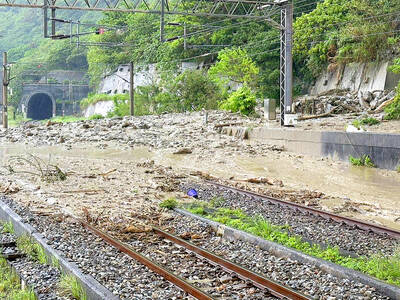
ROLLER-COASTER RIDE: More than five earthquakes ranging from magnitude 4.4 to 5.5 on the Richter scale shook eastern Taiwan in rapid succession yesterday afternoon Back-to-back weather fronts are forecast to hit Taiwan this week, resulting in rain across the nation in the coming days, the Central Weather Administration said yesterday, as it also warned residents in mountainous regions to be wary of landslides and rockfalls. As the first front approached, sporadic rainfall began in central and northern parts of Taiwan yesterday, the agency said, adding that rain is forecast to intensify in those regions today, while brief showers would also affect other parts of the nation. A second weather system is forecast to arrive on Thursday, bringing additional rain to the whole nation until Sunday, it

CONDITIONAL: The PRC imposes secret requirements that the funding it provides cannot be spent in states with diplomatic relations with Taiwan, Emma Reilly said China has been bribing UN officials to obtain “special benefits” and to block funding from countries that have diplomatic ties with Taiwan, a former UN employee told the British House of Commons on Tuesday. At a House of Commons Foreign Affairs Committee hearing into “international relations within the multilateral system,” former Office of the UN High Commissioner for Human Rights (OHCHR) employee Emma Reilly said in a written statement that “Beijing paid bribes to the two successive Presidents of the [UN] General Assembly” during the two-year negotiation of the Sustainable Development Goals. Another way China exercises influence within the UN Secretariat is
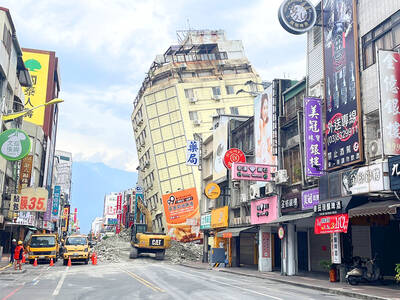
LANDSLIDES POSSIBLE: The agency advised the public to avoid visiting mountainous regions due to more expected aftershocks and rainfall from a series of weather fronts A series of earthquakes over the past few days were likely aftershocks of the April 3 earthquake in Hualien County, with further aftershocks to be expected for up to a year, the Central Weather Administration (CWA) said yesterday. Based on the nation’s experience after the quake on Sept. 21, 1999, more aftershocks are possible over the next six months to a year, the agency said. A total of 103 earthquakes of magnitude 4 on the local magnitude scale or higher hit Hualien County from 5:08pm on Monday to 10:27am yesterday, with 27 of them exceeding magnitude 5. They included two, of magnitude
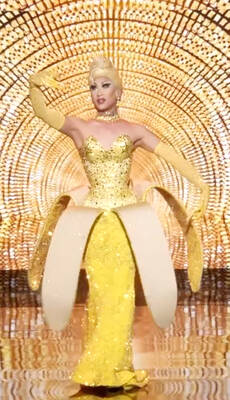
Taiwan’s first drag queen to compete on the internationally acclaimed RuPaul’s Drag Race, Nymphia Wind (妮妃雅), was on Friday crowned the “Next Drag Superstar.” Dressed in a sparkling banana dress, Nymphia Wind swept onto the stage for the final, and stole the show. “Taiwan this is for you,” she said right after show host RuPaul announced her as the winner. “To those who feel like they don’t belong, just remember to live fearlessly and to live their truth,” she said on stage. One of the frontrunners for the past 15 episodes, the 28-year-old breezed through to the final after weeks of showcasing her unique


 RSS
RSS