


Nestle SA, the world's biggest food maker, said it had been told to withdraw one of its milk powder products from sale in eastern China after government tests showed it contained an excessive amount of iodine.
The Zhejiang Province branch of the State Administration of Industry and Commerce found the level of iodine in the product exceeded the national limit, Nestle said in a statement e-mailed to Bloomberg News.
The iodine level conforms to international standards and is safe, the company said in the statement.
"Nestle has already withdrawn the product in Zhejiang Province, and may have to do so in other parts of China," said Lu Xiao, spokeswoman for Nestle at China Global Public Relations Co in Beijing.
"We cannot estimate now the extent of loss Nestle would incur because of this, as the problem seems to be spreading," she said.
Carrefour SA, the Paris-based supermarket operator, told stores nationwide to pull the product from its shelves, the Oriental Morning Post reported today, citing an unidentified spokesman for the French retailer.
"We did sample examinations on Nestle's products in the province and discovered the problems," said Shen Yan, spokeswoman of the commerce regulator in Zhejiang Province.
"It's hard to say at the moment whether the same problems exist in other areas," she said.
Excessive iodine is found in "Nestle Growth Milk Powder Growth 3+," a product for babies older than one year and produced in China's northeastern Heilongjiang Province, Lu said. Iodine deficiency and excessive intake can both cause health problems.
Nestle, after thorough examination on production and processing procedures, found that the milk powder was disqualified by unstable iodine levels in fresh milk used to make powder, according to the statement.
"We are paying close attention to the iodine incident and will fully cooperate with the Chinese government," Vevey, Switzerland-based Nestle said.
China's government in March ordered Yum! Brands Inc's KFC restaurant chains to suspend the sale of several products after finding they contained Sudan 1, a dye that's been linked to cancer.
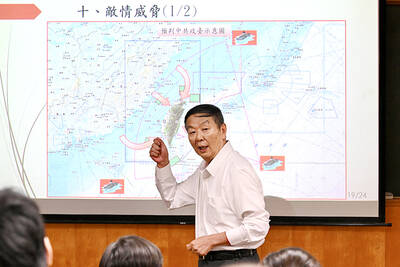
RETHINK? The defense ministry and Navy Command Headquarters could take over the indigenous submarine project and change its production timeline, a source said Admiral Huang Shu-kuang’s (黃曙光) resignation as head of the Indigenous Submarine Program and as a member of the National Security Council could affect the production of submarines, a source said yesterday. Huang in a statement last night said he had decided to resign due to national security concerns while expressing the hope that it would put a stop to political wrangling that only undermines the advancement of the nation’s defense capabilities. Taiwan People’s Party Legislator Vivian Huang (黃珊珊) yesterday said that the admiral, her older brother, felt it was time for him to step down and that he had completed what he
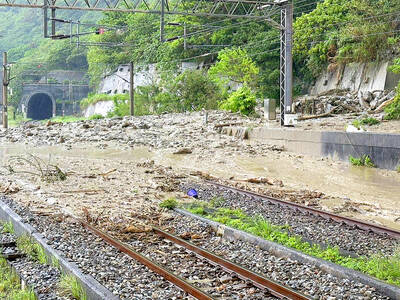
ROLLER-COASTER RIDE: More than five earthquakes ranging from magnitude 4.4 to 5.5 on the Richter scale shook eastern Taiwan in rapid succession yesterday afternoon Back-to-back weather fronts are forecast to hit Taiwan this week, resulting in rain across the nation in the coming days, the Central Weather Administration said yesterday, as it also warned residents in mountainous regions to be wary of landslides and rockfalls. As the first front approached, sporadic rainfall began in central and northern parts of Taiwan yesterday, the agency said, adding that rain is forecast to intensify in those regions today, while brief showers would also affect other parts of the nation. A second weather system is forecast to arrive on Thursday, bringing additional rain to the whole nation until Sunday, it
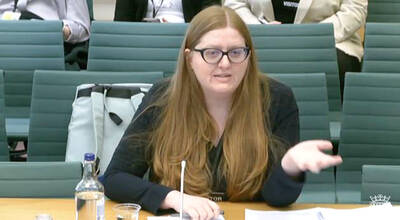
CONDITIONAL: The PRC imposes secret requirements that the funding it provides cannot be spent in states with diplomatic relations with Taiwan, Emma Reilly said China has been bribing UN officials to obtain “special benefits” and to block funding from countries that have diplomatic ties with Taiwan, a former UN employee told the British House of Commons on Tuesday. At a House of Commons Foreign Affairs Committee hearing into “international relations within the multilateral system,” former Office of the UN High Commissioner for Human Rights (OHCHR) employee Emma Reilly said in a written statement that “Beijing paid bribes to the two successive Presidents of the [UN] General Assembly” during the two-year negotiation of the Sustainable Development Goals. Another way China exercises influence within the UN Secretariat is
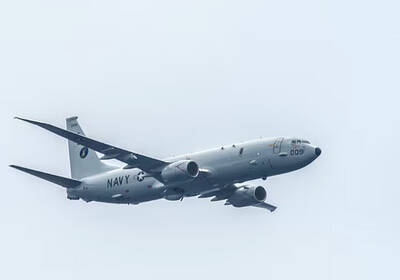
CHINA REACTS: The patrol and reconnaissance plane ‘transited the Taiwan Strait in international airspace,’ the 7th Fleet said, while Taipei said it saw nothing unusual The US 7th Fleet yesterday said that a US Navy P-8A Poseidon flew through the Taiwan Strait, a day after US and Chinese defense heads held their first talks since November 2022 in an effort to reduce regional tensions. The patrol and reconnaissance plane “transited the Taiwan Strait in international airspace,” the 7th Fleet said in a news release. “By operating within the Taiwan Strait in accordance with international law, the United States upholds the navigational rights and freedoms of all nations.” In a separate statement, the Ministry of National Defense said that it monitored nearby waters and airspace as the aircraft


 RSS
RSS