


Nike's decision to stop selling its sneakers and clothes at Sears is casting a spotlight on the impact retail environments have on marketers' brands.
Though the companies themselves have said little about the move, retail analysts quickly pronounced it a result of the Kmart Holding Corp.'s US$12 billion acquisition of Sears, Roebuck & Co in March.
Nike may have feared that its products would wind up for sale at Kmart, a discount chain, analysts said. If not, Nike may still have worried that Sears Holdings, the company that resulted from the Kmart-Sears combination, would undermine Nike's image.
When Sears Holdings was formed, its chief executive, Alan Lacy, said that the new company would offer a complete shopping solution.
"Shoppers will have greater access to the leading proprietary brands of both Kmart and Sears," Lacy said.
Kmart stores, for example, would be able to sell products once exclusive to Sears, like Craftsman tools and Kenmore appliances.
The cross-pollination, however, has yet to significantly improve the image of either chain.
At the same time, Nike has continued to pursue high-gloss ad campaigns. It is spending an estimated US$20 million to US$30 million, for example, on its warriors campaign, which shows professional athletes donning masks.
In sum, Nike spent an estimated US$220 million last year to advertise in major US media, according to TNS Media Intelligence. It is also the runaway sales leader in its chief category. With about US$3.2 billion in wholesale footwear sales last year, Nike represented 36.3 percent of the nation's US$8.9 billion branded athletic shoe market, according to Sporting Goods Intelligence. Its next closest competitor, Reebok, had 12.2 percent of that market.
Sears, which sold Nike shoes primarily aimed at women and children, will suffer the loss of the swoosh more than Nike will miss the department store, said John Shanley, senior athletic and footwear industry analyst at the Susquehanna Investment Group.
Joani Komlos, a spokeswoman at Nike in Beaverton, Oregon, called the company's decision a brand management matter.
"The decision was made based on what we felt was best for the brand," she said, declining to elaborate.
"Advertisers are learning that where they sell their products has tremendous effects," said Robert Passikoff, president at Brand Keys in New York, a brand and customer-loyalty consultant. "Where your product values are reinforced by the venue, you will see higher see higher levels of consideration."
In a Brand Keys index that tracks retailer characteristics like merchandise selections, shopping experiences and store reputations, Sears stores score above average but have lost ground over the last five years, Passikoff said.
Not every branding expert found wisdom in the Nike withdrawal.
"It is surprising and incredibly short-sighted of Nike to pull their sneakers from Sears," said Debbie Millman, president of the New York office of the Sterling Group. "This would have been the perfect opportunity to leverage the idea of a `specially designed' sneaker for the retailer in an effort to capitalize on the current design-led economy we are living in, which is a good part of what is currently differentiating Target."
Nike has happily sold its sneakers to Wal-Mart since March, but only a swoosh-free brand called Starter. It plans to monitor the results of its Wal-Mart deal for a while before deciding whether to expand the strategy to other chains. The company expects to stop shipping products to Sears in October, meaning that they will stay on Sears shelves through the end of the year.
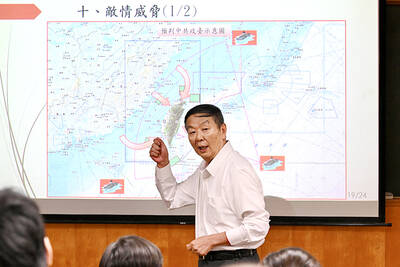
RETHINK? The defense ministry and Navy Command Headquarters could take over the indigenous submarine project and change its production timeline, a source said Admiral Huang Shu-kuang’s (黃曙光) resignation as head of the Indigenous Submarine Program and as a member of the National Security Council could affect the production of submarines, a source said yesterday. Huang in a statement last night said he had decided to resign due to national security concerns while expressing the hope that it would put a stop to political wrangling that only undermines the advancement of the nation’s defense capabilities. Taiwan People’s Party Legislator Vivian Huang (黃珊珊) yesterday said that the admiral, her older brother, felt it was time for him to step down and that he had completed what he
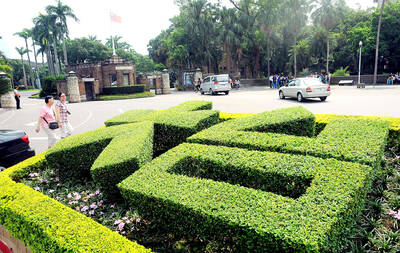
Taiwan has experienced its most significant improvement in the QS World University Rankings by Subject, data provided on Sunday by international higher education analyst Quacquarelli Symonds (QS) showed. Compared with last year’s edition of the rankings, which measure academic excellence and influence, Taiwanese universities made great improvements in the H Index metric, which evaluates research productivity and its impact, with a notable 30 percent increase overall, QS said. Taiwanese universities also made notable progress in the Citations per Paper metric, which measures the impact of research, achieving a 13 percent increase. Taiwanese universities gained 10 percent in Academic Reputation, but declined 18 percent
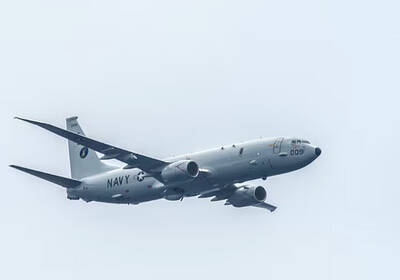
CHINA REACTS: The patrol and reconnaissance plane ‘transited the Taiwan Strait in international airspace,’ the 7th Fleet said, while Taipei said it saw nothing unusual The US 7th Fleet yesterday said that a US Navy P-8A Poseidon flew through the Taiwan Strait, a day after US and Chinese defense heads held their first talks since November 2022 in an effort to reduce regional tensions. The patrol and reconnaissance plane “transited the Taiwan Strait in international airspace,” the 7th Fleet said in a news release. “By operating within the Taiwan Strait in accordance with international law, the United States upholds the navigational rights and freedoms of all nations.” In a separate statement, the Ministry of National Defense said that it monitored nearby waters and airspace as the aircraft
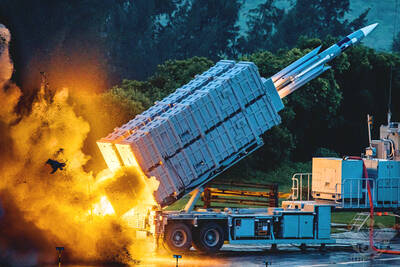
UNDER DISCUSSION: The combatant command would integrate fast attack boat and anti-ship missile groups to defend waters closest to the coastline, a source said The military could establish a new combatant command as early as 2026, which would be tasked with defending Taiwan’s territorial waters 24 nautical miles (44.4km) from the nation’s coastline, a source familiar with the matter said yesterday. The new command, which would fall under the Naval Command Headquarters, would be led by a vice admiral and integrate existing fast attack boat and anti-ship missile groups, along with the Naval Maritime Surveillance and Reconnaissance Command, said the source, who asked to remain anonymous. It could be launched by 2026, but details are being discussed and no final timetable has been announced, the source


 RSS
RSS