


Deputy US Secretary of State Robert Zoellick is determined to break a free-trade impasse with Southeast Asia during a visit to the region this week but has cautioned that any agreement reached will have to be comprehensive.
Two years after US President George W. Bush announced an initiative to forge free-trade pacts with export-driven, economically-booming Southeast Asian nations, Washington has managed to strike only one deal so far -- with Singapore.
But the US-Singapore Free Trade Agreement cannot be a benchmark for Southeast Asia as the island city state is already largely tariff free.
So, many economies in the region have been following closely the protracted US-Thailand free trade negotiations, which seem to have been bogged down over US demands for stringent intellectual property rights protection and Thai requests for access to low-cost pharmaceuticals.
Zoellick told reporters at the weekend that he would try to break the free-trade deadlock when he meets with Thai Prime Minister Thaksin Shinawatra in Bangkok, the first stop of his regional swing that will also include Malaysia, Vietnam, Indonesia, Singapore and the Philippines.
"One of the purposes of my visit, since in the case of the negotiations with Thailand the Thai prime minister plays a very key, leading role, will be to talk to him on some of the key elements to move this forward," said Zoellick, who was US trade representative before his new assignment.
Southeast Asia is key to the US as it hosts approximately US$88 billion in US direct investment and is the third largest overseas market for US exports. US trade with the region totals US$127 billion.
Zoellick was quick to point out that any perceived delay by the US in striking free-trade deals with Southeast Asian nations was due to the comprehensive nature of the negotiations.
Citing competitor China's swift free-trade deals with ASEAN, Zoellick said, "I think the Chinese have been very shrewd in how they handled this.
"Here I don't want to get too technical but there are lots of different types of free trade agreements. People use the term loosely," he said, acclaiming US free-trade agreements as "the top of the class product."
He said the US pacts tried to cover agricultural products, services, intellectual property, government procurement, environment and labor, as opposed to the China-ASEAN deal which largely centered on manufactured goods.
China and ASEAN last year signed a deal to liberalize trade barriers and pave the way for a more comprehensive accord planned for 2010 that could see the creation of the world's largest free-trade zone covering nearly 2 billion people.
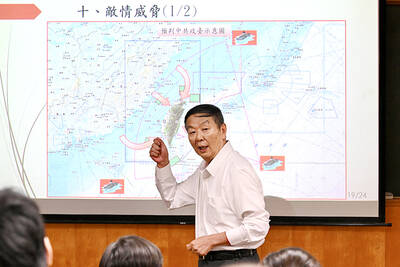
RETHINK? The defense ministry and Navy Command Headquarters could take over the indigenous submarine project and change its production timeline, a source said Admiral Huang Shu-kuang’s (黃曙光) resignation as head of the Indigenous Submarine Program and as a member of the National Security Council could affect the production of submarines, a source said yesterday. Huang in a statement last night said he had decided to resign due to national security concerns while expressing the hope that it would put a stop to political wrangling that only undermines the advancement of the nation’s defense capabilities. Taiwan People’s Party Legislator Vivian Huang (黃珊珊) yesterday said that the admiral, her older brother, felt it was time for him to step down and that he had completed what he
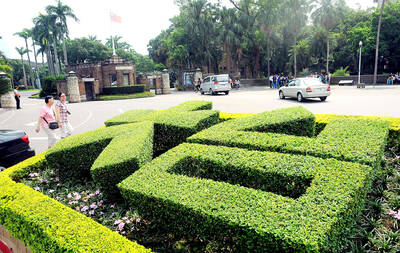
Taiwan has experienced its most significant improvement in the QS World University Rankings by Subject, data provided on Sunday by international higher education analyst Quacquarelli Symonds (QS) showed. Compared with last year’s edition of the rankings, which measure academic excellence and influence, Taiwanese universities made great improvements in the H Index metric, which evaluates research productivity and its impact, with a notable 30 percent increase overall, QS said. Taiwanese universities also made notable progress in the Citations per Paper metric, which measures the impact of research, achieving a 13 percent increase. Taiwanese universities gained 10 percent in Academic Reputation, but declined 18 percent
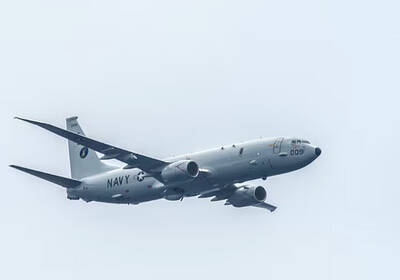
CHINA REACTS: The patrol and reconnaissance plane ‘transited the Taiwan Strait in international airspace,’ the 7th Fleet said, while Taipei said it saw nothing unusual The US 7th Fleet yesterday said that a US Navy P-8A Poseidon flew through the Taiwan Strait, a day after US and Chinese defense heads held their first talks since November 2022 in an effort to reduce regional tensions. The patrol and reconnaissance plane “transited the Taiwan Strait in international airspace,” the 7th Fleet said in a news release. “By operating within the Taiwan Strait in accordance with international law, the United States upholds the navigational rights and freedoms of all nations.” In a separate statement, the Ministry of National Defense said that it monitored nearby waters and airspace as the aircraft
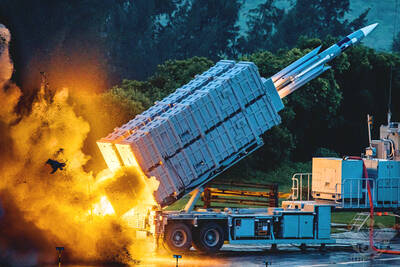
UNDER DISCUSSION: The combatant command would integrate fast attack boat and anti-ship missile groups to defend waters closest to the coastline, a source said The military could establish a new combatant command as early as 2026, which would be tasked with defending Taiwan’s territorial waters 24 nautical miles (44.4km) from the nation’s coastline, a source familiar with the matter said yesterday. The new command, which would fall under the Naval Command Headquarters, would be led by a vice admiral and integrate existing fast attack boat and anti-ship missile groups, along with the Naval Maritime Surveillance and Reconnaissance Command, said the source, who asked to remain anonymous. It could be launched by 2026, but details are being discussed and no final timetable has been announced, the source


 RSS
RSS