


Production costs in China will likely rise in the years ahead, curbing runaway textile exports, but countries protesting the current surge should have been better prepared, analysts here said yesterday.
Following the end of quotas regulating the global apparel trade on Jan. 1, Chinese textile exports to Europe, the US and Asia have soared, rising in the EU as much as 534 percent for some garments.
The flood of Chinese exports has produced a chorus of calls from textile manufacturers in Europe and the US for special protection for their industries.
Yesterday, EU Trade Commissioner Peter Mandelson flew into Hong Kong and warned that it was in China's interest to cut textile exports to avoid retaliatory measures from the EU.
Speaking to reporters during a brief stopover, he said, "I urge China to take a look at the textile measures they have put in place already and explore whether they can do more in this sector."
Natural brake
Analysts in China predict that in coming years the country's labor and manufacturing costs will rise, and this will act as a natural brake on the current surge in exports.
In December, China's commerce ministry spokesman Chong Quan (崇泉) was quoted as stating that:"We will impose export duties on certain textile products ... This is part of a string of measures China will take to ensure a smooth transition for textile integration following the end of the quota system."
Chong was referring to the dismantling of the Multi Fiber Arrangement (MFA), established in 1975 which allocated quotas of clothing and textiles that can be exported by developing nations with inexpensive labor.
And though its end was widely expected to see a surge in exports from China, textile manufacturers in Europe and the US failed to restructure their industries ahead of time, analysts said here.
Fair play
"The Chinese are perfectly entitled to do this, and other governments have not been making the political choices towards the modernization of the industry," said Brad Glosserman, a China analyst at Pacific Forum CSIS in Hawaii.
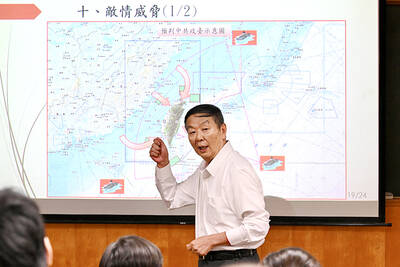
RETHINK? The defense ministry and Navy Command Headquarters could take over the indigenous submarine project and change its production timeline, a source said Admiral Huang Shu-kuang’s (黃曙光) resignation as head of the Indigenous Submarine Program and as a member of the National Security Council could affect the production of submarines, a source said yesterday. Huang in a statement last night said he had decided to resign due to national security concerns while expressing the hope that it would put a stop to political wrangling that only undermines the advancement of the nation’s defense capabilities. Taiwan People’s Party Legislator Vivian Huang (黃珊珊) yesterday said that the admiral, her older brother, felt it was time for him to step down and that he had completed what he

Taiwan has experienced its most significant improvement in the QS World University Rankings by Subject, data provided on Sunday by international higher education analyst Quacquarelli Symonds (QS) showed. Compared with last year’s edition of the rankings, which measure academic excellence and influence, Taiwanese universities made great improvements in the H Index metric, which evaluates research productivity and its impact, with a notable 30 percent increase overall, QS said. Taiwanese universities also made notable progress in the Citations per Paper metric, which measures the impact of research, achieving a 13 percent increase. Taiwanese universities gained 10 percent in Academic Reputation, but declined 18 percent
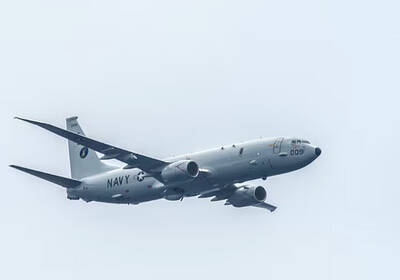
CHINA REACTS: The patrol and reconnaissance plane ‘transited the Taiwan Strait in international airspace,’ the 7th Fleet said, while Taipei said it saw nothing unusual The US 7th Fleet yesterday said that a US Navy P-8A Poseidon flew through the Taiwan Strait, a day after US and Chinese defense heads held their first talks since November 2022 in an effort to reduce regional tensions. The patrol and reconnaissance plane “transited the Taiwan Strait in international airspace,” the 7th Fleet said in a news release. “By operating within the Taiwan Strait in accordance with international law, the United States upholds the navigational rights and freedoms of all nations.” In a separate statement, the Ministry of National Defense said that it monitored nearby waters and airspace as the aircraft
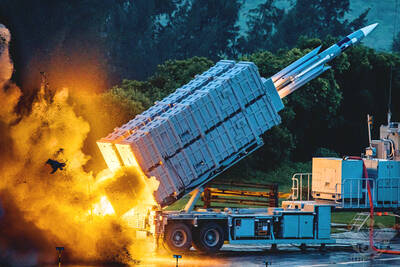
UNDER DISCUSSION: The combatant command would integrate fast attack boat and anti-ship missile groups to defend waters closest to the coastline, a source said The military could establish a new combatant command as early as 2026, which would be tasked with defending Taiwan’s territorial waters 24 nautical miles (44.4km) from the nation’s coastline, a source familiar with the matter said yesterday. The new command, which would fall under the Naval Command Headquarters, would be led by a vice admiral and integrate existing fast attack boat and anti-ship missile groups, along with the Naval Maritime Surveillance and Reconnaissance Command, said the source, who asked to remain anonymous. It could be launched by 2026, but details are being discussed and no final timetable has been announced, the source


 RSS
RSS