


The EU's top trade official, Peter Mandelson, said on Sunday that he would open a formal, two-month investigation of the flood of Chinese textiles into European markets.
He also warned of possible sanctions by summer and swifter measures that could allow Europe to impose limits on a range of Chinese-made items, like T-shirts and brassieres, within weeks. "Europe cannot stand by and watch its industry disappear," Mandelson said at a news conference.
Mandelson cited a 534 percent rise in sweater imports and a 413 percent rise in imports of men's trousers during the first three months of this year, compared with a year earlier, as examples of why the inquiry was needed.
The European Commission will examine evidence of surging imports in nine product categories, including blouses, women's overcoats, and flax and yarn products.
The investigation comes as French and Italian clothing manufacturers, in particular, are pressuring Mandelson to limit imports from China, which is making huge gains after an end to quotas.
But getting tough with China -- Europe's second-biggest trading partner after the US -- is a delicate matter.
While irked by China's low-cost clothing exports, European officials are mindful of keeping good relations to smooth the way for sales of lucrative Western technologies like nuclear power stations, high-speed trains and aerospace equipment as the Chinese economy booms.
Mandelson emphasized that Europe's choice to move forward with an investigation should not sour commercial relations with Beijing.
The move "is not a threat to China's textile interests and it is not an attempt to block China's rising position in the international trading system," he said.
"Nothing I do or say is going to jeopardize or imperil China's international trading position or that vitally important trading relationship between China and Europe."
Mandelson said he expected to continue discussions -- already under way for several weeks -- with Chinese officials during a visit to Hong Kong and Southeast Asia in coming days.
Mandelson said that above all, he wanted to avoid a trade war with China even as calls from some European politicians grew louder to impose immediate measures to prevent job losses in Europe.
"We're talking about people's livelihoods, we're talking about their jobs and their businesses," he said, while adding that the revamping of some European industries was necessary to keep Europe competitive in global markets.
Before imposing sanctions, investigators must establish that harm has been done to European manufacturers.
Penalties could involve freezing imports at current levels and capping growth at 7.5 percent a year, a measure foreseen under China's accession to the World Trade Organization in 2001.
But rather than punitive steps, Mandelson said he wanted China to step up its own limits on exports to relieve the need for Europe to impose measures that could be used to restrict Chinese products but that might also pose a risk to harmonious relations.
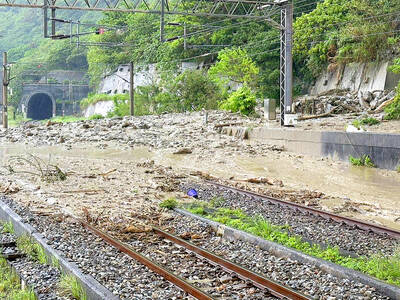
ROLLER-COASTER RIDE: More than five earthquakes ranging from magnitude 4.4 to 5.5 on the Richter scale shook eastern Taiwan in rapid succession yesterday afternoon Back-to-back weather fronts are forecast to hit Taiwan this week, resulting in rain across the nation in the coming days, the Central Weather Administration said yesterday, as it also warned residents in mountainous regions to be wary of landslides and rockfalls. As the first front approached, sporadic rainfall began in central and northern parts of Taiwan yesterday, the agency said, adding that rain is forecast to intensify in those regions today, while brief showers would also affect other parts of the nation. A second weather system is forecast to arrive on Thursday, bringing additional rain to the whole nation until Sunday, it

CONDITIONAL: The PRC imposes secret requirements that the funding it provides cannot be spent in states with diplomatic relations with Taiwan, Emma Reilly said China has been bribing UN officials to obtain “special benefits” and to block funding from countries that have diplomatic ties with Taiwan, a former UN employee told the British House of Commons on Tuesday. At a House of Commons Foreign Affairs Committee hearing into “international relations within the multilateral system,” former Office of the UN High Commissioner for Human Rights (OHCHR) employee Emma Reilly said in a written statement that “Beijing paid bribes to the two successive Presidents of the [UN] General Assembly” during the two-year negotiation of the Sustainable Development Goals. Another way China exercises influence within the UN Secretariat is
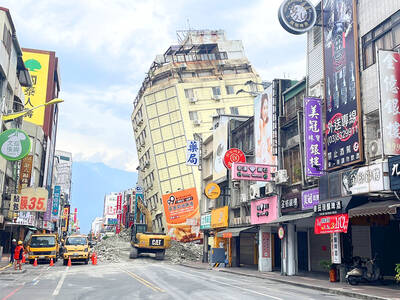
LANDSLIDES POSSIBLE: The agency advised the public to avoid visiting mountainous regions due to more expected aftershocks and rainfall from a series of weather fronts A series of earthquakes over the past few days were likely aftershocks of the April 3 earthquake in Hualien County, with further aftershocks to be expected for up to a year, the Central Weather Administration (CWA) said yesterday. Based on the nation’s experience after the quake on Sept. 21, 1999, more aftershocks are possible over the next six months to a year, the agency said. A total of 103 earthquakes of magnitude 4 on the local magnitude scale or higher hit Hualien County from 5:08pm on Monday to 10:27am yesterday, with 27 of them exceeding magnitude 5. They included two, of magnitude

Taiwan’s first drag queen to compete on the internationally acclaimed RuPaul’s Drag Race, Nymphia Wind (妮妃雅), was on Friday crowned the “Next Drag Superstar.” Dressed in a sparkling banana dress, Nymphia Wind swept onto the stage for the final, and stole the show. “Taiwan this is for you,” she said right after show host RuPaul announced her as the winner. “To those who feel like they don’t belong, just remember to live fearlessly and to live their truth,” she said on stage. One of the frontrunners for the past 15 episodes, the 28-year-old breezed through to the final after weeks of showcasing her unique


 RSS
RSS