


Consumers are willing to spend millions of dollars on the Web when it comes to music services like iTunes and gaming sites like Xbox Live. But when it comes to online news, they are happy to read it but loath to pay for it.
Newspaper Web sites have been so popular that at some newspapers, including The New York Times, the number of people who read the paper online now surpasses the number who buy the print edition.
This migration of readers is beginning to transform the newspaper industry. Advertising revenue from online sites is booming, and while it accounts for only 2 percent or 3 percent of most newspapers' overall revenues, it is the fastest-growing source of revenue. And newspaper executives are watching anxiously as the number of online readers grows while the number of print readers declines.
"For some publishers, it really sticks in the craw that they are giving away their content for free," said Colby Atwood, vice president of Borrell Associates Inc, a media research firm. The giveaway means less support for expensive news-gathering operations and the potential erosion of advertising revenue from the print side, which is much more profitable.
As Frederick Searby, an advertising and publishing analyst at J.P. Morgan, put it: "Newspapers are cannibalizing themselves."
As a result, nearly a decade after newspapers began building and showcasing their Web sites, one of the most vexing questions in newspaper economics endures: Should publishers charge for Web news, knowing that they may drive readers away and into the arms of the competition?
Of the nation's 1,456 daily newspapers, only one national paper, The Wall Street Journal, which is published by Dow Jones & Co, and about 40 small dailies charge readers to use their Web sites. Other papers either charge for online access to portions of their content or offer online subscribers additional features.
The New York Times on the Web, which is owned by The New York Times Co, has been considering charging for years and is expected to make an announcement soon about its plans. In January, The Times' Web site had 1.4 million unique daily visitors. Its daily print circulation averaged 1,124,000 in 2004, down from its peak daily circulation of 1,176,000 in 1993.
Executives at The Times have suggested that the paper, which already charges for its crossword puzzle, news alerts and archives online, may start charging for other portions of its content, but would not follow the Journal model, which charges online readers US$79 a year for everything.
(The Journal charges US$39 a year to online readers who also subscribe to the printed paper.)
"A big part of the motivation for newspapers to charge for their online content is not the revenue it will generate, but the revenue it will save, by slowing the erosion of their print subscriptions," Atwood said. "We're in the midst of a long and painful transition."
Most big papers are watching and waiting as they study the patterns of online readers. Analysts said that the growth in readers was slowing but that readers appeared to be spending more time on the Web sites.
"We're always looking at the issue," said Caroline Little, publisher of Washingtonpost.Newsweek Interactive, the online media subsidiary of The Washington Post Co. She said the online registration process that most papers now require for use of their Web sites, while free, lays the groundwork for charging if papers decide to go that route.
"You're getting information from your users and you can target ads to your users, which is more efficient for advertisers," Little said. "This has been a dipping of the toe in the water."
The Post has no plans to charge now because it would mean too big a drop-off in readers. "It's just not a strong financial proposition at this point," Little said.
Executives at other newspaper groups, including Gannett Co, which publishes USA Today, said they had no plans to start charging for online content either.
ROLLER-COASTER RIDE: More than five earthquakes ranging from magnitude 4.4 to 5.5 on the Richter scale shook eastern Taiwan in rapid succession yesterday afternoon Back-to-back weather fronts are forecast to hit Taiwan this week, resulting in rain across the nation in the coming days, the Central Weather Administration said yesterday, as it also warned residents in mountainous regions to be wary of landslides and rockfalls. As the first front approached, sporadic rainfall began in central and northern parts of Taiwan yesterday, the agency said, adding that rain is forecast to intensify in those regions today, while brief showers would also affect other parts of the nation. A second weather system is forecast to arrive on Thursday, bringing additional rain to the whole nation until Sunday, it

CONDITIONAL: The PRC imposes secret requirements that the funding it provides cannot be spent in states with diplomatic relations with Taiwan, Emma Reilly said China has been bribing UN officials to obtain “special benefits” and to block funding from countries that have diplomatic ties with Taiwan, a former UN employee told the British House of Commons on Tuesday. At a House of Commons Foreign Affairs Committee hearing into “international relations within the multilateral system,” former Office of the UN High Commissioner for Human Rights (OHCHR) employee Emma Reilly said in a written statement that “Beijing paid bribes to the two successive Presidents of the [UN] General Assembly” during the two-year negotiation of the Sustainable Development Goals. Another way China exercises influence within the UN Secretariat is

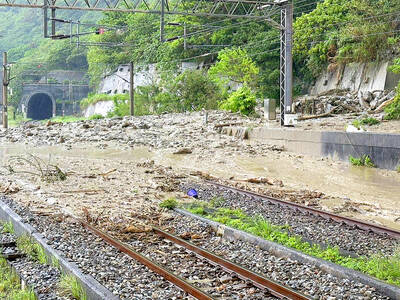
LANDSLIDES POSSIBLE: The agency advised the public to avoid visiting mountainous regions due to more expected aftershocks and rainfall from a series of weather fronts A series of earthquakes over the past few days were likely aftershocks of the April 3 earthquake in Hualien County, with further aftershocks to be expected for up to a year, the Central Weather Administration (CWA) said yesterday. Based on the nation’s experience after the quake on Sept. 21, 1999, more aftershocks are possible over the next six months to a year, the agency said. A total of 103 earthquakes of magnitude 4 on the local magnitude scale or higher hit Hualien County from 5:08pm on Monday to 10:27am yesterday, with 27 of them exceeding magnitude 5. They included two, of magnitude

Taiwan’s first drag queen to compete on the internationally acclaimed RuPaul’s Drag Race, Nymphia Wind (妮妃雅), was on Friday crowned the “Next Drag Superstar.” Dressed in a sparkling banana dress, Nymphia Wind swept onto the stage for the final, and stole the show. “Taiwan this is for you,” she said right after show host RuPaul announced her as the winner. “To those who feel like they don’t belong, just remember to live fearlessly and to live their truth,” she said on stage. One of the frontrunners for the past 15 episodes, the 28-year-old breezed through to the final after weeks of showcasing her unique


 RSS
RSS