


With the world's top two retailers faltering in the tough Japanese market, local retail chains are refining their approach to the budget-conscious and discerning Japanese consumer.
Despite the novelty of the megastore most Japanese still prefer frequent shopping at smaller local shops rather than weekly one-stop shopping to stock up their small refrigerators and pantries.
And fashion-conscious young Japanese are more likely to buy clothing at upscale department stores or less expensive specialty shops like GAP, Uniqlo and Muji, rather than the megastore.
"I sometimes buy clothes [at a megastore] for my child and some casual wear for myself, but not clothes for going out," said Miyuki Osaku, a 31-year-old housewife in Tokyo.
Kimiharu Oba, 28, an office worker, and his wife Satomi, 25, said they can't find their style of clothing at megastores and prefer to shop at department stores.
"The only clothing I buy at a big supermarket store is stockings. Their clothes are not cool at all," said a young female shopper strolling in Tokyo's posh Ginza district, home to every brand name in the world.
The nation's top retailers in the megastore or general merchandising category are also struggling to lure shoppers to their food sections.
"I go to smaller shops in the old shopping arcades where you can often find cheaper and fresher food and good quality clothes," said Daisuke Odagiri, 33, who lives near a Seiyu store in central Tokyo.
Carrefour SA of France, the world's second-largest retailer, has pulled out of Japan after four years in the red, selling all of its eight megastores to Japan's biggest retail group, Aeon Co Ltd.
Wal-Mart Stores Inc, the largest retailer in the world, has seen its "everyday low price" philosophy flop with Japanese shoppers who demand a wider range of higher quality goods to choose from.
Wal-Mart holds a 37.8 percent stake in the medium-sized supermarket chain Seiyu, which has posted net losses in the past two years of Wal-Mart style merchandising in Japan, the world's second-largest consumer market.
Responding to consumer's preferences, Japanese retailer Ito-Yokado has set up a research center to create new brands and merchandising, headed by the legendary Yukio Fujimaki, known for his successful purchasing strategy at the upscale department store Isetan.
Ito-Yokado, Japan's second-largest retailer, started in 1920 as a small shop in downtown Tokyo selling western attire and has grown into a group that includes 180 superstores in Japan and China, the Seven-11 convenience store chain and a bank.
"In the past it was said that Japanese [stores] needed lower-priced merchandise, modeling the success of discount outlets in the US," said Toshifumi Suzuki, chairman and chief executive officer of Ito-Yokado group.
"But emulating the US style will not lead to success in Japan due to the totally different economic structures in the two countries," he said.
The current front-runner, Aeon, began in 1758 selling kimono fabric and accessories and now operates over 300 JUSCO stores in Japan, China, Thailand and Malaysia.
It remains in expansionist mode with its takeover of Carrefour's hypermarkets, the term for general merchandizing which combines its supermarkets with department stores.
But Aeon is also responding to calls for improved quality.
"We will concentrate more on malls, and in merchandizing policy we will pursue quality as well as low prices," said Manabu Ohshima, an Aeon spokesman.
There are on average 91 grocery stores, supermarkets or convenience stores for every 10,000 people in Japan, far above the 54.8 in the US, 52.2 in Britain and 62.3 in France, according to trade ministry data.
Easing deflation and an increase in jobs in Japan would seem to bode well for consumer spending, but major retailers operating general merchandise or megastores have been struggling to achieve stable profits.
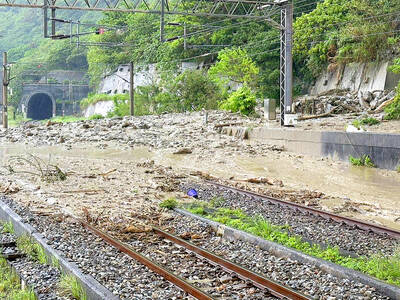
ROLLER-COASTER RIDE: More than five earthquakes ranging from magnitude 4.4 to 5.5 on the Richter scale shook eastern Taiwan in rapid succession yesterday afternoon Back-to-back weather fronts are forecast to hit Taiwan this week, resulting in rain across the nation in the coming days, the Central Weather Administration said yesterday, as it also warned residents in mountainous regions to be wary of landslides and rockfalls. As the first front approached, sporadic rainfall began in central and northern parts of Taiwan yesterday, the agency said, adding that rain is forecast to intensify in those regions today, while brief showers would also affect other parts of the nation. A second weather system is forecast to arrive on Thursday, bringing additional rain to the whole nation until Sunday, it

CONDITIONAL: The PRC imposes secret requirements that the funding it provides cannot be spent in states with diplomatic relations with Taiwan, Emma Reilly said China has been bribing UN officials to obtain “special benefits” and to block funding from countries that have diplomatic ties with Taiwan, a former UN employee told the British House of Commons on Tuesday. At a House of Commons Foreign Affairs Committee hearing into “international relations within the multilateral system,” former Office of the UN High Commissioner for Human Rights (OHCHR) employee Emma Reilly said in a written statement that “Beijing paid bribes to the two successive Presidents of the [UN] General Assembly” during the two-year negotiation of the Sustainable Development Goals. Another way China exercises influence within the UN Secretariat is
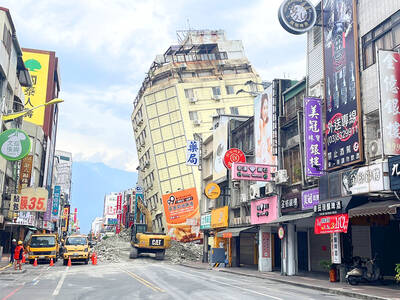
LANDSLIDES POSSIBLE: The agency advised the public to avoid visiting mountainous regions due to more expected aftershocks and rainfall from a series of weather fronts A series of earthquakes over the past few days were likely aftershocks of the April 3 earthquake in Hualien County, with further aftershocks to be expected for up to a year, the Central Weather Administration (CWA) said yesterday. Based on the nation’s experience after the quake on Sept. 21, 1999, more aftershocks are possible over the next six months to a year, the agency said. A total of 103 earthquakes of magnitude 4 on the local magnitude scale or higher hit Hualien County from 5:08pm on Monday to 10:27am yesterday, with 27 of them exceeding magnitude 5. They included two, of magnitude

Taiwan’s first drag queen to compete on the internationally acclaimed RuPaul’s Drag Race, Nymphia Wind (妮妃雅), was on Friday crowned the “Next Drag Superstar.” Dressed in a sparkling banana dress, Nymphia Wind swept onto the stage for the final, and stole the show. “Taiwan this is for you,” she said right after show host RuPaul announced her as the winner. “To those who feel like they don’t belong, just remember to live fearlessly and to live their truth,” she said on stage. One of the frontrunners for the past 15 episodes, the 28-year-old breezed through to the final after weeks of showcasing her unique


 RSS
RSS