


The Westinghouse Electric Corp was to present a bid to China yesterday for building four huge nuclear reactors, backed by a pledge of nearly US$5 billion in financial assistance from the US government that it hopes will give the company an edge over competitors from France, Germany and other nations.
But the package of loans and loan guarantees does not follow the typical pattern of the government's Export-Import (Ex-Im) Bank, and is raising objections from some critics.
Approved on a preliminary basis by the bank on Feb. 18, the package is almost three times larger than anything the bank has offered before. And while it would stimulate employment in the US, the price would amount to about US$1 million a job. The package also appears to benefit the British government, which owns Westinghouse through BNFL, the company formerly known as British Nuclear Fuels.
"If the risk were not falling on the Ex-Im bank, it would be falling on the British government," said Peter Bradford, a member of the Nuclear Regulatory Commission from 1977 to 1982.
Bradford said he opposed the subsidy to a foreign company, and what he called support by the commission for Westinghouse's sales efforts.
"Jobs really aren't what this is about. What it's about is protecting the investors in the company making the bid, and here, there is only one investor," he said.
Democratic Representative Dennis Kucinich, who is a frequent critic of the bank, said, "The bank is funded by US tax dollars; they should be supporting US companies. I'm not against US jobs, but shouldn't we be for US companies?"
Kucinich said that the deal could also eventually hurt the export of technology from this country because China has said that it wants to build many more plants and take over the manufacture of the components, many of which are now made in the US.
A spokesman for the bank, Phil Cogan, said the aid package had "nothing to do with shareholders." The package, which would go to the bank for final approval if Westinghouse won the bidding, "is for the Westinghouse Electric Company of Monroeville" in Pennsylvania, he said.
Ownership of the company "makes absolutely no difference," he said.
BNFL bought Westinghouse's nuclear unit from broadcasting company CBS in 1998.
The British government has intermittently discussed selling BNFL and its Westinghouse subsidiary and recently reorganized the company. To make itself more attractive, the company recently separated some of its unprofitable ventures, including liabilities related to a subsidiary that recovered plutonium from spent nuclear fuel for reuse.
Westinghouse spokesman Vaughn Gilbert, said that the proposal to build the Chinese reactors represented about 5,000 jobs in the US because components like the instrumentation and control systems would be manufactured here. The reactor vessel and the steam generators, the largest parts, would come from other countries.
Westinghouse would also supply the fuel, at least initially. China has expressed interest in building dozens more reactors and sticking to a standard design, so winning this contract could mean many years of business, although fewer parts would be imported as time went on. Bidders are hoping for a decision from China by the end of the year.
Cogan, the Ex-Im spokesman, said that the bank was backing only the portion of the contract that would involve work in the US. According to Westinghouse, the American portion of the deal is half the reactors' value, suggesting that the four reactors would cost US$10 billion, but the company would not disclose the amount of its bid.
Asked how the level of support -- almost US$5 billion for 5,000 jobs -- compared to that of other projects that the bank had nurtured, he insisted that the bank had no yardstick, and that dividing the amount of support by the number of jobs was not a good measure.
"That's a crazy equation," Cogan said.
Cogan said that the cost to US taxpayers would depend on the success of the project. If the loans are paid back on time, they could generate a profit for the bank, he said.
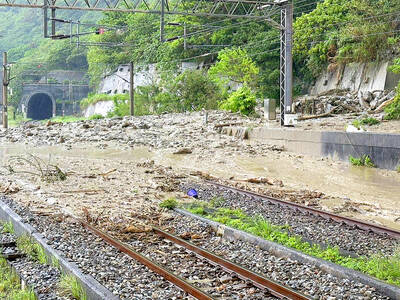
ROLLER-COASTER RIDE: More than five earthquakes ranging from magnitude 4.4 to 5.5 on the Richter scale shook eastern Taiwan in rapid succession yesterday afternoon Back-to-back weather fronts are forecast to hit Taiwan this week, resulting in rain across the nation in the coming days, the Central Weather Administration said yesterday, as it also warned residents in mountainous regions to be wary of landslides and rockfalls. As the first front approached, sporadic rainfall began in central and northern parts of Taiwan yesterday, the agency said, adding that rain is forecast to intensify in those regions today, while brief showers would also affect other parts of the nation. A second weather system is forecast to arrive on Thursday, bringing additional rain to the whole nation until Sunday, it
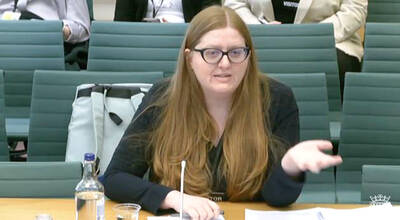
CONDITIONAL: The PRC imposes secret requirements that the funding it provides cannot be spent in states with diplomatic relations with Taiwan, Emma Reilly said China has been bribing UN officials to obtain “special benefits” and to block funding from countries that have diplomatic ties with Taiwan, a former UN employee told the British House of Commons on Tuesday. At a House of Commons Foreign Affairs Committee hearing into “international relations within the multilateral system,” former Office of the UN High Commissioner for Human Rights (OHCHR) employee Emma Reilly said in a written statement that “Beijing paid bribes to the two successive Presidents of the [UN] General Assembly” during the two-year negotiation of the Sustainable Development Goals. Another way China exercises influence within the UN Secretariat is
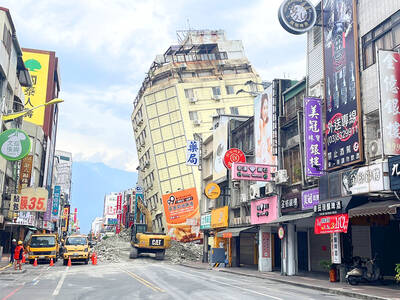
LANDSLIDES POSSIBLE: The agency advised the public to avoid visiting mountainous regions due to more expected aftershocks and rainfall from a series of weather fronts A series of earthquakes over the past few days were likely aftershocks of the April 3 earthquake in Hualien County, with further aftershocks to be expected for up to a year, the Central Weather Administration (CWA) said yesterday. Based on the nation’s experience after the quake on Sept. 21, 1999, more aftershocks are possible over the next six months to a year, the agency said. A total of 103 earthquakes of magnitude 4 on the local magnitude scale or higher hit Hualien County from 5:08pm on Monday to 10:27am yesterday, with 27 of them exceeding magnitude 5. They included two, of magnitude

Taiwan’s first drag queen to compete on the internationally acclaimed RuPaul’s Drag Race, Nymphia Wind (妮妃雅), was on Friday crowned the “Next Drag Superstar.” Dressed in a sparkling banana dress, Nymphia Wind swept onto the stage for the final, and stole the show. “Taiwan this is for you,” she said right after show host RuPaul announced her as the winner. “To those who feel like they don’t belong, just remember to live fearlessly and to live their truth,” she said on stage. One of the frontrunners for the past 15 episodes, the 28-year-old breezed through to the final after weeks of showcasing her unique


 RSS
RSS