


Four years after the collapse of the Internet bubble, phone companies and equipment makers are finally producing steady profits. But their turnaround has failed to impress investors who have lingering doubts about the industry's outlook.
The reasons for hesitancy are many, but they boil down to this: growth in the next-generation services and wireless products now being offered by phone companies only partly make up for the declines in their older, traditional phone businesses.
The market response to earnings on Thursday from SBC Communications is typical of this tug-of-war. SBC, the large local phone provider, earned US$2.1 billion in the third quarter, a 72.2 percent jump from the same period last year.
Sales grew 1.4 percent, the second consecutive year-over-year increase after three years of declines because of demand for its wireless and high-speed Internet products.
Yet SBC's share price fell 2 percent after the release of the numbers as investors continued to fret about the continued decline in the company's traditional local phone business.
The company's shares have slipped 3.3 percent so far this year. Like its rivals, SBC is relying on growth in other areas, most notably mobile phones. Cingular, which is 60 percent owned by SBC, added a net 657,000 new customers in the quarter, beating analysts' expectations.
Cingular was to get an additional boost yesterday when regulators were expected to approve its purchase of AT&T Wireless.
Yet there, too, investors may be worried that spending by wireless customers has stopped rising despite the fact that mobile-phone companies are spending billions of dollars to build new, high-speed networks that can transmit more data.
The net result is that although phone companies' revenue overall is rising thanks to their wireless divisions, those gains have not been enough to quiet investors' qualms.
"Phone companies are moving from the businesses that are struggling and shifting to where there's upside," said Todd Rosenbluth, a telecommunications analyst at Standard & Poor's.
He doesn't see the stocks of phone companies "as growth stories. Their days of big moves are in the past."
Not surprisingly, the phone companies' difficulties are trickling down to the equipment makers. Lucent Technologies, the US' largest telecommunications equipment maker, said Wednesday that after losing nearly US$29 billion in the past three years, it earned a full-year profit this year.
Sales also grew for the first time since 2000, rising 7 percent for the fiscal year. Lucent's shares rose 3 percent after the numbers were released, but they are down nearly 10 percent since April, when they hit their peak for this year.
Lucent's chief executive, Patricia Russo, noted that her company had won a US$5 billion order from Verizon Wireless to build its next-generation cell-phone network, as well as several big contracts from mobile-phone carriers overseas.
But the picture in its fixed-line equipment business, Lucent's bread-and-butter for years, is murkier. While demand for Lucent's new optical switches, routers and other equipment for new Internet-based networks is improving, demand for its old circuit-switch equipment is falling.
"It's tough for the equipment manufacturers to make money when their customers are not spending," said Brett Azuma, the head of research at RHK, a telecommunications consultant based in San Francisco.
RETHINK? The defense ministry and Navy Command Headquarters could take over the indigenous submarine project and change its production timeline, a source said Admiral Huang Shu-kuang’s (黃曙光) resignation as head of the Indigenous Submarine Program and as a member of the National Security Council could affect the production of submarines, a source said yesterday. Huang in a statement last night said he had decided to resign due to national security concerns while expressing the hope that it would put a stop to political wrangling that only undermines the advancement of the nation’s defense capabilities. Taiwan People’s Party Legislator Vivian Huang (黃珊珊) yesterday said that the admiral, her older brother, felt it was time for him to step down and that he had completed what he

Taiwan has experienced its most significant improvement in the QS World University Rankings by Subject, data provided on Sunday by international higher education analyst Quacquarelli Symonds (QS) showed. Compared with last year’s edition of the rankings, which measure academic excellence and influence, Taiwanese universities made great improvements in the H Index metric, which evaluates research productivity and its impact, with a notable 30 percent increase overall, QS said. Taiwanese universities also made notable progress in the Citations per Paper metric, which measures the impact of research, achieving a 13 percent increase. Taiwanese universities gained 10 percent in Academic Reputation, but declined 18 percent

CHINA REACTS: The patrol and reconnaissance plane ‘transited the Taiwan Strait in international airspace,’ the 7th Fleet said, while Taipei said it saw nothing unusual The US 7th Fleet yesterday said that a US Navy P-8A Poseidon flew through the Taiwan Strait, a day after US and Chinese defense heads held their first talks since November 2022 in an effort to reduce regional tensions. The patrol and reconnaissance plane “transited the Taiwan Strait in international airspace,” the 7th Fleet said in a news release. “By operating within the Taiwan Strait in accordance with international law, the United States upholds the navigational rights and freedoms of all nations.” In a separate statement, the Ministry of National Defense said that it monitored nearby waters and airspace as the aircraft

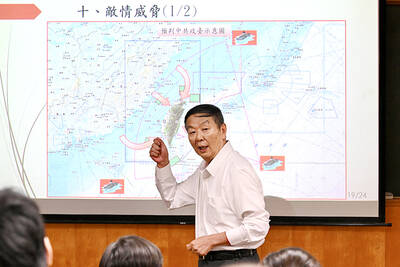
UNDER DISCUSSION: The combatant command would integrate fast attack boat and anti-ship missile groups to defend waters closest to the coastline, a source said The military could establish a new combatant command as early as 2026, which would be tasked with defending Taiwan’s territorial waters 24 nautical miles (44.4km) from the nation’s coastline, a source familiar with the matter said yesterday. The new command, which would fall under the Naval Command Headquarters, would be led by a vice admiral and integrate existing fast attack boat and anti-ship missile groups, along with the Naval Maritime Surveillance and Reconnaissance Command, said the source, who asked to remain anonymous. It could be launched by 2026, but details are being discussed and no final timetable has been announced, the source


 RSS
RSS