


Thailand's largest oil refiner, Thai Oil, began selling as much as US$700 million in shares to the public yesterday in what promises to be Thailand's largest initial public offering since its parent, PTT, sold shares to the public in 2001.
The offering represents a watershed for Thailand. Five years ago, Thailand's financial system was at the mercy of big corporate defaulters, among which Thai Oil and other refiners were the biggest.
Now with oil at US$50 a barrel, Thailand finds itself once again at the mercy of refiners like Thai Oil.
"It's truly a turning point for the industry," said Ann Rujivatra, an energy analyst at CLSA Emerg-ing Markets in Bangkok.
For investors, analysts say, the sale provides an opportunity to share in the surging profits of a company vital to a rapidly growing economy where demand for fuel has risen at least 10 percent this year despite escalating prices.
Most of the shares they will buy are not new, but rather are owned by creditors who accepted them in lieu of about $900 million in debt in 2000. It is not clear who owns this stock now; many original lenders may have long ago written off losses on the debt, part of which was forgiven and part restructured.
But buyers of distressed debt, who bought their holdings at a pittance, stand to do well at the sale. For this group, this week's sale represents a chance to cash out.
"Just when creditors thought they would get stuck for 10 years, high oil prices have bailed them out," said Kitti Nathisuwan, an energy analyst at Macquarie Securities in Bangkok.
Thai Oil has a 21 percent share of Thailand's market for refined petroleum products, including gasoline and diesel fuel.
Like so many companies around Asia in the early 1990s, Thai Oil took advantage of stunning economic growth to borrow heavily to expand capacity until the Asian financial crisis in 1997 and 1998 stopped growth and left the firm unable to pay back its debts.
Thai Oil ended up with US$2.29 billion in debt. After a year of bargaining between the company and its 140 creditors, including Chase Manhattan Bank, Bank of Tokyo-Mitsubishi and three of Thailand's largest banks, lenders in 2000 agreed to take 49 percent of the company.
When the global economy recovered, so did Thailand's export engine. China's rapid growth increased demand for raw materials, creating a boom in demand for Thai rice and rubber, which in turn raised demand for fuel to run generators and farmers' pickup trucks.
Then oil prices began to rise as the United States prepared to go to war in Iraq. Since then, profit margins for refiners in Asia have risen to their highest since 1996. Yet refineries cannot meet demand.
Increased demand for oil and limited supplies have had a marked effect on Thai Oil's bottom line. Thai Oil's net profits jumped from 359 million baht (US$8.7 million) in 2001 to 6.75 billion baht (US$163 million) in 2003.
In the first half this year, the company earned 6.6 billion baht. Refining margins jumped from their 2001 level of US$1.35 a barrel to US$6.47 a barrel this year.
Some analysts believe oil prices are bound to come down as competitors raise capacity and supplies.
Others nonetheless predict refining margins have further to climb because of capacity constraints in Thailand.
"We don't think it's peaked yet," said Rujivatra.
Optimism over its prospects prompted Thai Oil in August to double the amount of cash it aimed to raise from its offering, to US$600 million from US$300 million. Now it is expecting to rake in even more in what analysts predict will be a heavily oversubscribed offering.
The company will sell 900 million shares for between 27 baht and 32 baht each (US$0.65 to US$0.77). Only 90 million of the shares on offer are new; the rest belong to creditors.
Of the combined offering, roughly 38 percent is reserved for foreign institutions, 13 percent for Thai institutions. Underwriters have allocated less than 7 percent for local individuals to buy.
The rest of the shares will go either back to creditors or to PTT and its affiliates. PTT will maintain its 49 percent stake, swapping other refining assets for shares.
The underwriters, led by J.P. Morgan Chase, Merrill Lynch and Morgan Stanley, will announce the average offering price Oct. 13.

Taiwan has experienced its most significant improvement in the QS World University Rankings by Subject, data provided on Sunday by international higher education analyst Quacquarelli Symonds (QS) showed. Compared with last year’s edition of the rankings, which measure academic excellence and influence, Taiwanese universities made great improvements in the H Index metric, which evaluates research productivity and its impact, with a notable 30 percent increase overall, QS said. Taiwanese universities also made notable progress in the Citations per Paper metric, which measures the impact of research, achieving a 13 percent increase. Taiwanese universities gained 10 percent in Academic Reputation, but declined 18 percent
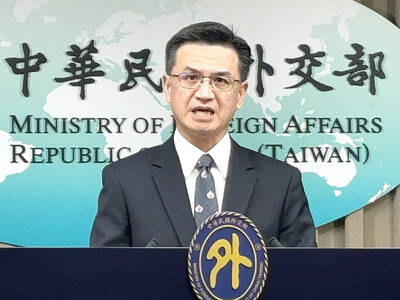
BULLY TACTICS: Beijing has continued its incursions into Taiwan’s airspace even as Xi Jinping talked about Taiwan being part of the Chinese family and nation China should stop its coercion of Taiwan and respect mainstream public opinion in Taiwan about sovereignty if its expression of goodwill is genuine, the Ministry of Foreign Affairs (MOFA) said yesterday. Ministry spokesman Jeff Liu (劉永健) made the comment in response to media queries about a meeting between former president Ma Ying-jeou (馬英九) and Chinese President Xi Jinping (習近平) the previous day. Ma voiced support for the so-called “1992 consensus,” while Xi said that although the two sides of the Taiwan Strait have “different systems,” this does not change the fact that they are “part of the same country,” and that “external
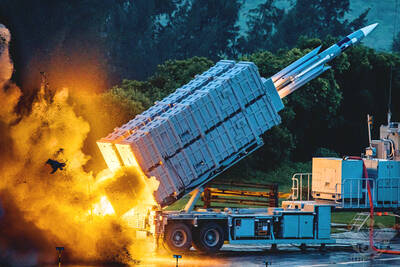
UNDER DISCUSSION: The combatant command would integrate fast attack boat and anti-ship missile groups to defend waters closest to the coastline, a source said The military could establish a new combatant command as early as 2026, which would be tasked with defending Taiwan’s territorial waters 24 nautical miles (44.4km) from the nation’s coastline, a source familiar with the matter said yesterday. The new command, which would fall under the Naval Command Headquarters, would be led by a vice admiral and integrate existing fast attack boat and anti-ship missile groups, along with the Naval Maritime Surveillance and Reconnaissance Command, said the source, who asked to remain anonymous. It could be launched by 2026, but details are being discussed and no final timetable has been announced, the source
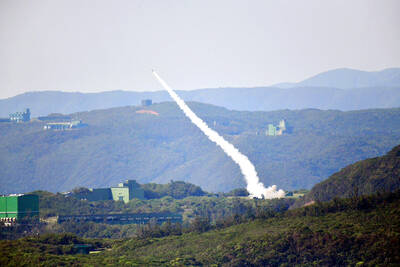
SHOT IN THE ARM: The new system can be integrated with Avenger and Stinger missiles to bolster regional air defense capabilities, a defense ministry report said Domestically developed Land Sword II (陸射劍二) missiles were successfully launched and hit target drones during a live-fire exercise at the Jiupeng Military Base in Pingtung County yesterday. The missiles, developed by the Chungshan Institute of Science and Technology (CSIST), were originally scheduled to launch on Tuesday last week, after the Tomb Sweeping Day holiday long weekend, but were postponed to yesterday due to weather conditions. Local residents and military enthusiasts gathered outside the base to watch the missile tests, with the first one launching at 9:10am. The Land Sword II system, which is derived from the Sky Sword II (天劍二) series, was turned


 RSS
RSS