


Tatsuya Ito, who started a pizza delivery business to fund a career in politics, was named as Japan's top banking regulator, replacing Heizo Takenaka, who will oversee the privatization of the postal savings system.
Ito, 43, was Takenaka's deputy and drafted a 2002 plan that called on nationwide banks to cut bad-loan ratios by half within three years. Ito has a law degree from Tokyo's Keio University, the alma mater of Japan's Prime Minister Junichiro Koizumi.
Six months
The reshuffle gives Ito six months to prepare for a lifting of the blanket government protection of Japanese bank deposits. Takenaka and Ito forced Mizuho Financial Group Inc and other lenders to slash bad loans and introduce new financial products to help prepare them for the rule change.
"The role of the regulators now is to encourage banks to improve their profitability and foster new businesses," said Susumu Takahashi, chief economist at Japan Research Institute Ltd. "It's now more up to the banks themselves to secure a source for profit, and the government need only set a general direction for them."
Ito started the pizza business with his wife in his 20s after receiving advice from Konosuke Matsushita, founder of Japan's biggest consumer electronics company, which bears his name, according to Ito's Web site. He was elected to Japan's lower house of parliament in 1993, and is a member of the ruling Liberal Democratic Party.
Takenaka, 53, who took up the post two years ago, kept his economic policy portfolio in Koizumi's new Cabinet, government spokesman Hiroyuki Hosoda said.
Targeting bad loans
Takenaka took over as financial services minister on Sept. 30, 2002, describing the industry as "seriously," ill and setting up a reform plan that called on the seven largest lenders to halve the level of their bad loans in the three years ending next March. Ito led efforts to map out targets for bad loans and business improvements at banks.
The seven lenders, which had ¥14 trillion (US$126.5 billion) of bad loans as of March 31, may meet Takenaka's target six months ahead of schedule, Yoshifumi Nishikawa, head of the Japanese Bankers Association said last week.
"The overall framework for banking administration is set," said Nozomu Kunishige, an analyst with BNP Paribas Securities Japan Ltd. "There should be no change in the basic policy, and whoever takes over should succeed the direction."
In his first few months in office, Takenaka was met by criticism from bankers and lawmakers who said he was over-interfering in their businesses. His plan to change rules governing what banks can count as capital was viewed as a means of injecting public money into lenders.
Takenaka's focus on the quality of bank capital forced Resona Holdings Inc, the nation's fifth-largest lender by assets, to seek government funding, the first bailout of a nationwide bank since 1999. In May last year, Resona applied for ¥1.96 trillion of public money after its capital was depleted by mounting bad loans and a reduction in deferred tax assets, or estimated future tax savings.
Ashikaga Bank Ltd, based in the Tochigi prefecture north of Tokyo, was nationalized last November after it was unable to pay debt and its assets fell to less than its liabilities. It was Japan's first bank nationalization in five years.
Ito may need to strengthen oversight of the more than 600 regional lenders in Japan, including credit unions and associations, whose bad loans accounted for more than 60 percent of the nation's total in the year ended Mar. 31.
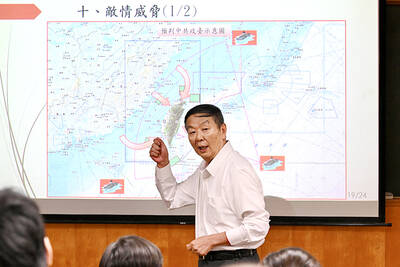
RETHINK? The defense ministry and Navy Command Headquarters could take over the indigenous submarine project and change its production timeline, a source said Admiral Huang Shu-kuang’s (黃曙光) resignation as head of the Indigenous Submarine Program and as a member of the National Security Council could affect the production of submarines, a source said yesterday. Huang in a statement last night said he had decided to resign due to national security concerns while expressing the hope that it would put a stop to political wrangling that only undermines the advancement of the nation’s defense capabilities. Taiwan People’s Party Legislator Vivian Huang (黃珊珊) yesterday said that the admiral, her older brother, felt it was time for him to step down and that he had completed what he
Taiwan has experienced its most significant improvement in the QS World University Rankings by Subject, data provided on Sunday by international higher education analyst Quacquarelli Symonds (QS) showed. Compared with last year’s edition of the rankings, which measure academic excellence and influence, Taiwanese universities made great improvements in the H Index metric, which evaluates research productivity and its impact, with a notable 30 percent increase overall, QS said. Taiwanese universities also made notable progress in the Citations per Paper metric, which measures the impact of research, achieving a 13 percent increase. Taiwanese universities gained 10 percent in Academic Reputation, but declined 18 percent

CHINA REACTS: The patrol and reconnaissance plane ‘transited the Taiwan Strait in international airspace,’ the 7th Fleet said, while Taipei said it saw nothing unusual The US 7th Fleet yesterday said that a US Navy P-8A Poseidon flew through the Taiwan Strait, a day after US and Chinese defense heads held their first talks since November 2022 in an effort to reduce regional tensions. The patrol and reconnaissance plane “transited the Taiwan Strait in international airspace,” the 7th Fleet said in a news release. “By operating within the Taiwan Strait in accordance with international law, the United States upholds the navigational rights and freedoms of all nations.” In a separate statement, the Ministry of National Defense said that it monitored nearby waters and airspace as the aircraft

UNDER DISCUSSION: The combatant command would integrate fast attack boat and anti-ship missile groups to defend waters closest to the coastline, a source said The military could establish a new combatant command as early as 2026, which would be tasked with defending Taiwan’s territorial waters 24 nautical miles (44.4km) from the nation’s coastline, a source familiar with the matter said yesterday. The new command, which would fall under the Naval Command Headquarters, would be led by a vice admiral and integrate existing fast attack boat and anti-ship missile groups, along with the Naval Maritime Surveillance and Reconnaissance Command, said the source, who asked to remain anonymous. It could be launched by 2026, but details are being discussed and no final timetable has been announced, the source


 RSS
RSS