


A deal between French energy group Total and Russian gas firm Novatek shows that oil majors have an appetite for Russia's energy riches despite the Yukos affair, but also the limited role now possible for foreigners in this strategic sector, analysts say.
Total said last week that it had signed an agreement to acquire a quarter share of the small but fast-growing gas producer Novatek for a undisclosed price tag estimated at a billion dollars.
US oil major ConocoPhillips is expected on Wednesday to pick up a 7.6 percent stake in Russia's number two oil producer LUKoil at auction for US$2 billion or more -- the biggest deal since BP of Britain bought 50 percent of Russian oil group TNK last year.
"Totals acquisition marks a pickup in foreign investment in the Russian oil and gas sector which has seen something of a hiatus since the TNK-BP deal last year," said Stephen O'Sullivan at the United Financial Group brokerage in Moscow.
"Overall this is a positive development for Russia's investment climate," he said.
Total had eyed a stake in Sibneft, the fifth-largest Russian oil producer which last year broke off a merger with the No. 1 Yukos after it became locked in a battle with the Kremlin that threatens to drive it into state control. But Sib-neft's entanglement with Yukos forced Total to look for another target, and it went for Novatek, a firm created in 1994 and which accounts for 3.3 percent of Rus-sia's gas output, dwarfed by the state-owned monopoly Gazprom.
ConocoPhillips, keen to acquire at least 20 percent in LUKoil, which has proven reserves of almost 16 billion barrels of crude, may have to settle for the 7.6 percent state shareholding on offer.
An analyst from Renaissance Capital finance house in Moscow, Adam Landes, says Western oil giants are knocking at the door in Russia -- the world's second-largest oil exporter after Saudi Arabia -- which has vast untapped crude resources.
"There are compelling resource and economic reasons why international oil companies are attracted to Russia," he said.
But under President Vladimir Putin, the rules of the game have gradually changed in a more state-dominated environment which no longer welcomes major foreign equity involvement in the sector.
"There doesn't appear to be a big interest on the part of Russia to have foreign owners controlling strategic parts of the indus-try," Landes said.
Last October, ExxonMobil was reported to be negotiating to purchase up to 40 or 50 percent or more of shares in a company being created by Yukos and Sibneft. That potential deal, which would have handed control of the largest Russian oil producer to a US rival, may have been a factor in the state's campaign to rein in Yukos' main owner, tycoon Mikhail Khodorkovsky, analysts say.
"It was one of the reasons Yukos has ended up where it is today, the government did not want to see Yukos get into the hands of foreigners," said Valery Nesterov of Moscow investment firm Troika Dialog.
A Western oil executive in Moscow recognizes that BP's half-ownership of the No. 4 oil group in Russia, which was personally blessed by Putin, is not an option open to other foreign firms.
"It is difficult for us to move into big Russian companies, we are left with the medium-sized ones ... We'll have to wait two or three years at least for the climate to change," the oilman said.
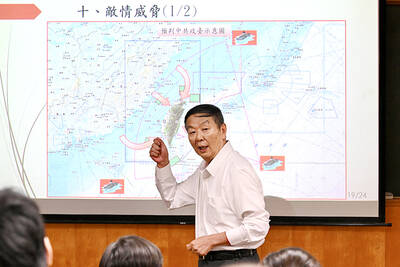
RETHINK? The defense ministry and Navy Command Headquarters could take over the indigenous submarine project and change its production timeline, a source said Admiral Huang Shu-kuang’s (黃曙光) resignation as head of the Indigenous Submarine Program and as a member of the National Security Council could affect the production of submarines, a source said yesterday. Huang in a statement last night said he had decided to resign due to national security concerns while expressing the hope that it would put a stop to political wrangling that only undermines the advancement of the nation’s defense capabilities. Taiwan People’s Party Legislator Vivian Huang (黃珊珊) yesterday said that the admiral, her older brother, felt it was time for him to step down and that he had completed what he
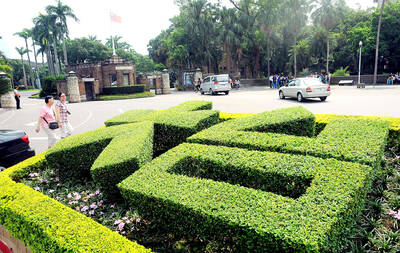
Taiwan has experienced its most significant improvement in the QS World University Rankings by Subject, data provided on Sunday by international higher education analyst Quacquarelli Symonds (QS) showed. Compared with last year’s edition of the rankings, which measure academic excellence and influence, Taiwanese universities made great improvements in the H Index metric, which evaluates research productivity and its impact, with a notable 30 percent increase overall, QS said. Taiwanese universities also made notable progress in the Citations per Paper metric, which measures the impact of research, achieving a 13 percent increase. Taiwanese universities gained 10 percent in Academic Reputation, but declined 18 percent
UNDER DISCUSSION: The combatant command would integrate fast attack boat and anti-ship missile groups to defend waters closest to the coastline, a source said The military could establish a new combatant command as early as 2026, which would be tasked with defending Taiwan’s territorial waters 24 nautical miles (44.4km) from the nation’s coastline, a source familiar with the matter said yesterday. The new command, which would fall under the Naval Command Headquarters, would be led by a vice admiral and integrate existing fast attack boat and anti-ship missile groups, along with the Naval Maritime Surveillance and Reconnaissance Command, said the source, who asked to remain anonymous. It could be launched by 2026, but details are being discussed and no final timetable has been announced, the source
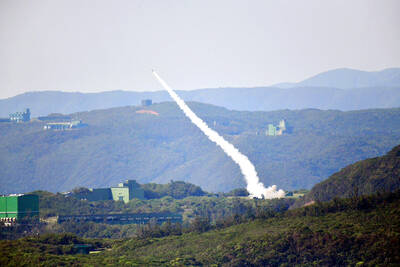
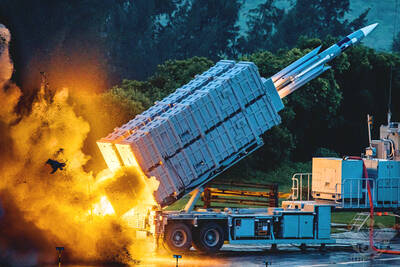
SHOT IN THE ARM: The new system can be integrated with Avenger and Stinger missiles to bolster regional air defense capabilities, a defense ministry report said Domestically developed Land Sword II (陸射劍二) missiles were successfully launched and hit target drones during a live-fire exercise at the Jiupeng Military Base in Pingtung County yesterday. The missiles, developed by the Chungshan Institute of Science and Technology (CSIST), were originally scheduled to launch on Tuesday last week, after the Tomb Sweeping Day holiday long weekend, but were postponed to yesterday due to weather conditions. Local residents and military enthusiasts gathered outside the base to watch the missile tests, with the first one launching at 9:10am. The Land Sword II system, which is derived from the Sky Sword II (天劍二) series, was turned


 RSS
RSS